Chess Strategy for Beginners: The 5 Essential Rules of Positional Play
In chess, tactical puzzles are the low-hanging fruit. You learn a fork, you spot a pin, you execute a mate-in-two, and you win material. But as you climb past the beginner ranks, you quickly notice a frustrating pattern: your opponents stop giving their pieces away.
Suddenly, there are no obvious tactics on the board. Your pieces are developed, but you have no idea what to do next. You shuffle your pieces aimlessly, create weaknesses in your own position, and slowly get squeezed off the board.
This is the transition from tactics to strategy.
While tactics are about short-term forcing moves to win material, positional strategy is about the long-term health, coordination, and placement of your pieces. If tactics are the bricks, positional strategy is the blueprint.
For adult improvers, mastering positional play is the single fastest way to stop plateauing. Here are the 5 essential rules of positional chess strategy that every beginner must master.
1. Control the Center (Beyond the Opening)
Every beginner is told to control the center in the opening. You push your e-pawn or d-pawn, develop your knights toward the center, and castle. But many players forget about the center the moment the middlegame begins.
In positional chess, the center is the highway of the board. The player who controls the center controls the game. When you control the central squares (d4, e4, d5, e5), your pieces can easily swing from the kingside to the queenside to launch attacks or defend threats. If your opponent controls the center, your pieces are pushed to the edges of the board, where they become passive and uncoordinated.
Consider this classic central pawn structure:
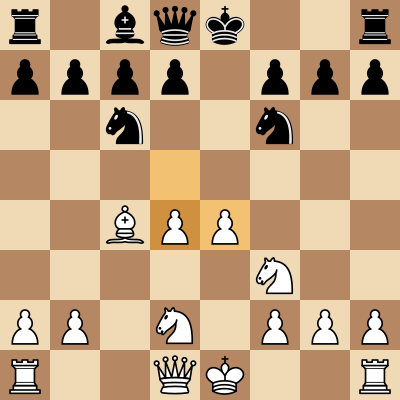
Positional Takeaway:
Occupying vs. Controlling: You don't always have to occupy the center with pawns. You can control it with long-range pieces (like bishops on long diagonals or rooks on central files).
Centralize Your Pieces: If you don't know what to do, look for ways to bring your passive pieces closer to the center. A knight on the rim is dim, but a knight on e5 or d5 is a monster.
2. Identify and Claim Open Files with Your Rooks
Rooks are long-range heavy artillery. They are completely useless when trapped behind your own pawns. To unleash their power, they need open files (columns on the board with no pawns) or semi-open files (columns with only your opponent's pawns).
A fundamental rule of positional play is to place your rooks on open files, use them to penetrate the enemy camp, and eventually double them on the same file to create irresistible pressure.
The Battle for the d-File:
Look at this clean endgame position. White's rook is active, occupying the only fully open file on the board (the d-file), while Black's rook is passive.
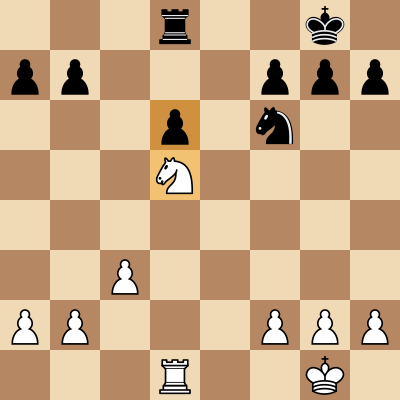
In this position, White's rook on d1 controls the entire d-file. It prevents Black's king from easily stepping up and stands ready to invade the 7th rank (d7), which is the absolute gold standard for rook placement in the endgame.
Positional Takeaway:
Claim the File: If a pawn trade opens a file, be the first to place your rook on it.
Double Up: Placing both of your rooks on the same open file (called "doubling on the file") completely locks down that sector of the board.
Target the 7th Rank: If you can get a rook onto your opponent's 2nd rank (or 7th rank if you are White), do it. It paralyzes the enemy king and sweeps up undefended pawns.
3. Understand Pawn Structure and Avoid Weaknesses
Pawns are the skeleton of your position. Unlike any other piece on the board, pawns can never move backward. Every time you push a pawn, you make a permanent decision that alters the landscape of the game forever.
Beginners often push pawns impulsively to attack enemy pieces. Positional players know that every pawn push leaves behind "holes"—squares that can no longer be defended by pawns.
To play strong positional chess, you must avoid creating these common pawn weaknesses:
Doubled Pawns: Two pawns of the same color stacked on the same file. They block each other and are difficult to defend.
Isolated Pawns: A pawn with no friendly pawns on adjacent files. It can never be defended by another pawn, meaning your pieces must waste time babysitting it.
Backward Pawns: A pawn that has fallen behind its neighbors and cannot safely advance. The square directly in front of a backward pawn is a perfect outpost for your opponent's pieces.
Positional Takeaway:
Think Before You Push: Before pushing a pawn, ask yourself: What squares am I permanently giving up control over?
Target Enemy Weaknesses: If your opponent has an isolated or doubled pawn, stop trying to checkmate them. Instead, pile your pieces onto that weak pawn, force them to defend it passively, and slowly grind them down.
4. Maximize Piece Activity (The "Good" vs. "Bad" Bishop)
In chess, material is only half the story. A bishop is worth 3 points on paper, but if it is trapped behind its own pawns, its real-world value is closer to zero.
Positional play is about maximizing the activity of your pieces while restricting your opponent's. The most famous example of this is the concept of Good vs. Bad Bishops:
A Bad Bishop is a bishop that is blocked by its own pawns on the same color squares. If all your pawns are on light squares, your light-squared bishop has no scope and acts as little more than a tall pawn.
A Good Bishop is a bishop whose pawns are on the opposite color squares, allowing it to move freely across the board.
Look at this symmetrical, closed position:
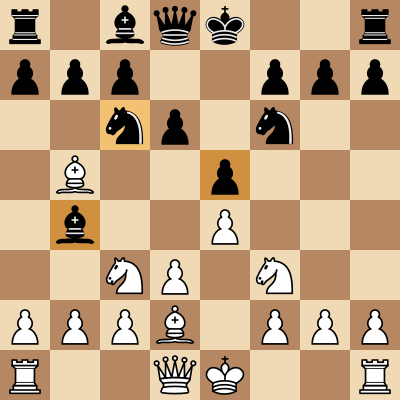
Even in a highly symmetrical setup, piece activity dictates who has the upper hand. Notice how White's light-squared bishop on b5 is active, pinning Black's knight on c6, while Black's bishop on b4 is doing the same. If White can trade their bishop for Black's active knight, they can alter the strategic balance of the game.
Positional Takeaway:
Fix Your Bad Bishops: If you have a bad bishop, look for opportunities to trade it off for your opponent's active bishop or knight, or push your pawns to opposite-colored squares to open up diagonals.
Find Outposts for Knights: Knights love "outposts"—squares deep in enemy territory that cannot be attacked by enemy pawns. A knight anchored on an outpost is often worth more than a rook.
5. Prophylaxis: Stop Your Opponent's Plans Before They Happen
The ultimate mark of a mature positional player is prophylaxis—the art of preventing your opponent's plans before they even have a chance to execute them.
Beginners play "one-way chess." They focus entirely on their own moves, their own attacks, and their own threats. When their opponent makes a move, they ignore it and keep pushing forward, only to get hit by a tactical blunder they never saw coming.
Positional masters constantly ask themselves: What does my opponent want to do? If they had two moves in a row, what would they play?
If your opponent's only active plan is to open a file or jump a knight into an outpost, prophylactic play means spending a move to stop that plan cold. Once your opponent has no active plans left, they will slowly suffocate under the weight of their own passivity.
How to Practice Prophylaxis:
The Golden Question: After every single move your opponent makes, stop. Do not look at your own plans. Ask: What is the threat of that move? Why did they put that piece there?
Stop the Counterplay: If you are winning or have a comfortable space advantage, don't rush to attack. First, identify your opponent's only source of counterplay and shut it down. Once they are completely paralyzed, you can convert your win at your leisure.
Summary: The Positional Checklist
The next time you play a game and find yourself without any immediate tactical shots, don't panic. Take a deep breath and run through this positional checklist:
Center: Can I bring a piece closer to the center or increase my control over central squares?
Rooks: Is there an open or semi-open file I can claim with my rooks?
Pawns: Have I created any permanent weaknesses in my pawn structure? Can I target a weak pawn in my opponent's camp?
Activity: Which of my pieces is the least active? How can I improve its position or trade it off?
Prophylaxis: What is my opponent's main plan, and how can I stop it?
By shifting your focus from short-term tactical hunting to long-term positional planning, you will play cleaner, more controlled chess. You will stop relying on your opponents making simple blunders, and start winning games through pure strategic dominance. This is how adult improvers become club players.
From the same category
Keep reading
What is a Good Accuracy Score in Chess? Rating-Level Benchmarks Explained
Ever wondered what a 'good' accuracy score actually is for your rating? Discover the realistic benchmarks for every level, why the percentage can be misleading, and how to use it to truly improve.
Is 97% Accuracy Good in Chess? What High Accuracy Really Tells You
97% accuracy sounds elite, but the number alone is misleading. Here's what it actually means across opening, middlegame, and endgame — and why some 97% games are stronger than others.
Chess Tactics for Beginners: How to Spot Forks, Pins, Skewers, and Discovered Attacks
Master the four fundamental chess tactics that win games. Learn how to spot forks, pins, skewers, and discovered attacks with concrete examples and board diagrams.