Chess Strategy for Club Players: 5 Advanced Positional Concepts to Break Your Plateau
In chess, tactical puzzles are the low-hanging fruit. You learn a fork, you spot a pin, you execute a mate-in-two, and you win material. But as you climb past the beginner ranks and enter the club player territory (1200–1800 Elo), you quickly notice a frustrating pattern: your opponents stop giving their pieces away.
Suddenly, there are no obvious tactics on the board. Your pieces are developed, but you have no clear target. If you shuffle your pieces aimlessly, you create weaknesses in your own position and slowly get squeezed off the board.
To break through this plateau, you must transition from short-term tactical calculation to long-term positional planning. Here are 5 advanced positional concepts that will transform how you look at the board and help you outplay your opponents strategically.
1. The Principle of Two Weaknesses
Against a competent club player, attacking a single weakness is rarely enough to win. If your opponent has one weak pawn or a vulnerable king, they can usually coordinate their pieces to defend it perfectly.
The Principle of Two Weaknesses states that to break a solid defense, you must create a second weakness on the opposite side of the board. By shifting your attacks back and forth between these two targets, you force your opponent's pieces to scramble across the board. Eventually, their coordination will collapse, and one of the weaknesses will fall.
Consider this rook endgame:
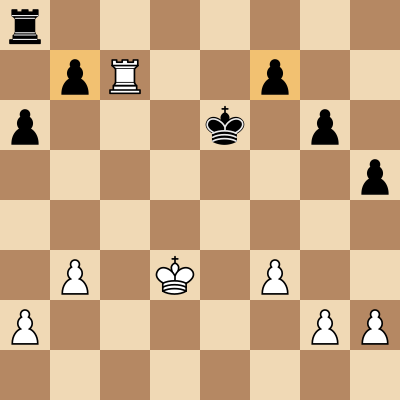
White's rook is highly active on the 7th rank (c7), creating immediate pressure on the weak pawns on b7 and f7. However, if White only focuses on these targets, Black can defend passively.
To win this game, White must apply the Principle of Two Weaknesses:
The First Weakness: The queenside pawns (
b7anda6), which are tied down by the active rook onc7.The Second Weakness: White must create a second target on the kingside. This is achieved by activating the White king to
d4ore4and pushing the kingside pawns (g2-g4andh2-h4-h5) to create a passed pawn or open up the Black king.
Black's passive rook and king cannot defend both sectors simultaneously. The moment Black's pieces commit to defending the kingside, the queenside pawns will fall.
Positional Takeaway:
Don't rush: If you have an advantage but can't break through, do not force a premature attack. Look to the other side of the board and ask: How can I create a second target?
2. Maintaining Pawn Tension
One of the most common mistakes intermediate players make is resolving pawn tension too quickly. When two pawns face each other (for example, a White pawn on c4 and a Black pawn on d5), the instinctive reaction is to either capture (cxd5) or push past (c5).
Advanced positional players know that tension is a weapon. Keeping the tension forces your opponent to remain passive, as they must constantly calculate the consequences of a capture. The moment you resolve the tension, you clarify the pawn structure and make your opponent's defensive task much easier.
Look at this typical Queen's Gambit Declined structure:
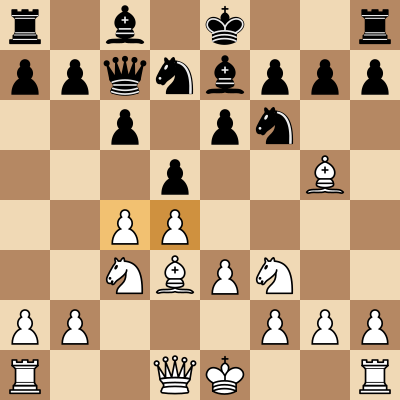
There is active pawn tension between White's pawn on c4 and Black's pawn on d5.
The Beginner's Mistake: Playing
cxd5immediately. This resolves the tension, opens up Black's light-squared bishop onc8, and gives Black an easy game.The Club Player's Approach: Maintain the tension. White should develop naturally with moves like
Rc1,O-O, orQc2, keeping the threat of capturing ond5alive. This forces Black to keep their pieces in defensive postures to guard the center.
By maintaining tension, you keep your opponent guessing and preserve your strategic flexibility.
Positional Takeaway:
The Tension Rule: Only resolve pawn tension if it concretely wins material, secures a permanent positional advantage (like creating an isolated pawn for your opponent), or if you are forced to do so. Otherwise, keep the pressure on.
3. Minor Piece Domination and Restriction
In closed or semi-closed positions, the absolute value of a minor piece (bishop or knight) is dictated entirely by the pawn structure. A bishop is worth 3 points on paper, but if its own pawns block its diagonals, it behaves like a "tall pawn."
To dominate your opponent positionally, you must learn to restrict their minor pieces while maximizing the activity of your own. This is often achieved by fixing your opponent's pawns on the same color squares as their bishop, rendering it completely passive.
Consider this closed pawn structure:
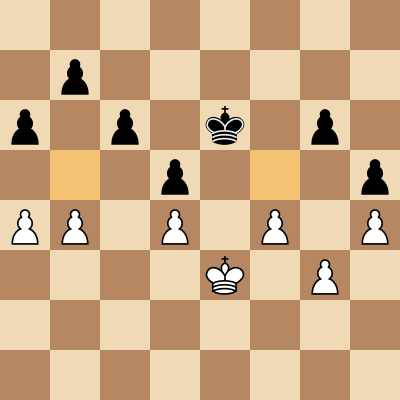
In this endgame, the pawn structure is highly locked. White's pawns are on a4, b4, d4, f4, g3, and h4.
If Black has a light-squared bishop, it is a "bad bishop" because all of Black's central pawns are fixed on light squares (c6, d5). It is trapped behind its own pawn chain and has no active targets. White, on the other hand, can use their king and pawn breaks like b5 or f5 (highlighted) to break open the position at the optimal moment.
By placing your pawns on the opposite color of your own bishop, you ensure your piece remains active. Conversely, by forcing your opponent's pawns onto the color of their bishop, you lock that piece in a permanent prison.
Positional Takeaway:
Identify the "Bad" Piece: Look at your opponent's minor pieces. If they have a bad bishop, avoid trading it. Keep it on the board as a passive spectator while you trade off their active pieces.
4. The Positional Exchange Sacrifice
To a beginner, giving up a rook for a bishop or knight (an exchange sacrifice) is a blunder. To a master, it is one of the most powerful strategic weapons in chess.
A positional exchange sacrifice is not made to deliver an immediate checkmate or win material back in 3 moves. Instead, it is played to secure long-term, permanent positional advantages that outweigh the nominal 2-point material deficit.
You should consider a positional exchange sacrifice to:
Destroy an opponent's key defender: If your opponent has a monster knight on an outpost or a bishop dominating a crucial diagonal, sacrificing a rook for that piece can completely paralyze their position.
Secure an impregnable outpost: Giving up a rook to place a knight on an unassailable central square (like
e5ord5) where it cannot be challenged. A well-placed knight on the 5th or 6th rank is often stronger than a passive rook.Ruin the enemy pawn structure: Creating doubled, isolated pawns in your opponent's camp that you can slowly harvest in the endgame.
When you make a positional exchange sacrifice, you are betting that your active, coordinated minor pieces and superior pawn structure will outplay your opponent's passive, uncoordinated rooks.
Positional Takeaway:
Look beyond material: Stop treating piece values as absolute laws. A rook on an open file is worth 5 points; a rook trapped in a closed corner is worth 2. Evaluate pieces by their activity, not their starting value.
5. Prophylaxis: Thinking Backward
The ultimate mark of a mature club player is prophylaxis—the art of preventing your opponent's plans before they even have a chance to execute them.
Most intermediate players play "one-way chess." They focus entirely on their own ideas, attacks, and threats. When their opponent makes a move, they ask, "What is the direct threat of this move?" If there is no immediate tactical threat, they ignore it and continue with their own plan.
Prophylactic thinking requires you to ask a deeper question:
"If my opponent had two moves in a row, what would their plan be? How can I stop that plan right now?"
If your opponent's only active plan is to jump a knight to f5, prophylaxis means playing g4 or g3 to prevent it entirely. If their plan is to open the c-file, prophylaxis means placing a rook on c1 or a bishop on b2 to contest it before the file even opens.
By systematically neutralizing your opponent's active plans, you force them into passivity. Psychologically, this is incredibly frustrating to play against; positionally, it is lethal.
Positional Takeaway:
The Karpov Rule: Before executing your own active plan, spend one move to completely shut down your opponent's counterplay. Once they are paralyzed, you can convert your advantage at your leisure.
Summary: The Club Player's Strategic Checklist
The next time you find yourself in a quiet middlegame with no immediate tactical shots, do not panic. Run through this positional checklist to find the correct plan:
Weaknesses: Can I create a second weakness in my opponent's camp to stretch their defense?
Tension: Am I resolving pawn tension too quickly, or can I maintain it to keep my opponent passive?
Restriction: Is there a way to fix my opponent's pawns on the color of their bishop to make it a "bad" piece?
Exchange Sacrifices: Would giving up a rook for a dominant minor piece secure long-term control of the board?
Prophylaxis: What is my opponent's most active plan, and how can I stop it before they start?
By shifting your focus from short-term tactical hunting to long-term positional planning, you will play cleaner, more controlled chess. You will stop relying on your opponents making simple blunders, and start winning games through pure strategic dominance. This is how you break your plateau and transition from a casual player to a true club competitor.
From the same category
Keep reading
Chess Strategy for Beginners: The 5 Essential Rules of Positional Play
Tired of aimless piece shuffling? Transition from short-term tactics to long-term planning with these 5 essential rules of positional chess strategy.
What is a Good Accuracy Score in Chess? Rating-Level Benchmarks Explained
Ever wondered what a 'good' accuracy score actually is for your rating? Discover the realistic benchmarks for every level, why the percentage can be misleading, and how to use it to truly improve.
Is 97% Accuracy Good in Chess? What High Accuracy Really Tells You
97% accuracy sounds elite, but the number alone is misleading. Here's what it actually means across opening, middlegame, and endgame — and why some 97% games are stronger than others.