Why Your Chess Accuracy Drops After One Blunder
Quick answer: one blunder drops your chess accuracy because accuracy is not an average of "how pretty" every move looked. It is heavily shaped by the biggest moments in the game - especially moves that swing the evaluation from equal or winning to losing.
That is why a game can feel mostly fine and still finish with a painful number. You may have played 25 reasonable moves, missed one tactic, and watched the accuracy score act like the whole game was a disaster. Annoying? Yes. Useful? Also yes - if you know what to look for.
Why one blunder can tank the whole score
Chess accuracy rewards moves that stay close to the engine's best continuation. A quiet developing move that is slightly worse than best usually costs very little. A tactical miss that changes the result of the game costs a lot.
So the score is not saying, "you played badly every move." It is usually saying, "this one decision changed the game enough that everything after it happened in a worse position."
Move type | Typical effect on accuracy | What it usually means |
|---|---|---|
Small inaccuracy | Small drop | You chose a playable move, but missed a cleaner plan. |
Mistake | Medium drop | You worsened the position or missed an important chance. |
Blunder | Large drop | You allowed a tactic, lost material, or changed the likely result. |
Forced losing position after the blunder | Continued drag | Even decent moves may score lower because the position is already damaged. |
The "one bad move" effect
The most common pattern looks like this:
You play a normal opening and reach a playable middlegame.
Your accuracy is probably fine so far.
You miss one forcing move: a check, capture, fork, pin, or loose piece.
The evaluation swings hard.
The rest of the game is now harder, so the final score looks much worse.
This is why players often ask why their chess accuracy is so low even when they remember playing "mostly okay." The answer is often not fifty tiny mistakes. It is one tactical turning point.
A simple position example
You do not need a spectacular sacrifice for accuracy to collapse. Sometimes the whole game turns on a loose piece or an unprotected queen.
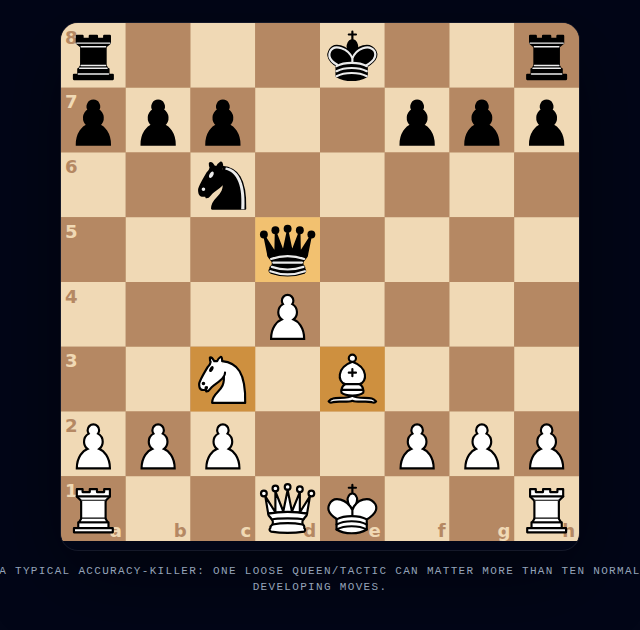
The lesson is not "memorize this position." The lesson is: before you make the comfortable move, scan the board for the forcing stuff first. Checks, captures, threats, loose pieces. Every serious accuracy drop starts with one of those being ignored.
Why your next moves also look worse
After a blunder, your next moves may be judged harshly even if they are human and logical. Why? Because you are no longer solving the original position. You are solving the damaged version.
Imagine you hang a rook. The next five moves might be reasonable attempts to fight back, but they are happening from a losing material balance. The engine is comparing your choices to the best defensive try, not to the comfortable game you had before.
Practical read: if your accuracy dropped after one blunder, review the position before the blunder - not only the moves after it. That is where the lesson lives.
How to review the blunder correctly
Do not just stare at the final percentage. Use this review checklist instead:
Find the biggest evaluation swing. That is usually the real accuracy killer.
Ask what type of miss it was. Check, capture, threat, loose piece, back-rank problem, or bad trade?
Look one move earlier. What warning sign was already visible?
Name the pattern. "I missed a knight fork" is more useful than "I played badly."
Train that pattern. One named weakness is fixable. A vague bad score is not.
This is exactly where DeepBlunder is useful: paste the game, find the move that caused the collapse, then turn the explanation into one concrete pattern to watch for next time.
What accuracy drop is normal after a blunder?
There is no universal number, but these ranges are useful:
5-10 point drop: usually a mistake or missed improvement, not necessarily game-losing.
10-20 point drop: often a serious tactical miss, lost material, or a blown advantage.
20+ point drop: usually a major blunder, especially in a short game where one move dominates the score.
Short games exaggerate this effect. In a 15-move game, one blunder is a huge percentage of the sample. In a 70-move endgame, the same mistake may be diluted by many additional moves.
How to stop one blunder from ruining your games
The goal is not to calculate like Stockfish. The goal is to build one anti-blunder habit before every forcing position.
Check your opponent's threats first. What would they play if they moved twice?
Scan checks, captures, and attacks. For both sides, not just your own.
Look for loose pieces. Undefended queens, rooks, and bishops are tactical magnets.
Pause after your opponent makes a forcing move. Checks and captures deserve extra respect.
Review the pattern, not the shame. The fix is a repeatable habit, not self-punishment.
FAQ
Can one blunder really ruin chess accuracy?
Yes. One major blunder can swing the evaluation enough to dominate the final accuracy score, especially in shorter games.
Does low accuracy mean I played badly the whole game?
Not always. It can mean you played a mostly normal game with one critical tactical mistake. Find the turning point before judging the whole performance.
Should I care more about accuracy or blunders?
Care about the blunders behind the accuracy. The percentage is a signal. The actual improvement comes from identifying the repeated mistake pattern.
Bottom line
One blunder can absolutely wreck your chess accuracy. But that is not bad news. It means the game may have one clear lesson instead of fifty mysterious problems. Find the swing, name the pattern, and fix that one habit before your next game.
Want the fast version? Paste your PGN into DeepBlunder and see which move actually destroyed your accuracy.