Chess Openings for Beginners: How to Build Your First Solid Repertoire
Chess Openings for Beginners: How to Build Your First Solid Repertoire
Many chess players fall into a common trap when they start learning openings. They spend hours memorizing long, complex variations of sharp lines like the Sicilian Najdorf or the King's Gambit, only to get frustrated when their opponent plays an "incorrect" move on turn four and ruins their preparation.
For beginners and adult improvers, memorizing moves is a waste of time. Your opponents will not play "book" moves, and you will quickly find yourself out of your depth.
Instead of memorizing lines, you need to understand opening principles and build a compact, reliable repertoire based on solid, logical structures. This guide will show you how to do exactly that.
The Three Golden Rules of Opening Play
Before choosing specific openings, you must understand what you are trying to achieve in the first 10 moves. Every strong opening move satisfies at least one of these three golden rules:
Control the Center: The central squares (
e4,d4,e5,d5) are the most important on the board. Controlling them allows your pieces to move freely and restricts your opponent's coordination.Develop Your Pieces: Bring your minor pieces (knights and bishops) into the game. As a general rule, develop knights before bishops, and do not move the same piece twice in the opening unless forced.
King Safety: Castle early to get your king out of the center and activate your rook.
If a move does not control the center, develop a piece, or help you castle, it is probably a mistake.
Building Your White Repertoire: The Italian Game
As White, you have the first-move advantage. You want to claim the center immediately and develop your pieces toward active squares.
For beginners, we recommend starting with 1. e4. This opens up diagonals for your queen and light-squared bishop.
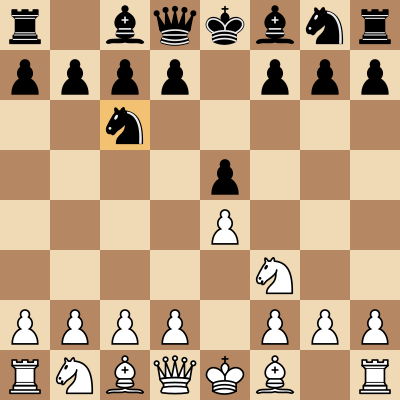
The Starting Position: 1. e4 e5 2. Nf3 Nc6
After 1... e5, Black matches your central claim. You play 2. Nf3, developing a knight to its most natural square and immediately attacking Black's pawn on e5. Black defends with 2... Nc6.
The Italian Game: 3. Bc4
Now, you play 3. Bc4. This is the Italian Game, one of the oldest and most logical openings in chess.
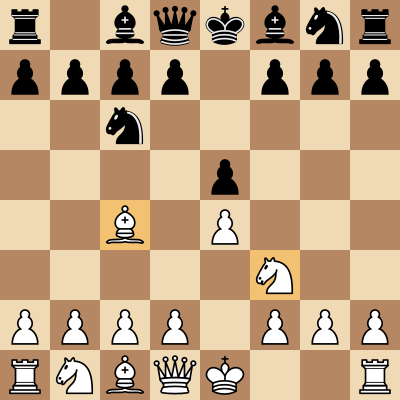
Why this bishop placement is perfect for beginners:
It controls the center, specifically eyeing the
d5square.It targets Black's weakest point: the
f7pawn (which is only defended by the Black king).It prepares short castling on the very next move.
How to Handle Black's Responses
From this position, Black has two main moves:
1. The Two Knights Defense: 3... Nf6
Black attacks your pawn on e4. Instead of getting fancy, defend it simply with 4. d3. This solidifies your center, opens up a path for your dark-squared bishop, and keeps your position incredibly safe.
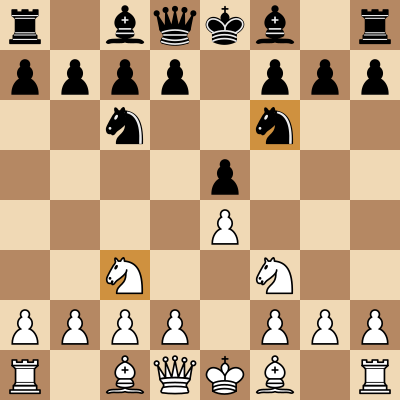
2. The Giuoco Piano: 3... Bc5
Black mirrors your bishop. Again, play 4. d3 (or castle first, then play d3). You will follow up by developing your other knight to c3 (or d2), your dark-squared bishop to e3 or g5, and castling.
This setup is called the Giuoco Pianissimo ("very quiet game"). It is incredibly solid, avoids early tactical traps, and teaches you how to maneuver your pieces in a structured middlegame.
Building Your Black Repertoire: Simple, Universal Setups
As Black, your opponent has a tempo advantage. Your primary goal is to equalize—neutralize White's first-move advantage, fight for central control, and castle safely.
To keep your learning curve manageable, you need simple, reliable responses to White's two most common first moves: 1. e4 and 1. d4.
Responding to 1. e4: The French Defense (1... e6)
Instead of playing 1... e5 and allowing White to dictate the game with the Italian or Ruy Lopez, we recommend the French Defense: 1... e6.
No matter what White plays next, your second move is almost always 2... d5.
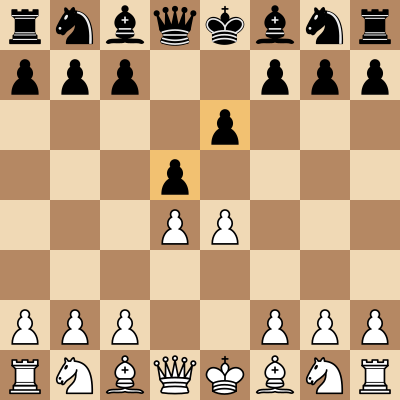
Why the French Defense is excellent for beginners:
Rock-solid structure: Your pawn on
d5is firmly supported by the pawn one6.Clear plans: You will attack White's center with pawn breaks like
c5and develop your pieces behind a safe pawn wall.Avoids sharp theory: It takes White out of their comfort zone and forces them to play on your terms.
Note: Your light-squared bishop on c8 can sometimes be restricted by your own pawns. You will learn to develop it via b6 and Ba6, or activate it later once the center opens up.
Responding to 1. d4: The Queen's Gambit Declined (1... d5)
If White starts with 1. d4, respond symmetrically with 1... d5.
If White plays the Queen's Gambit (2. c4), do not capture the pawn. Capturing on c4 gives up your central control. Instead, play 2... e6—the Queen's Gambit Declined (QGD).
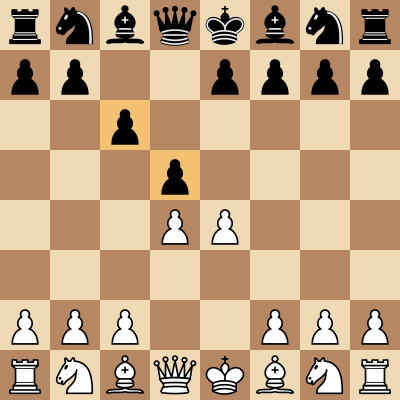
Why the QGD is your best weapon:
It is one of the most respected, classical openings in chess history.
Your pawn on
d5is securely defended, preventing White from dominating the center.Your development is straightforward: develop your knight to
f6, bishop toe7, and castle.
The Common Beginner Opening Mistakes to Avoid
As you begin playing these structures, keep these three critical warnings in mind:
Do Not Bring Your Queen Out Early: Bringing your queen out on move two or three (like trying the Scholar's Mate) is a major mistake. Your opponent will develop their minor pieces while attacking your queen, forcing you to waste moves running away while they build a massive lead in development.
Do Not Make Too Many Pawn Moves: Beginners often push their flank pawns (like
h3,a3,h6,a6) to "prevent" attacks. These moves do not develop pieces or control the center. Limit your pawn moves in the opening to those necessary to free your pieces and fight for the center.Do Not Ignore Your Opponent's Threats: It is easy to get hyper-focused on your own setup. Before making your move, always ask: "What is my opponent's move attacking? What is their plan?"
Summary: Your Opening Action Plan
To build a solid foundation, you do not need to know 20 moves of theory. You only need to know how to reach a playable, comfortable position.
Here is your starter repertoire:
Opponent Move | Your Opening | Key Setup Moves |
|---|---|---|
As White (1. e4) | Italian Game |
|
As Black vs. 1. e4 | French Defense |
|
As Black vs. 1. d4 | Queen's Gambit Declined |
|
Focus on playing these three setups consistently. Analyze your games afterward to see where you drifted from basic principles, and use the DeepBlunder AI coach to review your tactical and positional accuracy. By mastering the structures rather than memorizing the moves, you will build a resilient opening game that transitions smoothly into winning middlegames.
From the same category
Keep reading

Chess Strategy for Club Players: 5 Advanced Positional Concepts to Break Your Plateau
Stuck at a tactical plateau? Discover 5 advanced positional chess concepts—like the Principle of Two Weaknesses, pawn tension, and prophylaxis—to outplay your opponents strategically and raise your Elo.
Chess Strategy for Beginners: The 5 Essential Rules of Positional Play
Tired of aimless piece shuffling? Transition from short-term tactics to long-term planning with these 5 essential rules of positional chess strategy.

What is a Good Accuracy Score in Chess? Rating-Level Benchmarks Explained
Ever wondered what a 'good' accuracy score actually is for your rating? Discover the realistic benchmarks for every level, why the percentage can be misleading, and how to use it to truly improve.