The 7 Most Common Opening Mistakes Under 1200 Elo
Most chess players under 1200 do not lose in the opening because they forgot move 9 of the Sicilian Najdorf.
They lose because they move the same piece three times, leave the king in the center, grab a poisoned pawn, or launch an attack with half the army still asleep.
That is good news. It means you do not need to memorize 200 opening lines to improve. You need to stop making the small, repeatable mistakes that turn a playable position into a disaster by move 12.
This guide breaks down the seven opening mistakes that cost the most games under 1200 Elo — and what to do instead.
1. Memorizing moves without understanding the point
The classic beginner opening routine looks like this:
Watch a video on the Italian Game.
Memorize the first five moves.
Opponent plays something weird on move three.
Panic.
Invent a move that breaks every opening principle.
The problem is not that opening study is useless. The problem is studying openings like a password you have to remember.
A good opening move usually does one of four things:
fights for the center,
develops a piece,
protects the king,
creates a direct threat that actually works.
If you cannot explain why a move helps one of those goals, you probably do not own the opening yet. You are borrowing it.
Fix: after every opening move you learn, ask: what square does this control, what piece does this improve, or what threat does this stop?
That one question is worth more than another ten memorized moves.
2. Moving the same piece again and again
One of the fastest ways to fall behind in the opening is to treat one piece like the main character.
You play Nf3, then Ng5, then Nxf7, then the knight has to escape, and suddenly your queenside pieces are still at home while your opponent has developed everything.
Sometimes a repeated move is tactical and correct. But under 1200, repeated piece moves are usually a symptom of hope chess: attacking something because it looks annoying, not because the position supports it.
Bad pattern:
move one piece repeatedly,
chase pawns,
make one-move threats,
ignore undeveloped pieces.
Better pattern:
develop both knights,
develop both bishops,
castle,
connect the rooks,
only then start a serious attack.
If your opponent attacks one of your pieces early, do not just run. Ask whether you can develop another piece with tempo, defend naturally, or make a stronger threat.
Rule of thumb: in the first 8–10 moves, every move should bring a new piece into the game unless there is a concrete tactic.
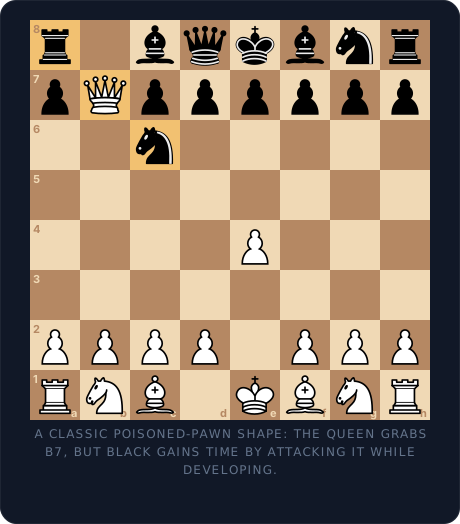
3. Bringing the queen out too early
The queen is powerful, which is exactly why beginners love using it early.
The trap is simple: an early queen move often creates one threat, but gives your opponent several useful developing moves with tempo.
For example, after an early queen sortie, Black may gain moves like Nc6, Nf6, Be7, or g6 while attacking the queen. You think you are attacking. In reality, your opponent is developing for free.
Early queen adventures usually fail for three reasons:
the queen becomes a target,
your minor pieces stay undeveloped,
your king remains stuck in the center.
That does not mean the queen can never move early. Scholar's Mate patterns, queen checks, and tactical queen moves exist. But if the attack does not win material or create a lasting weakness, you are probably helping your opponent.
Fix: before moving your queen in the opening, ask: if my opponent attacks the queen with a developing move, am I still happy?
If the answer is no, develop a knight or bishop instead.
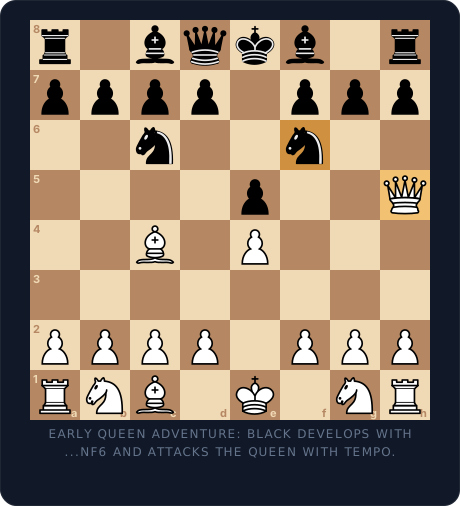
4. Grabbing pawns before finishing development
Free pawns are not always free. Sometimes they come with interest.
A common opening mistake under 1200 is taking a pawn on the wing or in the center while your king is still uncastled and your pieces are not ready.
The pawn may be poisoned because capturing it:
opens a file toward your king,
pulls a defender away,
lets your opponent gain time attacking your piece,
delays castling,
traps the piece that captured it.
This is why strong players often ignore pawns that beginners instantly grab. They are counting time, not just material.
Imagine you win one pawn but spend three moves doing it. If your opponent uses those three moves to develop, castle, and open the center, you may have won a pawn and lost the game.
Fix: when you see a “free” pawn, run this checklist:
Is the capturing piece safe after the capture?
Does the capture delay castling?
Can my opponent attack the piece with development?
Does the capture open a line against my king?
If I do not take it, can I simply improve my position?
If you cannot answer those questions, leave the pawn alone. Boring moves win a lot of games under 1200.
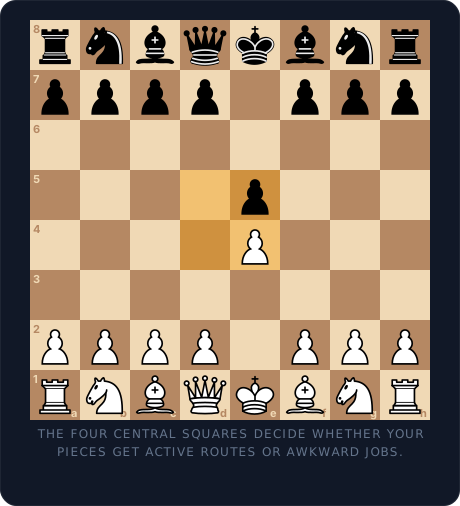
5. Ignoring the center
Beginners often attack the side of the board before they have earned the right to attack anything.
A flank attack can be strong, but only when the center is stable or under control. If the center is open and your king is still there, pushing side pawns is usually an invitation to get punished.
Common examples:
pushing
h4ora4before developing,chasing a bishop with pawns while your center collapses,
attacking the king side while your own king has not castled,
letting your opponent build a huge pawn center with no challenge.
The center matters because pieces move through it. Control the center and your pieces become faster. Lose the center and every move feels awkward.
Fix: in most beginner openings, aim to place or challenge pawns on e4, d4, e5, or d5, then develop pieces toward central squares.
You do not need a perfect opening. You need a position where your pieces can breathe.
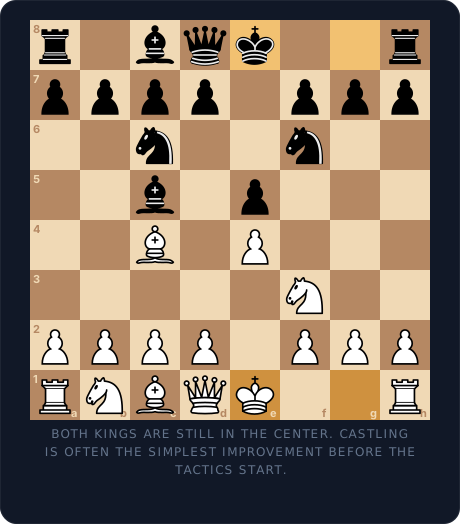
6. Castling too late
The king is not safe in the center just because nothing bad has happened yet.
That sentence alone would save thousands of beginner games.
Players under 1200 often delay castling because they want to make “one useful move first.” Then another. Then another. Suddenly the center opens and every tactic comes with check.
Late castling is dangerous because:
checks become forcing moves,
pins become stronger,
your rooks stay disconnected,
your opponent can open the center with tempo.
There are positions where delaying castling is correct. But if you are under 1200, assume castling early is the default unless you have a clear reason not to.
Fix: after developing two minor pieces, ask: can I castle now?
If yes, castle. You can be creative after your king is safe.
7. Starting an attack before your pieces are ready
This is the biggest one.
A beginner sees the enemy king and thinks: attack. A stronger player asks: how many pieces can actually join?
Most failed opening attacks have the same shape:
one queen,
one bishop or knight,
no rook support,
undeveloped queenside,
king still in the center.
That is not an attack. That is a field trip.
A real attack needs coordination. You want multiple pieces aiming at the same zone, open lines, king safety, and a reason the opponent cannot simply defend and gain time.
Before launching an attack, count attackers and defenders. If you have two attackers and they have three defenders, you probably need to improve another piece first.
Fix: build before you break. Develop, castle, connect rooks, improve your worst piece, then look for tactics.
The funny thing is that when your pieces are developed, tactics appear by themselves. You do not have to force them.
A simple opening checklist for under 1200 Elo
Use this after every game, especially if you were worse by move 10.
Did I fight for the center?
Did I develop both knights and bishops?
Did I move one piece too many times?
Did I bring my queen out before I had to?
Did I grab a pawn that cost me time?
Did I castle before the center opened?
Did my attack use enough pieces?
Was my first serious mistake actually an opening mistake, or a tactic right after the opening?
That last question matters. Many players blame the opening when the real issue was a missed tactic on move 11.
This is where reviewing your own games beats memorizing more theory.
How DeepBlunder helps you fix opening mistakes
Opening books tell you what the best move was. That is useful, but it is not always enough.
If you are under 1200, the bigger question is usually: why did my move fail?
DeepBlunder analyzes your game with Stockfish 18 and explains the mistakes in plain English. Instead of only seeing that a move was inaccurate, you can understand whether you:
ignored development,
weakened your king,
missed a tactic,
gave up the center,
chased material,
or started an attack too early.
That turns the opening from a memorization problem into a feedback loop.
Play your usual openings. Import the game. Find the first moment your position got worse. Then fix that pattern in the next game.
That is how club players actually improve.
What to study next
If you want a practical opening path, start here:
For a simple beginner repertoire, read Chess Openings for Beginners: How to Build Your First Solid Repertoire.
If your games collapse after one tactical miss, read Why Your Chess Accuracy Drops After One Blunder.
If you want a better post-game review habit, read How to Review a Chess Game Without Getting Lost in Engine Lines once it is live.
Do not try to learn every opening. Learn the mistakes that keep showing up in your own games.
That is the fastest route from “I know the first five moves” to “I understand what I am doing.”