The Discovered Attack: How to Unleash Hidden Tactics in Chess
You are playing a tense middlegame. Your pieces are developed, but your opponent’s king looks perfectly safe behind a solid wall of pawns. You scan the board for direct threats, but there are no simple forks, pins, or hanging pieces.
Then, you notice a subtle alignment. Your rook is on an open file, pointing directly at your opponent’s queen. The only thing blocking the path is your own bishop.
If you move the bishop to a random square, the queen will simply step aside. But what if you move the bishop to an active square that creates an immediate, forcing threat of its own?
Suddenly, your opponent is faced with a double crisis: they must respond to the new threat created by your bishop, but they also have to deal with the sudden, long-range attack on their queen. Because they can only make one move at a time, they cannot escape both.
This is the discovered attack—one of the most elegant, explosive, and game-winning tactical motifs in chess.
In this guide, we will break down the anatomy of the discovered attack, analyze the devastating sub-category of the discovered check, and give you a concrete checklist to spot these hidden opportunities in your own games.
The Core Concept: What is a Discovered Attack?
A discovered attack occurs when you move one piece (the "intervening piece") out of the way, revealing a hidden line of attack from a long-range piece (a bishop, rook, or queen) sitting directly behind it.
To understand why this is so powerful, think of it as a tactical ambush. The hidden piece has been aiming at its target for several moves, but the threat was dormant because your own piece was blocking the path. The moment the blocking piece steps aside, the attack is "discovered."
Because the intervening piece is free to move anywhere, it can create a completely independent threat—such as checking the king, attacking another high-value piece, or threatening a checkmate. Your opponent is forced to respond to the most urgent threat, usually leaving the target of the discovered attack to be captured.
Let’s look at a classic example to see how this works in practice.
Position 1: The Dormant Alignment
Consider this common middlegame position. White's rook on d1 is aligned with Black's queen on d7, but the path is currently blocked by White's light-squared bishop on d3.
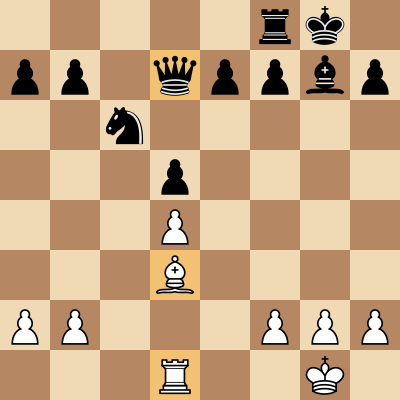
If White plays a quiet positional move, Black will eventually realize the danger and move the queen to a safer square. But White has a forcing tactical shot that exploits this alignment immediately.
Position 2: Unleashing the Ambush
White plays:
1. Bxh7+!
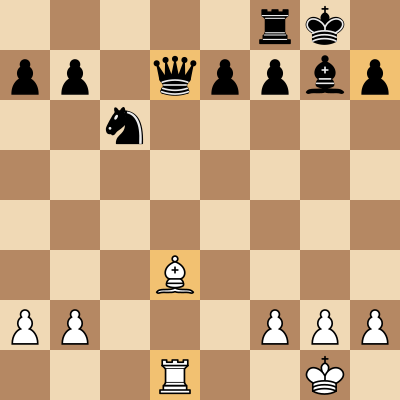
Let’s analyze what this single move accomplishes:
The Direct Threat: The bishop captures the h7 pawn and delivers a direct check to the Black king on g8.
The Discovered Threat: By moving off the d3 square, the bishop has opened the d-file, allowing the White rook on d1 to attack the Black queen on d7.
Black is in check and must respond to the check. They have no time to save their queen.
After Black recaptures the bishop:
1... Kxh7
White plays the decisive follow-up:
2. Rxd7
White wins the Black queen in exchange for a bishop and a pawn—a completely winning material advantage.
The Ultimate Weapon: The Discovered Check
While a discovered attack on a queen is devastating, a discovered check is even more lethal.
A discovered check occurs when the hidden, long-range piece is the one that delivers check to the enemy king when the intervening piece moves. This is exceptionally powerful because the intervening piece is completely free to capture any undefended piece on the board, no matter how well-defended it seems, because the opponent is legally forced to escape the check first.
Let's look at a classic opening trap where a discovered check completely paralyzes Black.
Position 3: The French Defense Trap (Black's Perspective)
This position can arise from a variation of the French Defense. White has just played a quiet-looking move, but has actually set a deadly trap. Black's queen on d5 is active, but notice the alignment of White's light-squared bishop on d3 and dark-squared bishop on a3.
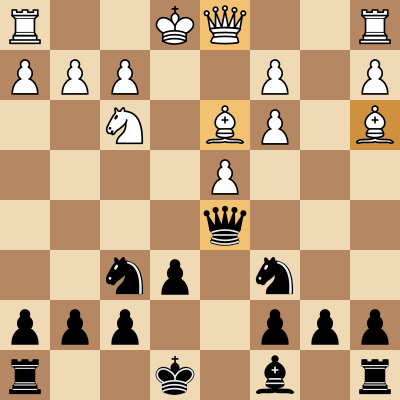
If Black plays carelessly, White can unleash a discovered check. For example, if Black tries to develop naturally with a move like 1... Bd7?, White has:
2. Bxh7+!
The bishop captures the h7 pawn and checks the king. But more importantly, it clears the b1-h7 diagonal, allowing White's queen or bishop to control the board, or in similar structures, opening up a direct line of attack.
In this specific structure, the move 2. Bb5! or a similar bishop jump can also create a devastating double attack. When the intervening piece also checks the king, it is called a double check.
A double check is the most forcing move in chess. Because the king is being attacked by two different pieces from two different directions simultaneously, the opponent cannot block the check or capture the attacking piece. The only legal way to escape a double check is to move the king. This often allows the attacking pieces to deliver an immediate checkmate.
The 3-Point Checklist to Spot Discovered Attacks
Discovered attacks do not appear out of thin air. They are the result of specific piece alignments. To train your tactical vision to spot these opportunities before your opponent does, run through this 3-point checklist on every single turn:
1. Scan for Linear Alignments
Look for any files, ranks, or diagonals where your long-range pieces (Rooks, Bishops, Queens) are pointing toward high-value enemy targets (King, Queen, undefended minor pieces), even if there are multiple pieces blocking the path.
2. Identify the Intervening Pieces
If you find an alignment, identify the exact piece (yours or your opponent's) that is blocking the line of attack. If it is your piece, start calculating: Where can this piece move to create a high-priority threat (a check, a capture, or a mate threat)?
3. Calculate the Forcing Responses
Before pulling the trigger, verify that your opponent has no forcing counter-tactics. Ask yourself:
Can my opponent block the discovered attack while defending against the intervening piece's threat?
Can they deliver an intermediate check (a zwischenzug) that ruins my coordination?
If the intervening piece is capturing material, is that material worth more than the piece I might lose if the tactic fails?
How to Defend Against Discovered Attacks
The best way to master a tactic is to understand how to defend against it. If you find yourself on the receiving end of a discovered alignment, do not panic. Use these defensive resources to neutralize the threat:
Break the Alignment: The simplest defense is to step out of the line of fire. If you notice a rook pointing at your queen, move your queen to a different file before your opponent can organize an attack.
Pin the Intervening Piece: If your opponent's blocking piece is pinned to their own king or queen, they cannot move it to unleash the discovered attack.
Create a Counter-Threat: If your opponent unleashes a discovered attack, look for a forcing intermediate move (like a check) that forces them to defend before they can capture your target.
Summary: Unleash the Hidden Power of Your Pieces
The discovered attack is a masterclass in piece coordination. It teaches you to look past the immediate, face-value threats on the board and see the deep, geometric relationships between your pieces.
By training your eyes to spot dormant alignments and calculating forcing jumps for your intervening pieces, you will transform from a player who merely reacts to direct attacks into a strategist who orchestrates devastating tactical ambushes.
Your Action Plan:
Never ignore alignments: If a rook or bishop is pointing at your king or queen, treat it as an active emergency, even if the path is blocked.
Practice daily puzzles: Discovered attacks are highly pattern-based. Solving 5–10 tactical puzzles a day will train your brain to recognize these setups instantly.
Analyze your games: Use the DeepBlunder AI coach to review your games. It will highlight the subtle alignments you missed and help you find the perfect moment to unleash your next discovered masterpiece.
From the same category
Keep reading

The Greek Gift Sacrifice: How to Spot and Execute the Classic Bishop Sac
Learn how to spot, calculate, and execute the Greek Gift Sacrifice (Bxh7+). Master the 4-point checklist and defeat every king retreat with this classic chess tactic.

Is 99% Accuracy Cheating in Chess? How to Spot Real Engine Use
Is a 99% accuracy score in chess proof of cheating? Learn how chess platforms calculate accuracy, when humans can legitimately score 99%, and the real behavioral red flags that expose engine users.
Chess Openings for Beginners: How to Build Your First Solid Repertoire
Stop memorizing endless lines. Learn how to build a compact, rock-solid opening repertoire for White and Black using core chess principles.