Is 99% Accuracy Cheating in Chess? How to Spot Real Engine Use
You’ve just finished a hard-fought game of chess. You click the "Game Review" button, wait a few seconds, and the screen flashes: 99.1% Accuracy.
Your immediate reaction is a mix of pride and anxiety. If you played the game, you might wonder if the platform’s anti-cheat algorithm is about to flag your account. If your opponent played it, your hand is probably hovering over the "Report" button.
In online chess, 99% accuracy is the ultimate red flag. But does a 99% accuracy score automatically mean someone is cheating?
The short answer is no. While engines routinely score 99% or higher, humans can and do achieve this level of precision under specific, completely legitimate circumstances. To understand when 99% is a sign of a brilliant game and when it is a sign of real engine use, we have to look past the single percentage and analyze the chess itself.
How Accuracy is Calculated (And Why It Flatters)
To spot a cheater, you first need to understand what the accuracy percentage actually represents. Platforms like Chess.com and Lichess calculate accuracy based on Average Centipawn Loss (ACPL). A centipawn is 1/100th of a pawn. Every time you make a move, the engine compares your choice to its top-recommended move. If the engine's top move has an evaluation of +1.00, and you play a move that drops the evaluation to +0.50, you have lost 50 centipawns.
Your accuracy score is a mathematical translation of this average loss across the entire game.
A 99% accuracy score does not mean you played like Stockfish at depth 30 on every single turn. It simply means your average centipawn loss per move was extremely low—typically under 5 centipawns.
There are three common, completely honest scenarios where a human player can easily score 99% accuracy:
1. The Short, Forced Miniature
If your opponent blunders a piece or walks into a well-known tactical trap early in the game, the correct moves become incredibly obvious. When there is only one logical move that wins material or escapes a threat, playing that move gives you 100% accuracy for that turn.
Consider this classic "Scholar's Mate" style threat or a simple tactical trap. If Black plays a terrible opening move and allows a forced sequence, White's moves are completely linear.
For example, look at this position from the Italian Game after 1. e4 e5 2. Nf3 Nc6 3. Bc4:
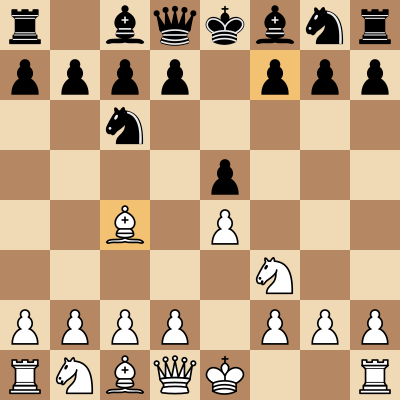
If Black plays a passive, non-developing move like 3... h6 and later walks into a simple tactical sequence, White's winning moves are highly forcing. If a game ends in 12 moves because one player blundered their queen and the other simply captured it and delivered a basic checkmate, the winner’s accuracy will routinely be 99%. They didn't calculate like a supercomputer; they just took the free material.
2. Deep Opening Preparation
If you have memorized 15 moves of opening theory in the Sicilian Najdorf or the Queen's Gambit, and your opponent plays deep into your preparation, you will play 15 consecutive "perfect" moves according to the engine.
If the game ends shortly after the opening phase due to a draw agreement or an early blunder, your accuracy will be near-perfect. You weren't cheating; you were simply reciting your homework.
3. Highly Simplified Endgames
In endgames with very few pieces on the board, the number of candidate moves drops dramatically. If you are converting a King and Rook vs. King checkmate, or pushing a passed pawn down an open file, almost every legal move that doesn't hang your piece is considered "excellent" or "best" by the engine.
A 50-move game that features 15 moves of normal middlegame play and 35 moves of a highly simplified, winning endgame will have its average accuracy heavily inflated by the simple endgame phase.
How to Spot Real Engine Use: The Red Flags
If 99% accuracy alone isn't proof of cheating, how do platforms actually catch engine users? Anti-cheat teams do not look at the accuracy score. They look at behavioral patterns and decision-making quality.
Here are the real red flags that distinguish a human playing a great game from an engine user.
1. Consistent Move Times (The "Metronome" Effect)
Humans think dynamically. We play obvious recaptures, forced checks, and opening moves in a fraction of a second. When faced with a complex positional choice or a sharp tactical branch, we stop and think for minutes.
Engines do not have feelings, and amateur cheaters usually copy moves from a second screen. This creates a highly suspicious time signature:
The Red Flag: A player takes exactly 6 to 10 seconds on every single move. They take 8 seconds to play a forced recapture of their queen, 8 seconds to play a standard opening move, and 8 seconds to find a highly complex, 5-move tactical sacrifice.
The Human Reality: A real human will play the recapture instantly (0.1 seconds) and spend 3 minutes on the sacrifice.
2. Playing "Useless" Prophylactic Moves
In complex middlegames, engines excel at finding tiny, slow positional improvements that look completely counter-intuitive to humans.
If a 1200-rated player suddenly spends 10 seconds to play a quiet king move like Kh1 or a pawn move like a3 in the middle of a sharp, double-edged attack, it is highly suspicious. Humans at that level almost always focus on direct threats, checks, and captures. Playing a highly advanced, quiet defensive move that only makes sense 8 moves later is a classic sign of engine assistance.
3. The "Smothered Mate" and Complex Tactical Depth
Consider a position where a player executes a highly complex tactical combination requiring them to calculate 6 moves ahead, including quiet moves that do not involve checks or captures.
Take this classic smothered mate pattern:
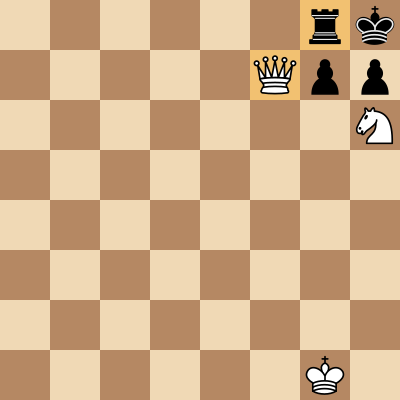
In this position, White has a forcing sequence starting with 1. Qg8+!! Rxg8 2. Nf7#. This is a highly forcing, beautiful tactical sequence. A human club player who has studied tactics can easily spot this pattern because it is a known motif. Finding this does not make someone a cheater.
However, if the winning sequence requires sacrificing a piece not for an immediate checkmate, but to secure a slightly better pawn structure 10 moves later, a human under 2000 Elo is highly unlikely to find it. If a low-rated player consistently finds these "silent" sacrifices that offer no immediate material return, they are likely using an engine.
4. Mismatched Rating vs. Tactical Complexity
If a player is rated 800 but plays a game with 99% accuracy that features highly complex, open tactical lines with multiple pieces hanging, it is almost certainly cheating. At the 800 level, players do not have the tactical vision or the calculation depth to navigate extreme complexity without making minor inaccuracies.
A clean, 99% accuracy game at the 800 level is only natural if the game was incredibly simple and short.
What to Do When You Suspect Cheating
If you encounter an opponent who plays with 99% accuracy and exhibits the suspicious patterns listed above, here is how you should handle it:
Do Not Accuse Them in Chat: Accusing opponents in the game chat is tilted behavior and accomplishes nothing. If they are cheating, they won't admit it. If they aren't, you are simply insulting a player who played a great game.
Analyze the Move Times: Open the game analysis and look at their move-time graph. If the line is flat (meaning they took the same amount of time for every move), that is your strongest evidence.
Report and Move On: Use the platform's built-in report tool. Select "Cheating" and, if the platform allows, write a brief note pointing out the specific suspicious behavior (e.g., "Consistent 8-second move times even on forced recaptures").
Trust the Algorithms: Major chess platforms have highly sophisticated anti-cheat systems that analyze millions of games. They don't just look at your one game; they compare the player's moves across dozens of games to see if their performance consistently matches top-tier engine recommendations. If they are cheating, they will be caught.
Summary: The Checklist
Before you hit report on a 99% accuracy game, run through this quick checklist:
Was the game under 20 moves? (If yes, 99% is common and easy to achieve).
Did I blunder early and make the winning moves obvious? (If yes, your opponent didn't need an engine to beat you).
Did they think longer on tough moves and play forced moves instantly? (If yes, they are playing naturally).
Was the endgame highly simplified? (If yes, accuracy is naturally inflated).
If the answer to all of these is "no," and their move times were a flat, metronomic line, you have a legitimate reason to suspect engine use. Report them, close the tab, and focus on your next game. The goal of chess is your own improvement—don't let a single suspicious game ruin your focus.
From the same category
Keep reading
Chess Openings for Beginners: How to Build Your First Solid Repertoire
Stop memorizing endless lines. Learn how to build a compact, rock-solid opening repertoire for White and Black using core chess principles.

Chess Strategy for Club Players: 5 Advanced Positional Concepts to Break Your Plateau
Stuck at a tactical plateau? Discover 5 advanced positional chess concepts—like the Principle of Two Weaknesses, pawn tension, and prophylaxis—to outplay your opponents strategically and raise your Elo.
Chess Strategy for Beginners: The 5 Essential Rules of Positional Play
Tired of aimless piece shuffling? Transition from short-term tactics to long-term planning with these 5 essential rules of positional chess strategy.