The Greek Gift Sacrifice: How to Spot and Execute the Classic Bishop Sac

You’ve spent the first ten moves of the game developing your pieces, securing your king, and fighting for the center. Your opponent has done the same, castling safely into a seemingly impenetrable kingside fortress.
Then, you spot it: a classic alignment. Their knight on f6 has been lured away or traded. Their h7 pawn stands defended only by their king.
You pick up your light-squared bishop, place it on h7, and slide it across the board.
"Bxh7+!"
This is the Greek Gift Sacrifice (also known as the classical bishop sacrifice). It is one of the most famous, devastating, and satisfying tactical motifs in chess. When executed correctly, it completely tears open the enemy king's pawn shield and leads to a forced checkmate or a decisive win of material.
But there is a catch. If you play Bxh7+ blindly without verifying the necessary conditions, you aren't sacrificing a bishop—you are simply blundering it. If your opponent can safely capture your bishop and defend their king, you will find yourself down a full minor piece with a ruined position.
In this guide, we will break down the anatomy of the Greek Gift, analyze the exact checklist you must run through before playing it, and look at the defensive resources you must watch out for.
The Basic Anatomy of the Greek Gift
The Greek Gift is a tactical sequence that typically occurs after the moves 1. e4 e5 2. Nf3 Nc6 3. Bc4 (or similar French/Caro-Kann structures where White has a pawn on e5 and Black has castled kingside).
The classic sacrifice relies on a highly coordinated team of White pieces:
The Light-Squared Bishop on the b1-h7 diagonal, ready to sacrifice itself on h7.
The Knight on f3, ready to jump to g5 to deliver check and support the attack.
The Queen on d1, ready to swing to h5 (or sometimes g4) to join the hunt.
The e5-Pawn, which plays a crucial defensive role by controlling the f6 square, preventing Black's knight from returning to defend the kingside.
Let's look at the starting position of a classic Greek Gift setup:
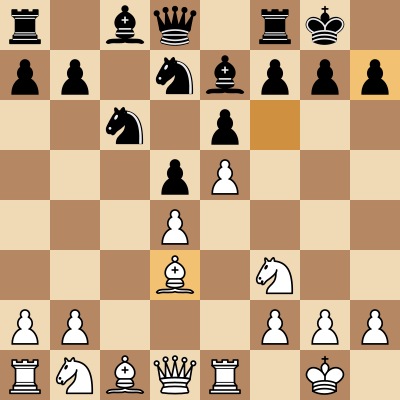
In this position, Black has castled kingside, but their defensive knight on f6 is missing (it is currently on d7). This is the ultimate trigger. Without a knight on f6 to defend h7, the Greek Gift is primed.
Step-by-Step: How the Sacrifice Unfolds
Let's walk through the forcing sequence move-by-move.
Step 1: The Sacrifice (1. Bxh7+)
White initiates the attack by capturing the h7 pawn with the bishop, delivering check.
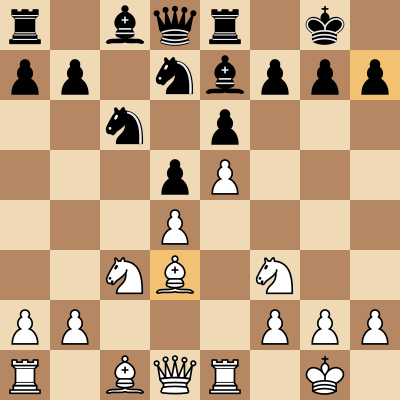
Black has no choice but to respond to the check. In almost all cases, Black must accept the sacrifice:
1... Kxh7 (Accepting the gift)
(Note: If Black plays 1... Kh8, refusing the sacrifice, they are simply down a pawn with a exposed king. White can retreat the bishop to d3 or b1 and enjoy a completely winning positional advantage.)
Step 2: The Knight Follow-up (2. Ng5+)
With the Black king drawn out to h7, White immediately follows up with:
2. Ng5+
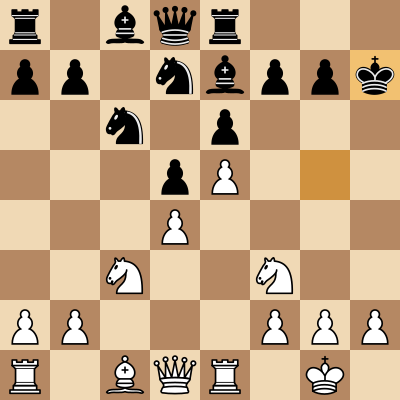
This check is highly forcing. The knight on g5 is defended by White's dark-squared bishop on c1 (or sometimes a queen on d1). Black's king must move.
Depending on where the Black king goes, White has different winning paths. Let's analyze the three main king retreats.
The Three King Retreats: How to Finish the Attack
Once White plays 2. Ng5+, Black's king has three realistic squares to retreat to: g8, g6, or h6. You must know how to win against each of them.
Case A: The King Retreats to g8 (2... Kg8)
This is the most common response. Black tries to run back to safety. However, this allows White's queen to enter the game with devastating effect:
3. Qh5
The queen threatens mate-in-one on h7 (4. Qxf7# or 4. Qh7#). Black is completely paralyzed because their f6 square is controlled by White's e5-pawn, meaning no knight can jump in to block the queen.
Black's only way to delay the mate is to clear an escape square for their king by moving their rook:
3... Re8 (trying to run via f8)
4. Qxf7+ Kh8
5. Qh5+ Kg8
6. Qh7+ Kf8
7. Qh8+ Ke7
8. Qxg7#
If Black tries to play 3... Bxg5 to eliminate the knight, White simply recaptures with the h-pawn: 4. hxg5. This opens up the h-file for White's rook, creating an unstoppable mating threat on h7 or h8.
Case B: The King Ventures Out to g6 (2... Kg6)
If Black's king steps forward to g6, they are trying to keep the extra material and defend the h7 square. However, this exposes the king to a brutal mating net in the middle of the board.
White's standard winning plan is to use the h-pawn to drive the king further out:
3. h4! (threatening h5+)
If Black plays passively, White will play 4. h5+ Kh6 5. Nxf7+ (a discovered check winning the queen) or deliver a direct mate.
For example, if Black plays 3... f5, White continues the chase:
4. h5+ Kf6
5. Qf3! (putting pressure on f5 and preparing to swing the queen into the attack)
With the king stranded on f6, Black's position will collapse within a few moves under the combined weight of White's active pieces.
Case C: The King Steps Sideways to h6 (2... Kh6)
This is the rarest and most desperate defense. Black's king steps to h6, directly challenging the knight on g5.
White wins this instantly with a discovered check:
3. Nxf7+
The knight jumps to f7, checking the king on h6 while simultaneously attacking Black's queen on d8. Because it is a double threat, Black must move their king, allowing White to capture the queen on the next move.
The Greek Gift Checklist: 4 Conditions for Success
Before you sacrifice your bishop on h7, you must verify that the tactical terrain supports the attack. If even one of these conditions is missing, the sacrifice will likely fail.
Run through this 4-point checklist on every single turn:
1. Is the f6 Square Controlled?
White must have a pawn on e5 (or another piece controlling f6). If Black can play ...Nf6 after your bishop sacrifice, their knight will defend h7, block your queen, and completely neutralize your attack.
2. Can the Knight on g5 be Safely Defended?
When you play 2. Ng5+, Black's king or bishop must not be able to capture your knight without consequences. Ensure your knight on g5 is defended by your dark-squared bishop on c1 or your queen on d1.
3. Can Black's Queen or Bishop Defend h5?
If you play 3. Qh5, can Black easily defend the h7 square? Watch out if Black has a bishop on the c2-h7 diagonal or a queen that can swing to f5 or g6 to guard the kingside.
4. Is your h-pawn ready to support?
If Black plays ...Bxg5, you must be able to recapture with hxg5 to open the h-file. If your h-pawn is still on h2, or if your rook on h1 is blocked, your attack might run out of steam.
Common Defensive Traps to Avoid
Even if the setup looks perfect, strong defenders have resources. Here are the two most common defensive traps you must calculate before pulling the trigger:
The "Quiet" King Escape
Sometimes, Black does not run to g8 or g6. Instead, they play 2... Kg8 3. Qh5 and then sacrifice their bishop on g5 to clear a path. If Black's light-squared bishop can capture your knight on g5, and you recapture with a pawn, Black might have enough defensive resources to run their king to the queenside via f8-e7-d8. Always calculate whether the king can successfully flee the board.
The Intervening Knight on d7
If Black has a knight on d7 (as shown in our starting diagram), they can sometimes use it to defend. If you play Bxh7+ too early, Black might play 1... Kxh7 2. Ng5+ Kg8 3. Qh5 Nf6!.
Wait—how did the knight get to f6?
If the e5-pawn was not firmly established, or if Black had a tactical resource to capture it, the knight on d7 can jump to f6 to save the day. Always make sure the e5-pawn is secure and cannot be captured or bypassed.
Summary: Master the Motif
The Greek Gift is not just a beautiful tactical trick; it is a fundamental pattern that every club player must master. By recognizing the alignment of the light-squared bishop, the f3-knight, and the d1-queen, you can turn a quiet positional game into a sudden, explosive victory.
Your Action Plan:
Memorize the classic setup: Bishop on d3/Bc4, Knight on f3, Queen on d1, Pawn on e5.
Scan your opponent's kingside: Is the f6 knight missing? Is h7 vulnerable?
Run through the 4-point checklist to ensure no defensive resources can spoil the sacrifice.
Practice the mating patterns against the three king retreats (g8, g6, and h6).
Once you train your tactical vision to spot this motif, your opponents will have to think twice before castling passively against your light-squared bishop. Use the DeepBlunder AI coach to review your games, analyze your tactical accuracy, and find the perfect moment to deliver your next Greek Gift.
From the same category
Keep reading

Is 99% Accuracy Cheating in Chess? How to Spot Real Engine Use
Is a 99% accuracy score in chess proof of cheating? Learn how chess platforms calculate accuracy, when humans can legitimately score 99%, and the real behavioral red flags that expose engine users.

Chess Openings for Beginners: How to Build Your First Solid Repertoire
Stop memorizing endless lines. Learn how to build a compact, rock-solid opening repertoire for White and Black using core chess principles.

Chess Strategy for Club Players: 5 Advanced Positional Concepts to Break Your Plateau
Stuck at a tactical plateau? Discover 5 advanced positional chess concepts—like the Principle of Two Weaknesses, pawn tension, and prophylaxis—to outplay your opponents strategically and raise your Elo.