How Many Types of Chess Opening Are There?
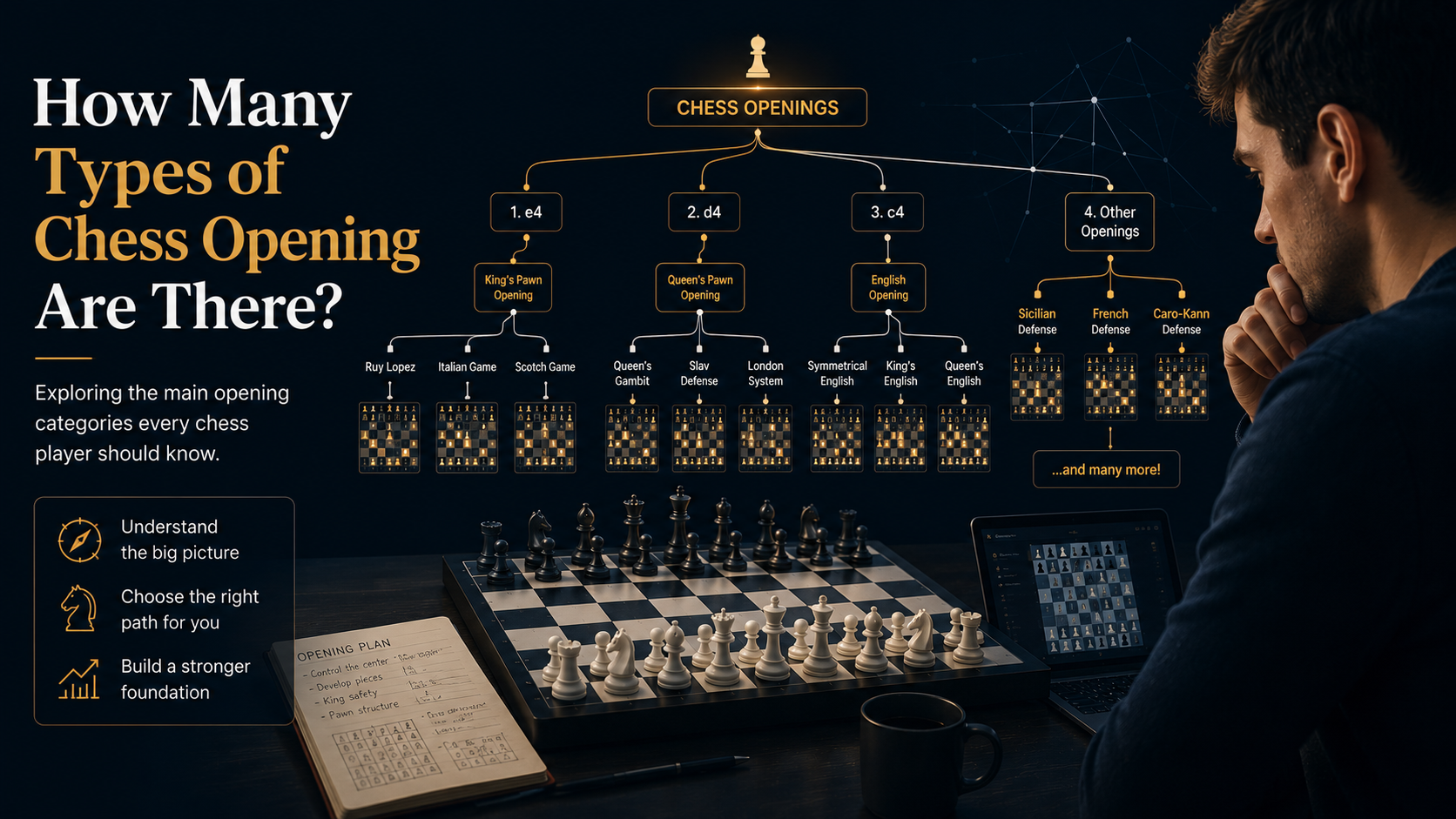
If you want the short answer first, here it is: there is no single official number of chess openings, because openings can be counted in different ways. You can count broad opening families, named openings, major systems, or the near-endless number of sub-variations that branch out after just a few moves.
That is why this question keeps showing up in search. Some players want a simple beginner answer. Others want the real theoretical answer. And a few are secretly asking a different question entirely: “How much opening theory is there, and do I really need to learn all of it?”
The good news is that you do not need a perfect number to understand the landscape. What matters is learning how chess openings are grouped, why some openings matter more than others, and how to study them without drowning in names, codes, and side lines.
DeepBlunder already has a strong cluster around practical chess confusion, from Is 70 Percent Accuracy Good in Chess? to Is 97% Accuracy Cheating in Chess?, What Chess Accuracy Is Suspicious?, What Is the Stupidest Rule in Chess?, What Is the Rarest Chess Rule?, and Why Is My Lichess Rating Higher Than Chess.com?, so an opening guide fits naturally into the same reader journey: turning chess confusion into usable understanding.
Why there is no single number
Openings can be counted in different ways
The first reason this topic is confusing is that “opening” can mean several different things.
A beginner may say there are only a handful of opening types:
Open games
Semi-open games
Closed games
Flank openings
Irregular openings
A club player may think in named openings:
Ruy Lopez
Sicilian Defense
French Defense
Queen’s Gambit
King’s Indian Defense
English Opening
A serious tournament player may think in systems and sub-variations:
Najdorf
Sveshnikov
Classical Sicilian
Berlin Defense
Marshall Attack
Catalan Open
Catalan Closed
Grünfeld Russian System
All three ways of counting are valid. They are just answering different versions of the same question.
So when someone asks, “How many types of chess opening are there?” the honest answer is:
At a broad beginner level, there are only a few major families.
At a named-opening level, there are dozens of important openings.
At a serious theory level, there are hundreds of major lines and effectively thousands of meaningful sub-variations.
That is why a clean one-number answer usually sounds wrong. Chess openings are not a short menu. They are more like a family tree.
The opening tree explodes quickly
Chess only starts with a few logical first moves, but from there the branches multiply fast.
One move from White creates options for Black. One reply from Black creates multiple systems for White. Then those systems split again. Before long, one opening name contains several major branches, and each branch contains several playable plans.
That is why “How many possible chess openings are there?” is both a simple question and a huge one. If you mean “how many recognized opening families do players study,” the answer is manageable. If you mean “how many possible opening move orders can occur in chess,” the answer is enormous.
And that difference matters for search intent. Most readers are not really asking for the total number of legal move sequences. They want to understand the structure of opening theory in a way that feels usable.
The main types of chess opening
1. Open games
Open games begin with:
1.e4 e51.e4 e5
This is the most classical family in chess. It leads to some of the oldest and most famous openings in the game, including:
Ruy Lopez
Italian Game
Scotch Game
Petrov Defense
Four Knights Game
Vienna Game
Open games are popular because they often create active piece play, quick development, and direct battles over the center. For beginners, they are also a useful way to learn basic opening principles: develop pieces, fight for the center, castle early, and avoid wasting time.
If your chess still suffers from early tactical damage, it often makes sense to combine simple open-game study with internal reads like How to Stop Hanging Pieces in Chess: A Complete Anti-Blunder Guide and Why Do I Miss One-Move Threats in Chess?, because many opening disasters are not theory problems at all but basic tactical-awareness problems.
2. Semi-open games
Semi-open games begin with:
1.e41.e4 and Black replies with something other than 1...e51...e5
This is where you find some of the richest and most heavily studied defenses in all of chess:
Sicilian Defense
French Defense
Caro-Kann Defense
Pirc Defense
Alekhine Defense
Scandinavian Defense
This family matters because it shows immediately why there is no small fixed number of openings. The Sicilian Defense alone contains a huge world of branches:
Najdorf
Dragon
Classical
Sveshnikov
Accelerated Dragon
Taimanov
Kan
So is the Sicilian one opening, or many openings?
Technically, it is both. It is one opening family and many major systems inside that family.
3. Closed games
Closed games usually begin with:
1.d4 d51.d4 d5
This family includes many strategically rich openings where pawn structure and long-term plans matter as much as early tactics. Major examples include:
Queen’s Gambit
Slav Defense
Semi-Slav
London System
Colle System
Torre Attack
Closed games often feel less explosive than open games, but they are not “quiet” in the lazy sense. They simply build tension differently. Many players who like structure, long plans, and positional play feel at home here.
If you follow elite chess coverage, you will also notice how often top events revolve around deep opening preparation in these d4 structures. That is one reason the tournament coverage on DeepBlunder, including FIDE Candidates 2026: players, storylines, and what matters, FIDE Candidates 2026 standings update April 14 2026, FIDE Candidates 2026 Round 10 Pairings, and FIDE Candidates 2026 Round 11 Preview, fits naturally beside opening content: high-level events constantly show how much openings shape the rest of the game.
4. Indian defenses and related d4 systems
A huge part of modern opening theory comes after:
1.d4 Nf61.d4 Nf6
From there, the position can enter:
King’s Indian Defense
Queen’s Indian Defense
Nimzo-Indian Defense
Grünfeld Defense
Bogo-Indian Defense
These openings are so important that many players think of them as their own world rather than as a small subcategory. They are among the clearest examples of why “types of openings” depends on how you divide the tree.
A beginner may lump them all under “closed d4 openings.” A stronger player knows those positions lead to very different middlegames.
5. Flank openings
Flank openings usually begin with a move other than 1.e41.e4 or 1.d41.d4, especially:
1.c41.c4 English Opening
1.Nf31.Nf3 Réti
1.b31.b3 Larsen Opening
1.g31.g3 King’s Fianchetto setups
1.f41.f4 Bird Opening
These openings are often used to avoid heavy mainstream theory or to reach flexible structures by transposition. They can be highly strategic and are often loved by players who prefer understanding over memorization, though of course strong theory still exists in many of them.
6. Irregular or uncommon openings
This is the category that attracts curiosity, memes, and a lot of beginner search traffic.
It includes unusual first moves such as:
1.a31.a3
1.h41.h4
1.Na31.Na3
1.f31.f3
Some of these are playable in casual settings. Some are clearly inferior in serious chess. Some are mostly known because they are provocative, funny, or used in online speed chess.
This category is where the search “What is the dumbest opening in chess?” usually lives.
So how many types of chess opening are there?
If you want a clean article answer, the best one is this:
There are about five to six major types of chess opening, depending on how you classify them:
Open games
Semi-open games
Closed games
Indian defenses
Flank openings
Irregular openings
That is the simplest high-level answer.
But if you mean named openings, the number is much larger. There are dozens of commonly studied openings and hundreds of named systems and variations. If you mean possible opening move orders, the number becomes effectively massive because every branch creates new branches.
Chess has a handful of major opening families, dozens of major named openings, and hundreds of important variations.
That sentence answers beginners, satisfies intermediate readers, and gives search engines a clear, quotable structure.
How many possible chess openings are there?
This is where the topic becomes more interesting.
If by “possible chess openings” you mean “how many legal opening move sequences can exist in chess,” the answer is extraordinarily large. Chess branches so fast that the number of legal move orders after only a few moves becomes huge. In that sense, there is no short final number that a practical article can give without becoming misleading.
But if you mean “how many real openings do chess players actually study,” then the answer is much more manageable:
A small number of first-move families
A few dozen major named openings
Several hundred serious lines worth recognizing
This is the difference between mathematical possibility and practical theory.
A useful analogy is language. The number of possible sentences in English is enormous, but the number of sentence patterns people use every day is manageable. Chess openings work the same way. The possible tree is giant, but practical opening study focuses on recognizable families and recurring systems.
How many chess openings are possible in practice?
In practical chess culture, openings are usually counted through naming conventions and classification systems rather than through raw combinatorics.
So a realistic practical answer is:
Around 20 to 30 major opening names that every club player should recognize
Many more important sub-variations inside those names
Far more possible move orders than any normal player will ever need to memorize
For example, even a “small” opening repertoire can contain:
one opening with White against 1...e51...e5
one line against the Sicilian
one line against the French
one line against the Caro-Kann
one line against 1.d41.d4
one line against flank systems
And that is already enough theory to keep an improving player busy for a long time.
This is one reason opening content performs well for traffic. Players are not only asking for counts. They are asking for permission not to learn everything.
What are the big 3 chess openings?
This phrase gets used in two slightly different ways, so a strong article should answer both.
Meaning 1: the big three first moves for White
Many players use “the big 3 chess openings” to mean the three biggest first-move families for White:
1.e41.e4
1.d41.d4
1.c41.c4
This is a useful practical definition because those moves have shaped a huge share of modern opening theory.
1.e41.e4 often leads to open games and semi-open games.
1.d41.d4 often leads to closed games and Indian defenses.
1.c41.c4 often leads to English structures and flexible transpositions.
If you are helping a beginner choose a style, this version of the “big three” is probably the most useful one.
Meaning 2: the big three classical opening families
Some coaches and articles use “the big 3” more broadly to mean:
Open games
Closed games
Flank openings
This is more of a teaching simplification than a strict theoretical rule, but it works well for beginners because it organizes the opening world by style rather than by move order.
Which definition should you use?
The big 3 chess openings usually mean 1.e41.e4, 1.d41.d4, and 1.c41.c4, though some beginner guides use the phrase more loosely for open, closed, and flank opening families.
That lets the article rank for the query without pretending there is one universal official phrasebook.
What is the dumbest opening in chess?
This query is fun, but it still deserves a careful answer.
There is no official “dumbest” opening in chess. Serious chess does not have a formal stupidity ranking. But in practical conversation, players usually mean one of two things:
an opening that is strategically bad
an opening that is mostly played as a joke or meme
That is why a few openings keep getting mentioned in this kind of discussion.
The usual suspects
Barnes Opening: 1.f31.f3
This move weakens the king, does little for development, and blocks the natural square for the knight. It is one of the first openings many players point to when they want an example of an objectively poor first move.
Bongcloud: 1.e4 e5 2.Ke21.e4 e5 2.Ke2
The Bongcloud is famous online precisely because it breaks so many opening principles on purpose. It moves the king early, interferes with castling, and often exists more as humor than as serious chess.
Grob: 1.g41.g4
The Grob is playable in the sense that it is legal and sometimes dangerous in surprise games, but it weakens White’s king and creates structural problems early. That makes it a common candidate in “worst opening” discussions.
Bird and other provocative flank tries
Some openings are not dumb at all but get mocked because they are unusual, offbeat, or easy to mishandle without understanding. That is an important distinction. Uncommon is not automatically bad.
The better answer
The better answer to the query is:
The dumbest opening in chess is not an official category, but joke openings like the Bongcloud and clearly weakening first moves like 1.f31.f3 are often treated as the strongest candidates because they violate basic opening principles early.
That gives the reader what they searched for while staying honest.
And because readers who enjoy weird-rule or weird-opening content often overlap, this section also links naturally with What Is the Stupidest Rule in Chess? and What Is the Rarest Chess Rule?.
How many openings do you actually need to learn?
Far fewer than you think.
This is where most opening articles either become useful or become noise.
A beginner does not need to learn:
every named opening
every sub-variation
every engine line
every trap on move eight
A beginner does need:
a plan with White
a reply to 1.e41.e4
a reply to 1.d41.d4
a basic idea against flank openings
understanding of opening principles
That is enough to start playing chess instead of memorizing a library.
A practical starting repertoire might look like:
White: Italian Game after 1.e41.e4
Black vs 1.e41.e4: Caro-Kann or 1...e51...e5
Black vs 1.d41.d4: Queen’s Gambit Declined or Slav-style setup
Basic flexible response vs flank openings
This is why the best opening advice is almost never “learn more lines.” It is “learn the ideas behind the lines.”
And if your games keep collapsing before middlegame plans even matter, the fastest gains often come from fixing tactical habits, not expanding theory. That is exactly why pages like How to Stop Hanging Pieces in Chess, Why Do I Miss One-Move Threats in Chess?, and How to Stop Losing Winning Positions in Chess should sit close to an openings article in your internal-link structure.
The real mistake players make with openings
The biggest opening mistake is not “not knowing enough names.”
It is confusing opening knowledge with opening skill.
A player can memorize twenty move orders and still:
hang a piece on move nine
miss a one-move threat
enter the middlegame with no plan
panic when the opponent deviates early
That is why opening study has to be tied to practical understanding.
The best opening questions are:
What squares am I fighting for?
Which pieces belong where?
What pawn structure am I aiming for?
What common tactical ideas exist in this line?
What middlegame plans usually follow?
Without those questions, opening study becomes trivia.
If you want to turn opening knowledge into practical results, use DeepBlunder to connect the opening to the mistakes that actually decide your games.
A good workflow is simple:
review where your opening left you with a problem
identify whether the issue was theory, structure, or tactics
train the recurring pattern instead of memorizing blindly
The strongest internal path from this article is:
Why opening articles drive traffic
Opening articles do well because they sit at the intersection of:
beginner curiosity
long-tail search behavior
practical chess improvement
identity and style questions
Players are not just searching for information. They are searching for orientation.
They want to know:
How big is the opening world?
Do I need to learn all of it?
Which opening fits my style?
Which opening should I avoid?
Which opening families matter most?
That is why this topic is strong for DeepBlunder. It complements the current cluster on accuracy, suspicious accuracy, rules confusion, rare rules, blunder control, and rating confusion by answering another classic beginner/improver question: how to organize the opening phase without getting lost.
FAQ
How many types of chess opening are there?
At a high level, there are about five to six major types of chess opening: open games, semi-open games, closed games, Indian defenses, flank openings, and irregular openings.
That is the clean beginner answer because it groups the opening world into broad families instead of drowning you in names.
At a deeper level, there are dozens of important named openings and hundreds of meaningful variations.
So the exact number depends on how you count them.
If you count practical families, the number is small.
If you count every major branch, it becomes very large.
How many possible chess openings are there?
If you mean all legal opening move sequences, the number is enormous and effectively far beyond what any practical player would count by hand in a normal learning context.
Every move creates multiple replies, and each reply creates further branching.
That means chess openings multiply very quickly.
If you mean practical openings that players actually study, the answer is much more manageable: a handful of major families, dozens of important named openings, and hundreds of real variations.
So the honest answer depends on whether you mean mathematical possibility or practical opening theory.
For most readers, the practical answer is the useful one.
How many chess openings are possible?
In theory, an enormous number of chess openings are possible because legal move orders branch very quickly from the first move onward.
In practice, though, players do not study “all possible openings.” They study recognizable opening families and the systems that matter for their level and style.
That is why practical chess culture talks in terms of names like Sicilian, French, Ruy Lopez, Queen’s Gambit, or English Opening.
A beginner only needs a small set of reliable opening ideas.
A tournament player may know many more branches, but even then the tree remains endless.
So possible openings are vast, while useful openings are a much smaller working set.
What are the big 3 chess openings?
Usually, the big 3 chess openings means White’s three biggest first moves: 1.e41.e4, 1.d41.d4, and 1.c41.c4.
Those moves anchor a huge amount of modern opening theory and lead to very different kinds of positions.
Some beginner guides use “big three” more loosely to mean open, closed, and flank opening families.
But for search intent, the most useful answer is 1.e41.e4, 1.d41.d4, and 1.c41.c4.
They are broad, influential, and central to opening study.
If you understand those three families, the opening world already starts to look much more manageable.
What is the dumbest opening in chess?
There is no official dumbest opening in chess, but joke or clearly weakening openings are usually what players mean by this question.
The Bongcloud and Barnes Opening are common examples because they break basic opening principles early, especially king safety and efficient development.
That said, “dumbest” is mostly a conversational label, not a chess term.
Some offbeat openings are risky but still playable if the user understands the ideas.
So the better answer is that the dumbest opening is usually an opening that weakens your position for no clear practical gain.
Funny openings may be entertaining, but they are not usually the best way to learn chess.
How many openings should a beginner learn?
A beginner should learn only a small number of openings at first.
One good White system, one dependable answer to 1.e41.e4, one answer to 1.d41.d4, and a basic plan against flank openings is usually enough.
That already gives you a stable foundation without drowning in theory.
The real goal is not memorizing names.
It is understanding development, center control, king safety, and recurring middlegame plans.
Once those ideas are strong, adding more openings becomes much easier.
Do I need to memorize every chess opening?
No, and trying to do that is one of the fastest ways to make chess feel heavier than it needs to be.
Even strong players do not “know everything.” They know the openings they play, the structures they face often, and the plans inside those positions.
A beginner gets much more value from learning principles and common tactical patterns than from memorizing deep sidelines.
If you know your setup, understand the purpose behind your moves, and avoid the biggest tactical mistakes, you are already ahead of many players at your level.
Opening knowledge should support your chess, not bury it.
That is the healthiest way to study.
Conclusions
So how many types of chess opening are there?
The best practical answer is that chess has about five to six major opening families, dozens of important named openings, and hundreds of serious variations. That is why there is no single official number that feels complete and beginner-friendly at the same time.
If someone asks how many possible chess openings there are, the honest answer is “far more than any player needs to memorize.” If someone asks what the big 3 chess openings are, the best answer is usually 1.e41.e4, 1.d41.d4, and 1.c41.c4. And if someone asks what the dumbest opening in chess is, the real point is not the name of the meme opening but the opening principles it breaks.
From the same category
Keep reading
Brilliant Chess Move: Stunning Bishop Sacrifice Led to Checkmate
Most chess players have experienced it at least once. You spot a free pawn, win some material, and feel confident about your position—only to discover that your opponent had seen something much deeper.

Why Your Chess Accuracy Drops After Move 15
If your chess accuracy drops after move 15, the problem is not that you suddenly become a worse player. The problem is that the game has shifted from memory to understanding, and you have not trained that transition enough.

Why You Always Get in Time Trouble (And How Stockfish 18 Fixes It)
Every chess player knows the feeling. You navigate the opening perfectly. You transition into a solid middlegame. You build a completely fine, perhaps even slightly superior, position. And then, you glance at the clock. Your opponent has 15 minutes left. You have 42 seconds. Panic!