Why Your Chess Accuracy Drops After Move 15

If you have ever finished a game thinking, “My opening was great, so why did everything fall apart ten moves later?” you are experiencing one of the most common rating leaks in chess.
Players constantly flood chess forums wondering why is my chess accuracy so low despite memorizing 15 moves of the Najdorf Sicilian. The harsh reality is that they survive the opening because they are borrowing confidence from Grandmaster theory. But the moment that theory ends—usually right around move 15—the game asks a different question: Do you actually understand the position, or were you just repeating moves?
In June 2026, as we watch elite players at the UzChess Cup in Tashkent transition seamlessly from opening prep into complex middlegames without breaking a sweat, club players are left wondering how to replicate that smoothness. The answer lies in the gap between how human brains handle uncertainty and how engines like Stockfish 18 evaluate transitions.
This ultimate guide will break down why your accuracy collapses after the opening, how to stop making emotional decisions when prep ends, and exactly what Stockfish sees that you are missing.
Why the Post-Opening Crash Happens
1. Opening Confidence is Borrowed Confidence
A lot of players feel smart in the opening because the moves come quickly. They know where the knight goes, they know the bishop belongs on g2, and they know to castle early. Everything feels controlled.
But this confidence is fake. The problem begins when players confuse opening fluency with chess fluency. They assume that because the first 12 moves felt smooth, the next phase will also feel smooth. Then the position changes shape. There is no more standard move order. The board asks for a concrete strategic plan, not a memory check.
That is when the inner panic begins. You will see this in your own games if you check the move timestamps. The opening flows, then suddenly there is a massive time drain. This is exactly why do I always get in time trouble in chess: you burn your clock because you are trying to invent a middlegame plan from scratch.
2. The Middlegame Punishes Vague Thinking
The opening forgives some vagueness because simple development is inherently useful. In many openings, just improving pieces and getting the king safe solves the most pressing problems.
The middlegame is much less forgiving. Once both sides are developed, every move has a highly specific job. A pawn move is not just “gaining space”—it might weaken key squares forever. A trade is not just "simplification"—it might improve the opponent’s king or fix your pawns on the wrong color.
This is why your accuracy can drop from 95% to 60% without you ever blundering a full piece. The collapse is positional before it becomes tactical.
3. Stockfish Does Not Get Emotionally Confused
Humans are deeply influenced by comfort, fear, and narrative. Stockfish 18 is not. You may play a move because it “looks active.” You may trade because you want to reduce tension. You may push a pawn because doing nothing feels frustrating.
The engine only asks one question: Does this move mathematically preserve the value of the position?
That gap matters. A human often wants the position to become clearer, leading them to ask why do I keep losing equal positions in chess. The engine does not care if the position feels pleasant. It only cares about structural integrity. DeepBlunder reveals that many post-opening mistakes are not tactical disasters; they are emotional decisions disguised as strategic choices.
The 7 Real Reasons Your Accuracy Drops After Move 15
1. Your Prep Ends, but Your Planning Never Starts
Many players think the moment opening theory ends, they should “find a good move.” That framing is already too narrow. After the opening, you usually do not need a single good move. You need a plan.
If you skip formulating a plan and start calculating random candidate moves, your accuracy will wobble immediately. The move may not be losing, but it lacks strategic direction.
2. You Trade the Wrong Piece
A lot of accuracy collapses come from trades that look reasonable in the moment. You exchange knights because it seems "clean." You swap queens because the position feels dangerous.
Then the engine points out that you traded your best defender or gave up the bishop pair for nothing. If you constantly wonder how to stop hanging pieces in chess, you must realize that bad trades leave your remaining pieces structurally vulnerable, making blunders inevitable 5 moves later.
3. You Push Pawns to Feel Productive
This is the most human mistake in chess. The position feels slow. You want to “do something.” So you push a wing pawn.
Pawn moves are emotionally satisfying because they look like progress. But engines are unforgiving with casual pawn pushes. A move that feels active to you may be the exact move that gives the opponent a permanent target.
4. You Stop Asking What Your Opponent Wants
A lot of post-opening collapses have nothing to do with your own plan; they come from neglecting your opponent’s. Players often become so focused on their own attack that they ignore a massive, building threat.
If you are constantly asking yourself why do I keep getting forked in chess or why do I miss one-move threats in chess, it is because you stopped scanning for the opponent's ideas the second your opening prep finished.
5. You Miss the "Zwischenzug" in Complex Transitions
As the board opens up, the geometry becomes highly tactical. When making a standard recapture or responding to a threat, amateurs play the first forcing move they see. They fail to look for the "in-between move." This is precisely why do you keep missing zwischenzugs in chess. You assumed the transition was forced, but the engine sees a devastating intermediate check that completely shifts the evaluation.
6. You Play Worse When You Are Winning
Strangely, many players play their best chess to build an advantage, and then their accuracy plummets. They get a +3.0 advantage out of the opening and suddenly freeze. They ask why do I play worse when I'm winning in chess. The answer is psychological: they shift from playing to win, to playing not to lose. They make passive, overly defensive moves that bleed their centipawn advantage dry. If you want to know how to stop losing winning positions in chess, you must maintain the same aggressive accuracy that got you the advantage in the first place.
7. The Post-Brilliancy Hangover
Sometimes, you find a spectacular move 14 to close out the opening. You feel like a genius. But then, on move 15, you play a terrible blunder. Players search our blog asking why do I blunder right after finding a good move in chess. It is an adrenaline crash. You relax, assuming the game is won, and your tactical awareness shuts off.
🔥 STOP GUESSING WHY YOU LOST! 🔥Are you tired of playing 95% accuracy in the opening only to drop to 40% in the middlegame? Stop relying on generic chess advice. Find out exactly what Stockfish 18 sees in your games.
👉 Analyze your games on the DeepBlunder platform today!
What Stockfish Sees That You Don't
Imbalances Before Threats
Engines notice the important feature of the position long before the tactical consequence appears. You may look at a board and see equal material and no hanging pieces. Stockfish may already see that your backward pawn is hard to defend, your bishop has no future, and your king will become weak after one exchange.
That is why the evaluation bar sometimes drifts against you even when the game “looks normal.” The engine is simply measuring structural pressure more accurately than the human eye.
Flexibility Over Premature Action
Humans love clear plans. Engines love flexible positions. A human often makes an early commitment (like pushing a central pawn) because clarity feels comforting. The engine prefers keeping multiple plans alive until a concrete reason appears to commit. When you commit too early, your accuracy drops.
A Practical Method to Fix the Move-15 Collapse
If you want to fix this leak, you need a system. Reading articles on the DeepBlunder blog is great, but applying the knowledge is what raises your rating.
Step 1: Audit the First Evaluation Drift
Do not start your game review by looking at the move where you lost your Queen. Look at the move where the evaluation went from +0.5 to -0.8. That was the moment your opening ended and your misunderstanding began.
Step 2: Name the Illusion
When you find that drifting move, ask yourself why you played it. Was it "I needed to do something active"? Was it "I wanted to simplify"? Name the illusion. Once you name it, you can fix it.
Step 3: Learn Structures, Not Just Lines
The biggest upgrade you can make is shifting your study time from memorizing moves to understanding structures. For every opening you play, know the typical pawn breaks, the worst minor piece, and the favorable endgame transitions.
Conclusion
If your chess accuracy drops after move 15, the problem is not that you suddenly become a worse player. The problem is that the game has shifted from memory to understanding, and you have not trained that transition enough.
You do not need mystical improvement. You need a better bridge between the opening and the middlegame. Recognize when preparation ends, ask better positional questions, stop making emotional pawn moves, and review the first drift in evaluation instead of only the final tactical disaster.
By fixing this single leak, a lot of other problems start shrinking too. Your time management improves, your blunders decrease, and your good openings start turning into genuinely won games.
FAQ
Why does my chess accuracy drop after move 15?Because that is often the point where memorized opening theory ends and real decision-making begins. If you understand lines but not structures, your move quality will fall.
Why do I play well in the opening and badly in the middlegame?Openings reward pattern memory and general development principles. Middlegames demand concrete plans, structural understanding, and precise trade decisions.
How do I know when my preparation has ended?Usually, when there is no obvious “book move” left and the position starts offering several sensible plans. That is your cue to slow down.
Why do equal positions still feel hard?Equality does not mean simplicity. Many equal positions are rich in strategic detail. If you misunderstand the structure, the game can drift against you without a tactical blunder.
Are my problems tactical or positional?Usually both, but sequentially. The first error is often positional (misunderstanding the structure on move 15), and the later punishment is tactical (getting forked on move 20).
From the same category
Keep reading
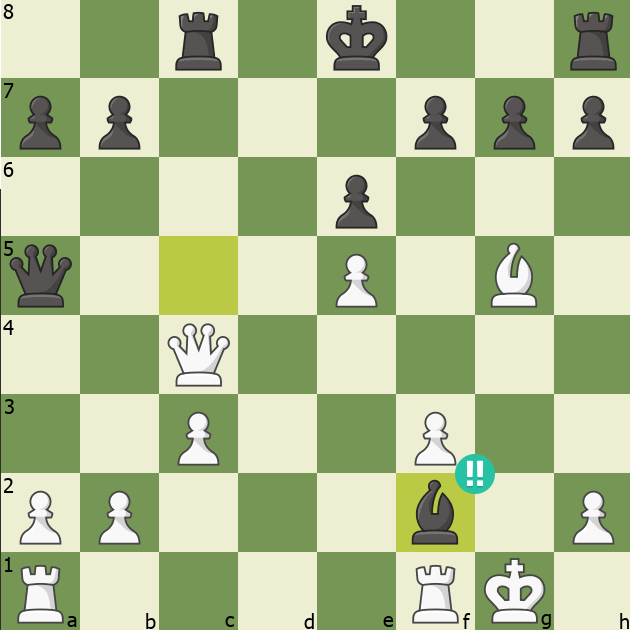
Brilliant Chess Move: Stunning Bishop Sacrifice Led to Checkmate
Most chess players have experienced it at least once. You spot a free pawn, win some material, and feel confident about your position—only to discover that your opponent had seen something much deeper.
Why You Always Get in Time Trouble (And How Stockfish 18 Fixes It)
Every chess player knows the feeling. You navigate the opening perfectly. You transition into a solid middlegame. You build a completely fine, perhaps even slightly superior, position. And then, you glance at the clock. Your opponent has 15 minutes left. You have 42 seconds. Panic!
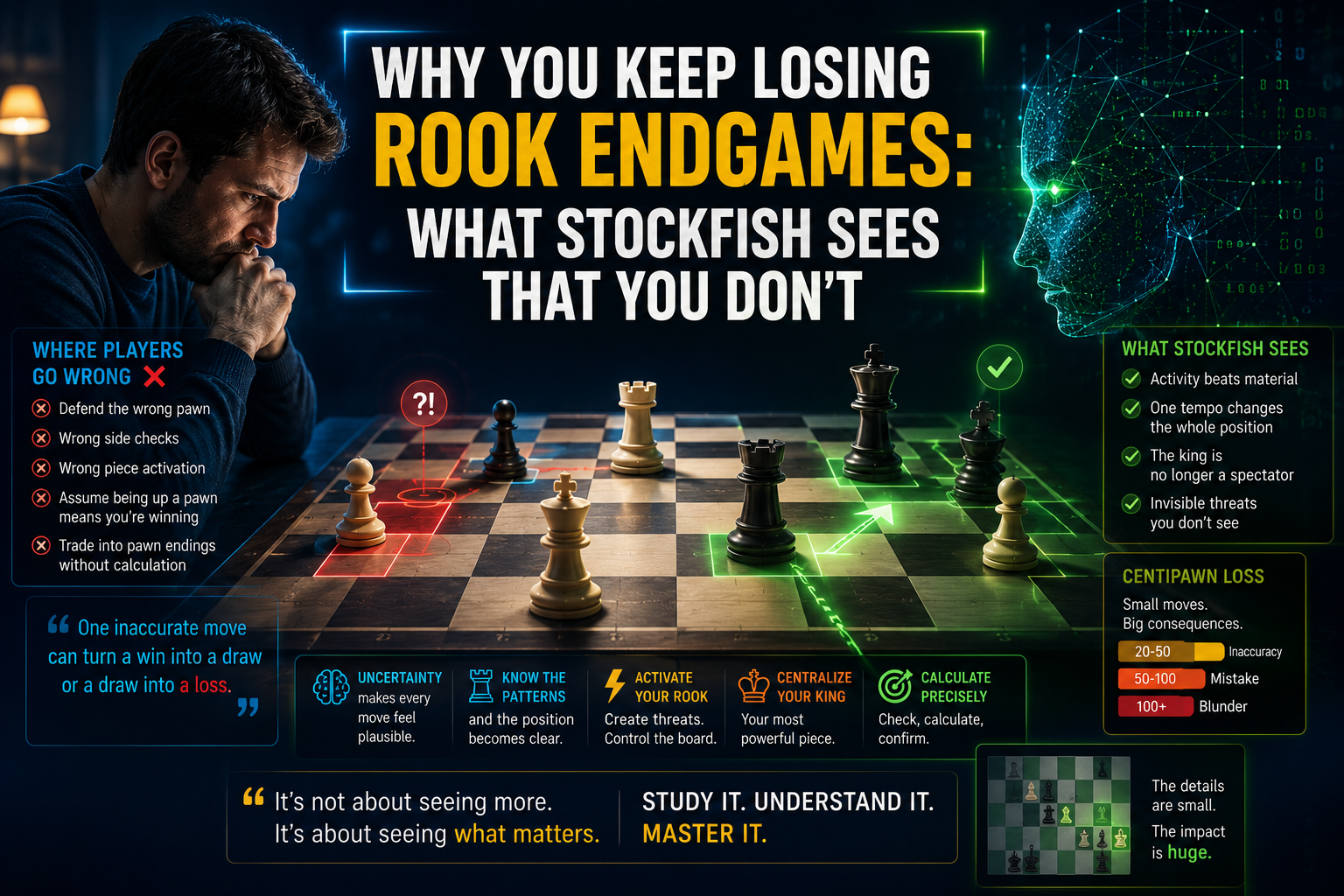
Why You Keep Losing Rook Endgames: What Stockfish Sees That You Don’t
If you keep losing rook endgames, the issue is usually not talent. It is pattern recognition. Once you learn to see what Stockfish sees, your endgames stop feeling random.