Is 70% Accuracy Good in Chess? Elo Guide

Is 70% Accuracy Good in Chess? What It Means by Elo
Yes — 70% accuracy can be good in chess, especially for beginner and intermediate players. But it depends heavily on your rating, the game length, how sharp the position was, and whether your mistakes were one-off slips or repeated patterns.
For an 800-rated player, 70% can be a solid game. For a 1600-rated player, 70% might mean you missed one or two important tactical moments. For a titled player, 70% usually means something went badly wrong.
The better question is not “is 70% good?” It is: which mistake made my accuracy drop, and do I keep making it?
70% chess accuracy by rating
Use this as a rough practical guide, not a law. Accuracy is affected by opponent strength, opening familiarity, time pressure, and how forcing the game was.
Rating range: 0–800 — How 70% usually looks: Often a decent game with some missed tactics — What to check: Hanging pieces, one-move threats, basic mates
Rating range: 800–1200 — How 70% usually looks: Playable, but likely with one major blunder — What to check: Forks, pins, undefended pieces, king safety
Rating range: 1200–1500 — How 70% usually looks: Mixed: good ideas plus a tactical miss — What to check: Calculation depth and move-order mistakes
Rating range: 1500–1800 — How 70% usually looks: Usually below your best level — What to check: Critical moments, conversion, endgame technique
Rating range: 1800–1900+ — How 70% usually looks: Often a warning sign — What to check: Tactical oversight or strategic misjudgment
So if you are around 1000 Elo and scored 70%, do not panic. If you are 1700 and keep scoring 70%, that is useful information: your games probably contain recurring critical mistakes.
Why 70% accuracy can be misleading
A single accuracy number hides too much context.
You can score 70% because you played a wild tactical game where both sides had difficult choices. You can also score 70% because you hung a queen on move 12 and played fine afterward. Those are not the same problem.
Accuracy also changes based on:
Game length: short games can inflate or deflate accuracy quickly.
Opening traps: one bad prepared line can ruin the score.
Forced positions: obvious recaptures often boost accuracy.
Opponent mistakes: if your opponent blunders first, your moves may become easier.
Time pressure: many 70% games are really clock-management problems.
That is why chasing a higher percentage is less useful than finding the repeated cause.
Is 70% accuracy good for beginners?
For beginners, yes — 70% is usually a healthy sign if the game did not include a huge one-move blunder.
At beginner level, the main goal is not to play engine-perfect chess. It is to stop losing games to the same simple patterns:
leaving pieces undefended
missing checks and captures
ignoring opponent threats
moving the same piece too often in the opening
attacking before the king is safe
If your accuracy is around 70%, your next improvement probably comes from reducing blunders, not memorizing deeper opening theory.
Is 70% accuracy good for intermediate players?
For intermediate players, 70% is more of a diagnostic signal.
If you are 1200–1500, a 70% game often means you understood parts of the position but failed at one key moment. That moment might be a missed tactic, a bad trade, or an endgame conversion error.
This is where engine-only analysis can be frustrating. The engine tells you the best move, but not always the human reason you missed it.
Ask:
Was the bad move tactical or strategic?
Did I miss my opponent’s threat?
Was I trying to win material too early?
Did I calculate only my own forcing line?
Have I made this type of mistake before?
That last question is the money question.
The real lesson: find the recurring mistake
A 70% game is not automatically good or bad. It is a clue.
If DeepBlunder analyzes five of your recent games and the same pattern appears three times — for example, missed back-rank tactics, loose pieces after queen trades, or opening moves that weaken your king — that is more useful than knowing one game was “70%.”
The goal is not to become a player who always scores 90% accuracy. The goal is to become a player who stops losing the same way twice.
What to do after a 70% accuracy game
Do this instead of staring at the number:
Find the biggest evaluation swing. That is usually the move that changed the game.
Write the mistake in human language. Not “Stockfish says Qf3.” Say “I moved my defender away from the back rank.”
Check whether it happened before. One blunder is noise. A repeated blunder is a training plan.
Create one rule for your next games. Example: “Before attacking, check if my queen is defending a loose piece.”
Review similar positions. Pattern recognition beats memorizing engine lines.
FAQ
Is 80% accuracy good in chess?
Usually, yes. For many club players, 80% is a strong game. But an easy winning position can produce 80% without much difficulty, while a sharp tactical battle can make 80% very impressive.
Is 90% accuracy good in chess?
Yes, but context matters. A short game with many forced moves can produce 90% accuracy without meaning you played like a master.
Is 70% accuracy suspicious?
No. 70% accuracy is not suspicious. It is common at beginner and intermediate levels and usually means the game contained normal human mistakes.
Can you win with 70% accuracy?
Absolutely. You can win with 70% if your opponent made larger mistakes, if you converted the key position, or if your inaccuracies happened after the game was already decided.
Why did I lose with 70% accuracy?
Because chess games are often decided by one or two critical mistakes. You can play many reasonable moves and still lose if the one bad move hangs material, allows mate, or ruins an endgame.
Bottom line
70% accuracy is not a verdict. It is a starting point.
If you are a beginner, it may be perfectly fine. If you are intermediate, it probably points to a specific recurring weakness. Either way, the useful move is the same: analyze the game, find the mistake pattern, and fix that pattern before your next session.
Want the useful version of engine analysis? Paste your PGN or import a Chess.com game into DeepBlunder and find the mistake that actually cost you the game — in plain English.
Where to go next
For the full improvement path behind accuracy scores, use the Chess Improvement Hub.
From the same category
Keep reading
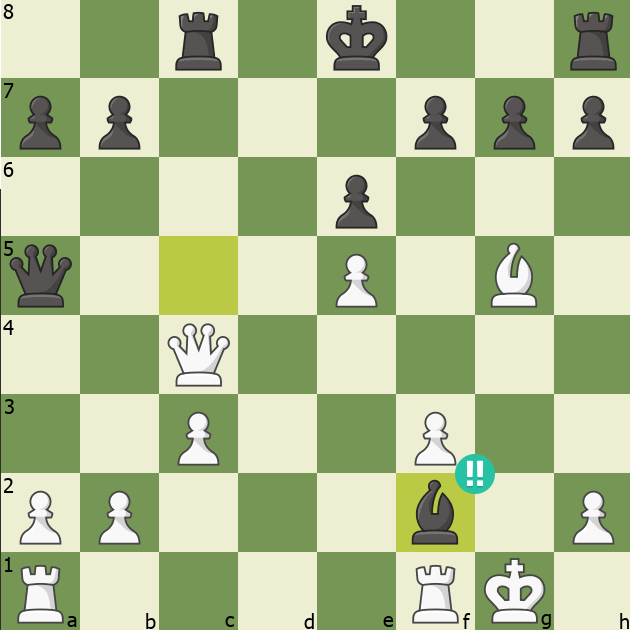
Brilliant Chess Move: Stunning Bishop Sacrifice Led to Checkmate
Most chess players have experienced it at least once. You spot a free pawn, win some material, and feel confident about your position—only to discover that your opponent had seen something much deeper.

Why Your Chess Accuracy Drops After Move 15
If your chess accuracy drops after move 15, the problem is not that you suddenly become a worse player. The problem is that the game has shifted from memory to understanding, and you have not trained that transition enough.
Why You Always Get in Time Trouble (And How Stockfish 18 Fixes It)
Every chess player knows the feeling. You navigate the opening perfectly. You transition into a solid middlegame. You build a completely fine, perhaps even slightly superior, position. And then, you glance at the clock. Your opponent has 15 minutes left. You have 42 seconds. Panic!