What Is the Rarest Chess Rule?
If you ask most chess players what the rarest chess rule is, the most common answer is en passant. It is legal, official, and old, yet many club players go months without seeing it in a serious game, and plenty of beginners meet it for the first time by assuming the move must be a bug or a cheat.
That makes en passant the perfect answer to the question, but it also hides a more interesting truth. The rarest chess rule is not just the rule people forget. It is the rule that combines strict timing, unusual board geometry, low practical frequency, and a level of confusion that survives even after players already know the basics.
So the short answer is simple: the rarest chess rule is usually en passant. The fuller answer is better: en passant is the least common mainstream rule most players actually need to know, while other unusual rules like the fifty-move rule or underpromotion are either rarer in practice as events or belong to different categories of chess oddities.
Why en passant is usually called the rarest chess rule
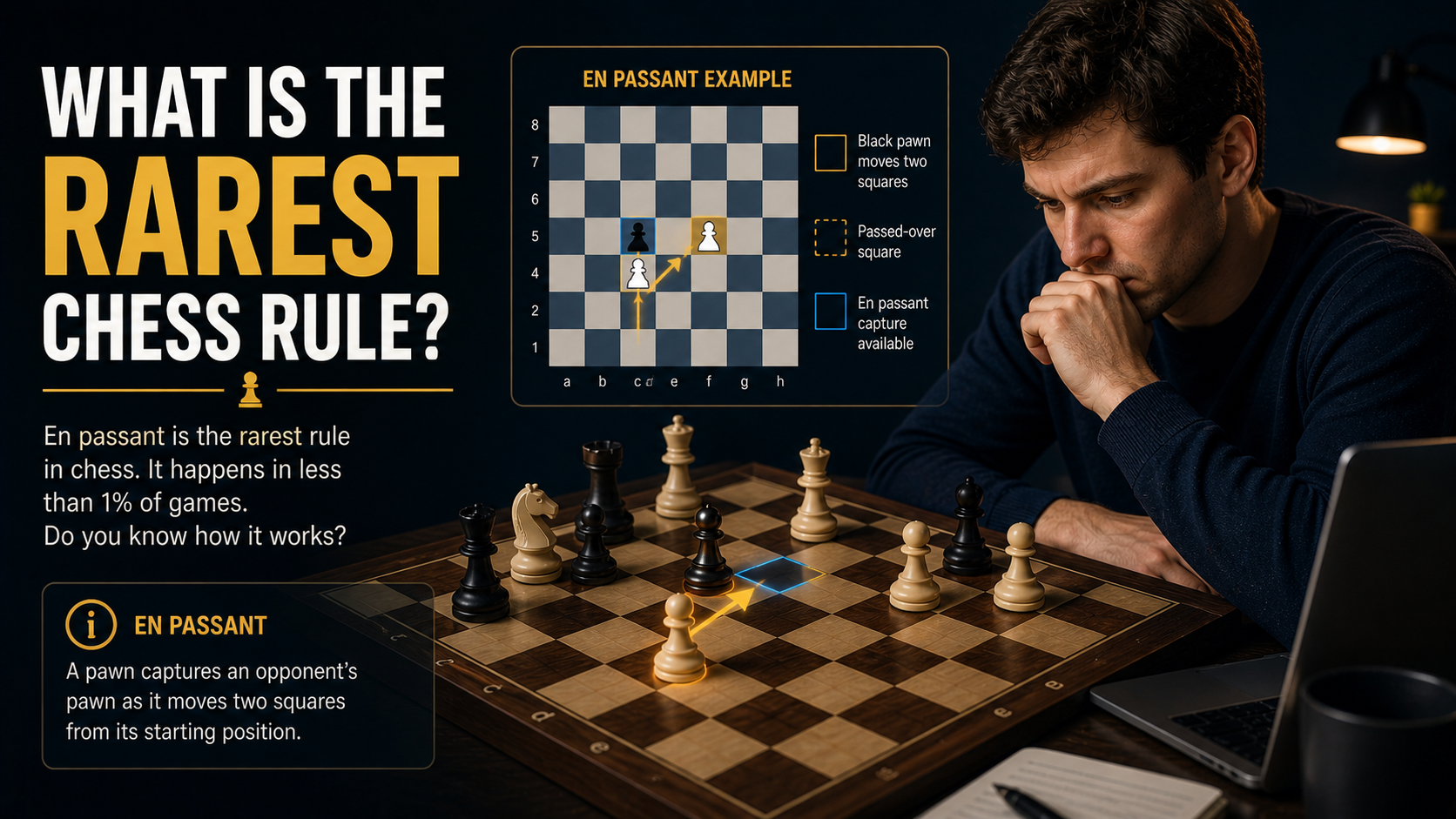
En passant is a special pawn capture that becomes legal only in one narrow situation: an enemy pawn moves two squares from its starting square, lands next to your pawn, and your pawn captures it as if it had moved only one square. The move is legal only on the very next move.
That last detail is the reason the rule feels so rare. It is not enough for the pawns to stand next to each other. It is not enough for the capture to make sense strategically. The entire opportunity exists for one move and then disappears forever.
FIDE’s Laws of Chess define the rule directly in Article 3.7.d, which says that a pawn attacking a square crossed by an opponent’s pawn that advanced two squares from its original square may capture it as though the pawn had moved only one square, and that this capture is only legal on the move immediately following the advance.
That immediacy is what makes en passant feel mysterious even after someone explains it correctly. Most chess rules stay true after you learn them once. En passant is one of the few rules where the move can be legal now and illegal one move later without anything else changing on the board except timing.
If you have already read What Is the Stupidest Rule in Chess?, this will sound familiar. Stalemate frustrates players because the result feels unintuitive. En passant fascinates players because the legality feels temporary, precise, and slightly unreal until you understand why the rule exists.
What en passant actually means
The phrase “en passant” is French for “in passing,” and that translation explains the whole rule surprisingly well. The capturing pawn does not take the enemy pawn on the square where it landed; it captures the pawn as it passes through the square it skipped over with the two-square advance.
That is why the move looks illegal to so many new players. Visually, it seems as if the capturing pawn moved diagonally to an empty square. In reality, it is capturing the pawn that just passed beside it, exactly as the rules allow.
Chess.com’s help explanation says en passant is not a bug or a hack but a legal pawn move that has been part of chess for centuries. That sentence matters because the modern experience of learning chess often happens online, where a strange-looking move is easy to mistake for a glitch if you do not already know the rule.
This is also why en passant keeps generating search traffic. It is rare enough to surprise people, specific enough to create confusion, and visual enough to produce immediate emotional reactions. Someone sees it once, gets shocked, and instantly searches whether it is real.
Why the rule exists at all
En passant was created to stop a pawn from using the two-square advance to slip past an enemy pawn without giving that pawn the usual chance to interact. Public explanations of the rule consistently frame it as a correction introduced alongside the two-square pawn move so that pawns could not simply dodge contact by jumping past tension.
Without en passant, a pawn on its starting square could leap two squares and effectively bypass a neighboring enemy pawn that would normally control the intermediate square. That would create a strange loophole in pawn play and distort how central tension works.
Once you see the rule that way, en passant stops feeling random. It becomes an elegant patch for a very specific structural problem in chess. The move exists not to make the game weirder, but to keep pawn logic more consistent.
This is one reason rules articles do well when they go beyond “what” and explain “why.” The rule feels memorable once players understand the reason behind it. That is also the same educational pattern behind pieces like Why Do I Miss One-Move Threats in Chess? and How to Stop Hanging Pieces in Chess: A Complete Anti-Blunder Guide, where the key improvement comes from understanding the logic under the mistake rather than memorizing a surface rule.
Why en passant feels rarer than other chess rules
It requires a very specific structure
En passant cannot happen unless both sides have pawns in exactly the right relationship. One pawn must already be advanced to the correct rank, and the opposing pawn must then make a two-square move from its starting square to land beside it.
That already removes most positions from consideration. Unlike castling, check, promotion, or ordinary captures, en passant is not a rule that can arise in almost any type of game. It needs a pawn structure prepared for it.
It exists for one move only
This is the single most important reason the rule feels rare. A normal tactical idea may survive on the board for several moves. En passant is a disappearing opportunity. If you do not take it immediately, it no longer exists.
That makes it feel more like a trapdoor than a standard move. Even players who know the rule often miss it because they are thinking about something else and forget that the window closes instantly.
It is not needed in every game
Many chess rules appear so often that they stop feeling like rules at all. Players castle almost automatically. They check and capture constantly. They promote often enough to remember it clearly. En passant is different because a player can go many games without seeing a legal chance to use it.
That practical absence is what gives the rule its reputation. The rarest chess rule is not necessarily the hardest rule. It is often the one that players have to remember in a moment they barely ever meet.
It looks illegal when it happens
The visual weirdness of en passant gives it a second life. Many rare events in chess happen quietly. En passant looks controversial the moment it appears because a pawn seems to capture onto an empty square.
That makes it more memorable than other obscure rules and also more searchable. It is rare on the board and loud in the mind.
The strongest alternative: the fifty-move rule
If en passant is the rarest “special move” rule in common conversation, the fifty-move rule is one of the strongest rivals when talking about rare official rule applications. FIDE says a game may be drawn if each player has made the last 50 consecutive moves without a pawn move or a capture, and modern rules also recognize a mandatory draw after 75 such moves if checkmate has not intervened.
This rule feels rare for a different reason. It does not look strange on the board in one flash the way en passant does. Instead, it emerges slowly, usually in long technical endings, and often matters only when both players or an arbiter are fully aware of the count.
That makes it less visible to casual players but still genuinely unusual in practical play. A beginner can play hundreds of games and never see a live fifty-move claim, while still hearing about en passant in a tutorial or seeing it once in blitz.
So if you are asking which rare chess rule has the strongest “I can’t believe that is legal” effect, en passant wins. If you are asking which official rule many amateurs almost never experience directly in serious games, the fifty-move rule has a real case.
Why en passant wins the article anyway
The reason en passant is the better anchor for this topic is not just frequency. It is also search intent. Most people who type “rarest chess rule” are not secretly looking for a detailed article on draw-claim procedure. They want the weird one. They want the move that sounds fake, looks illegal, and gets passed around online as chess trivia.
En passant satisfies all of that. It is rare enough to be memorable, simple enough to explain, and strange enough to spark emotion. It also connects naturally to broader beginner-rule confusion, which fits well with the current DeepBlunder cluster around practical mistakes, misunderstood positions, and post-game learning.
That is exactly why this topic sits so nicely beside What Is the Stupidest Rule in Chess?. Stalemate is the rule players complain about; en passant is the rule they stare at in disbelief. One feels unfair. The other feels impossible until someone explains it properly.
How en passant works, step by step
To make en passant fully clear, it helps to slow the move down.
Your pawn is already advanced to a square where it attacks one of the squares an enemy pawn would cross if it moved two squares.
Your opponent moves a pawn two squares from its starting rank, and that pawn lands beside your pawn.
On your very next move only, your pawn may capture that pawn as if it had advanced only one square.
If you do not capture immediately, the right disappears.
That final step is where most errors happen. Players remember that en passant exists but forget that it is temporary. Then one move later they try it and discover it is no longer legal.
The rule is narrow, but once you understand the timing, it becomes perfectly logical. The move is not a bonus. It is a one-time answer to a two-square pawn jump.
Why beginners think en passant is illegal
The main reason is visual mismatch. Players are taught early that pawns capture diagonally onto occupied squares. En passant seems to violate that because the capturing pawn lands on a square that looked empty before the move.
The second reason is timing. Most chess rules do not expire immediately. A hanging piece is hanging until it moves or gets defended. A weak square stays weak. En passant is unusual because legality is tied to the most recent move in a very strict way.
The third reason is rarity itself. Because the opportunity does not appear constantly, many players never get enough repetition to make the rule feel normal. They understand it abstractly and still freeze when it appears over the board.
This is why the rule keeps surprising people who are otherwise perfectly competent players. The problem is not intelligence. It is exposure. Rare rules feel less “real” until they happen directly in your own game.
That same dynamic appears in many practical errors. Players often know something in theory and still miss it in reality. The pattern is similar to the one described in Why Do I Miss One-Move Threats in Chess?, where the issue is not always knowledge but live-board awareness under pressure.
Is en passant the rarest chess move too?
Often people mix “rarest chess rule” with “rarest chess move,” but the two are not exactly the same. En passant is a rule that creates a special move. Underpromotion to a bishop or rook, by contrast, may be rarer as a move event in practical play, but it is not usually discussed as a separate rule in the same way.
That distinction helps keep the article clean:
Rarest chess rule: en passant is the best general answer.
Rarest special move: en passant is still a strong answer in mainstream conversation.
Rarest move outcome: some underpromotions may be rarer than en passant in raw practical frequency.
For publication purposes, it is better not to muddy the headline by trying to collapse every version of rarity into one claim. The clean answer remains en passant, with a quick acknowledgment that move rarity and rule rarity are not identical.
How often does en passant really happen?
Public beginner explanations consistently describe en passant as rare, but they usually do not attach a universal official percentage to it. That is sensible, because practical frequency depends heavily on player level, opening choices, time control, and whether players notice the chance when it appears.
In amateur games, the move is rare enough that many players remember their first one. In faster time controls, it may appear slightly more often because pawns fly forward carelessly, though it may also be missed more often for the same reason.
At stronger levels, en passant is not mysterious, but it is still uncommon because the exact structure has to arise. That is why the rule remains memorable across ratings. It is not a beginner-only oddity. It is a genuine special case in the game.
The hidden strategic importance of en passant
En passant is rare, but it is not trivial. Because it changes pawn structure immediately, it can affect open files, central tension, king safety, and even tactical lines in sharp middlegames.
That means the move is not just a curiosity to memorize. It is a real part of practical chess. Missing an en passant capture can mean missing a strong structural break, while forgetting that your opponent has it can mean blundering a whole plan.
This is one more reason the rule matters for improving players. A rare rule still matters if the cost of forgetting it is high. The same principle shows up all over chess improvement. You may not face a given pattern often, but when it appears, the game expects you to know it.
That is also why rules content belongs naturally alongside training content. A player who wants fewer stupid losses should care about en passant for exactly the same reason they care about How to Stop Hanging Pieces in Chess: A Complete Anti-Blunder Guide: rare oversights still lose real games.
En passant and repetition rules
One of the most interesting places en passant appears in the official rulebook is in repetition logic. FIDE says positions are not considered the same for threefold repetition if a pawn that could have been captured en passant can no longer be captured that way.
That detail shows how deeply the rule is built into chess law. En passant is not just a cute special move sitting on the edge of the game. It affects whether positions are legally identical under draw-claim rules.
This is a great example of why the rule deserves more respect than it gets. Casual players think of en passant as an obscure exception. The rulebook treats it as part of the core legal identity of the position.
And that is exactly the kind of thing good rules articles can teach. The rarest chess rule is not just trivia. It is a window into how carefully chess handles timing, possibility, and board state.
The beginner trap: forgetting the move exists
One reason en passant remains so searchable is that it is easy to forget even after learning it. The opportunity appears rarely, the timing is immediate, and the board does not visually scream for attention the way a direct check does.
This leads to two classic mistakes:
Forgetting that you can capture en passant.
Forgetting that your opponent can capture en passant.
The second mistake is especially painful because it often feels unfair in the moment, even though the move is fully legal. A player pushes a pawn two squares, feels safe, and then loses the pawn anyway. That feeling of “I thought that was protected by the jump” is exactly why the rule survives in chess lore.
This is also why players who struggle with board awareness should treat rare-rule blindness as part of the same practical weakness that causes missed threats and loose pieces. Articles like Why Do I Miss One-Move Threats in Chess? and How to Stop Losing Winning Positions in Chess are relevant here because they attack the same core problem: failing to see what the position really allows.
Other rare chess rules worth mentioning
The fifty-move rule
As noted above, the fifty-move rule is one of the least commonly experienced official rules in ordinary amateur play. FIDE allows a draw claim after 50 consecutive moves by each player without a pawn move or a capture, and also recognizes a mandatory draw after 75 such moves if checkmate has not occurred.
This rule is not as famous as en passant because it is less theatrical. It does not shock players visually. It matters quietly, often in long endings, usually when both sides are already exhausted.
Threefold repetition claims
Threefold repetition is well known in principle, but the exact legal requirements are stricter than many casual players realize. FIDE says the same position must arise with the same player to move and the same possible moves available, which is why details like en passant rights and castling rights matter.
This makes repetition rules less “rare” as concepts but relatively rare as correctly understood legal claims in amateur over-the-board practice.
Dead position
FIDE also defines a drawn game when neither player can possibly checkmate the opponent by any series of legal moves. This is called a dead position.
It is an official and important rule, but it usually feels less rare because many common cases, like king versus king, are instantly recognizable to players.
Compared with all of these, en passant still wins the headline because it combines rarity, visibility, confusion, and search appeal better than any other single rule.
If rare rules, hidden tactics, and weird board states keep costing you points, DeepBlunder is built for exactly that kind of post-game clarity. Review the move where the position changed, identify the rule or tactical idea you missed, and turn one strange loss into a pattern you will never miss again.
A good place to continue after this article is How to Stop Hanging Pieces in Chess: A Complete Anti-Blunder Guide, then Why Do I Miss One-Move Threats in Chess?, and then How to Stop Losing Winning Positions in Chess. Those three pieces connect naturally with the same practical goal: fewer avoidable points thrown away.
FAQ
What is the rarest chess rule?
For most players, the rarest chess rule is en passant. It is a special pawn capture that can happen only in a very narrow situation and only on the move immediately after an enemy pawn advances two squares from its starting square.
That combination of structure and timing makes it feel much rarer than castling, promotion, or normal captures.
It is also one of the most misunderstood legal moves in chess, especially online, where players often assume it must be a bug the first time they see it.
Other rules, like the fifty-move rule, may also be rare in practical tournament application, but en passant is the clearest answer to the question most readers actually mean.
It is rare, real, and memorable for exactly the same reason: it looks strange and disappears if you miss the chance.
That is why it remains the best headline answer.
Why is en passant considered so rare?
En passant is considered rare because several conditions must line up at the same time. Your pawn must already be in the correct place, the enemy pawn must make a two-square move from its starting square, and the pawns must end up beside each other.
Even then, the move is legal only on your next move, not later.
That means the opportunity is both structurally uncommon and temporally fragile.
Many players also forget the rule when the moment finally appears, which makes the move feel even rarer in real games.
So its rarity comes not only from board structure but also from the one-move-only timing window.
That is what makes it different from almost every other normal tactical idea in chess.
Is en passant really legal in chess?
Yes, en passant is fully legal and part of the official rules of chess. Chess.com’s help material explicitly says it is not a bug or illegal pawn move, and FIDE’s Laws of Chess define it in Article 3.7.d.
The rule allows a pawn to capture an enemy pawn that has just advanced two squares, as if that pawn had moved only one square.
This capture is only legal immediately after the two-square move.
If you wait even one turn, the right disappears.
That timing is why the move feels suspicious the first time people see it.
But inside the rulebook, it is not strange at all. It is a standard legal exception built to preserve consistent pawn interaction.
Is the fifty-move rule rarer than en passant?
In some strict practical senses, the fifty-move rule may be rarer as a real tournament event than en passant is as a visible move. FIDE says a draw may be claimed after 50 consecutive moves by each player without a pawn move or capture, and the game is mandatorily drawn after 75 such moves if checkmate has not occurred.
That kind of rule application is extremely uncommon in ordinary casual chess.
However, when people ask for the “rarest chess rule,” they usually mean the strange and memorable rule they are most likely to encounter and misunderstand, and that is still en passant.
So the best answer depends on what kind of rarity you mean.
For search intent and general chess conversation, en passant is still the strongest answer.
For deep tournament-rule nerds, the fifty-move rule deserves honorable mention.
Why was en passant added to chess?
Public explanations of en passant say the rule was introduced because the two-square pawn advance created a loophole. Without the rule, a pawn could jump past an enemy pawn’s zone of influence and avoid the normal contact that pawn structures are supposed to create.
En passant fixes that by allowing the pawn to be captured as if it had advanced only one square.
In other words, the rule exists to keep pawn logic fair after the introduction of the two-square advance.
That is why the move is not random or decorative. It is a structural correction.
Once players understand that purpose, the rule feels much less weird.
It becomes one of the most elegant exceptions in the game rather than one of the dumbest.
What is the difference between the rarest chess rule and the rarest chess move?
The rarest chess rule and the rarest chess move are related but not identical ideas. En passant is usually the best answer for the rarest chess rule because it is a special legal exception built into the laws of the game.
The rarest chess move, however, could point toward something like a very unusual underpromotion, especially underpromotion to a bishop or rook in a meaningful practical game.
That makes move rarity a broader and messier category than rule rarity.
For most readers, the important distinction is simple: en passant is the rare rule that creates a rare move.
So if you are writing for general search intent, it is better to keep the headline focused on en passant and then mention rare moves separately.
That keeps the article clearer and closer to what most users actually want.
Conclusions
The rarest chess rule is usually en passant. It is official, legal, strategically meaningful, and rare enough that even players who know the rule can forget it when the chance finally appears.
What makes the rule so memorable is not only its low frequency. It is the combination of strict timing, unusual visual logic, and the fact that it exists for exactly one move before disappearing. That gives en passant a special place in chess culture that few other rules can match.
If you want one clean takeaway, use this: en passant is the rarest chess rule most players actually encounter, while rules like the fifty-move rule are rarer in more technical tournament settings. Either way, rare rules matter because chess punishes the player who forgets them exactly once.
From the same category
Keep reading
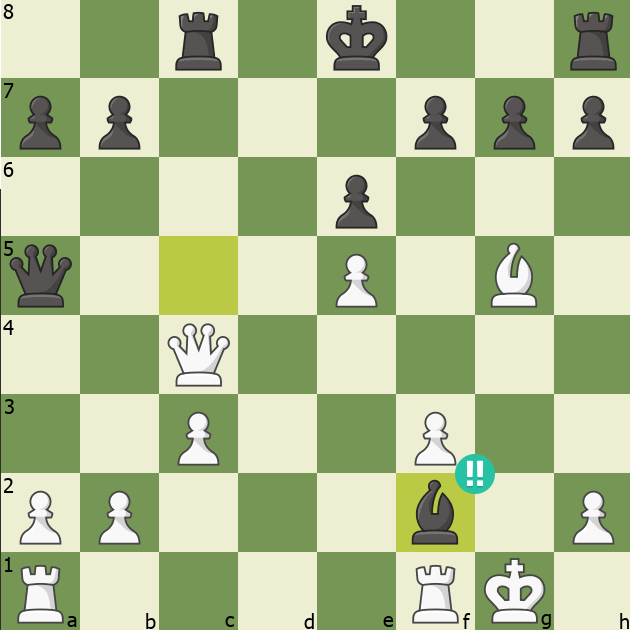
Brilliant Chess Move: Stunning Bishop Sacrifice Led to Checkmate
Most chess players have experienced it at least once. You spot a free pawn, win some material, and feel confident about your position—only to discover that your opponent had seen something much deeper.

Why Your Chess Accuracy Drops After Move 15
If your chess accuracy drops after move 15, the problem is not that you suddenly become a worse player. The problem is that the game has shifted from memory to understanding, and you have not trained that transition enough.
Why You Always Get in Time Trouble (And How Stockfish 18 Fixes It)
Every chess player knows the feeling. You navigate the opening perfectly. You transition into a solid middlegame. You build a completely fine, perhaps even slightly superior, position. And then, you glance at the clock. Your opponent has 15 minutes left. You have 42 seconds. Panic!