Why Do I Blunder Right After Finding a Good Move in Chess?
There is a very specific kind of chess pain that almost every improving player knows. You calculate well, find a strong move, feel proud for a second, and then immediately ruin the position on the very next turn.
This is one of the most frustrating patterns in practical chess because it feels irrational. If you were sharp enough to find the good move, why were you not sharp enough to avoid the blunder right after it?
The answer is usually not that your calculation suddenly disappeared. The real problem is that a good move often changes your mental state. You relax, you feel the hard part is over, you stop checking the opponent’s resources with the same intensity, and the board punishes you instantly.
That is why this pattern matters so much. It is not just a random mistake. It is a recurring psychological and practical leak, and once you see it clearly, it becomes much easier to fix.
Why this pattern happens
A good move creates emotional relief
Many blunders after a good move happen because the player experiences a small burst of relief. You found the tactic. You solved the hard moment. You improved the position. In your mind, the crisis is over.
That emotional release is dangerous. It lowers your alertness right when the position often becomes most tactically sensitive. Good moves force reactions, and forced reactions often create new tactical possibilities for both sides. If your concentration drops even slightly, the next move can punish you.
This is why players often say things like:
“I had everything under control.”
“I found the right move and then just switched off.”
“I thought the position was winning after that.”
“I stopped calculating because I assumed the game was basically decided.”
The move was good. The mindset afterward was not.
You start admiring your own move
This sounds funny, but it is real. After finding a strong move, players often spend a few seconds mentally celebrating it.
That can be subtle:
You feel clever.
You assume the opponent has no good response.
You start thinking about the result instead of the position.
You rush because you believe the move solved everything.
In practical terms, this is one of the most common forms of overconfidence in chess. It is not loud arrogance. It is tiny internal relief. And tiny internal relief is enough to miss a check, a zwischenzug, a tactical resource, or a counterattack.
You stop asking fresh questions
Before the good move, your thinking was probably active:
What is the threat?
What changes if I play this?
What is their best defense?
What happens after the obvious reply?
After the good move, many players fail to reset the calculation process. They continue emotionally from the previous position instead of fully entering the new one.
That is the core error.
Every move creates a new position. Every new position deserves a new scan. The board does not care that your last move was strong. It only cares what is true now.
The hidden trap: one good move does not mean one good sequence
A lot of players calculate individual moves better than they calculate transitions between positions. That is why they can find one strong idea and still fail on the next turn.
This happens because chess is not really a game of isolated moves. It is a game of changing relationships:
Which lines opened?
Which piece became loose?
Which check appeared?
Which square became weak?
Which piece is now overloaded?
Which reply is now possible that was not possible one move earlier?
A good move often changes the structure of the position enough to create a completely different tactical landscape. If you are still mentally living in the old position, you will miss what the new one contains.
That is why players often blunder right after doing something objectively good. The good move changed the board, but their attention did not change with it.
The “I earned the right to relax” illusion
This is one of the ugliest improvement traps in chess.
Players often feel that once they have done the difficult work, they deserve an easier finish. That emotion shows up after:
winning material
finding a tactical shot
forcing a simplification
surviving the opening
reaching a better endgame
spotting a strong defensive move
The mind quietly says: “Good, now the hard part is done.”
But in many chess positions, the hard part is not over. It has just changed form.
A tactical shot may lead to a technical position. A defensive move may create an active counterchance for the opponent. A simplification may produce a dangerous back-rank motif. Winning a pawn may leave one of your pieces hanging. The board often demands the same level of discipline after the “good move” as before it.
When players miss that, they do not lose because they could not find a strong move. They lose because they believed the strong move gave them permission to stop working.
Why this happens more to improving players
Stronger players do this too, but improving players feel it more often because their attention is still expensive. They can focus deeply for one moment, but holding that same quality across several moves is harder.
That is why this pattern fits so naturally beside existing DeepBlunder topics like How to Stop Hanging Pieces in Chess, Why Do I Miss One-Move Threats in Chess?, and How to Stop Losing Winning Positions in Chess. Those pages already speak to the same practical truth: many mistakes do not come from ignorance alone, but from broken attention at exactly the wrong moment.
Improving players usually have enough tactical knowledge to find some good moves. What they often lack is consistency of process:
checking the board again after the move
recalculating the opponent’s best response
spotting that the emotional pressure has changed
refusing to rush because the move felt satisfying
That is why this pattern is so trainable. It is not about becoming a genius. It is about becoming more stable move to move.
The most common versions of this blunder
1. The tactic worked, but your piece is now loose
You find a strong tactical move, maybe a fork, pin, discovered attack, or material-winning idea. The tactic is real. But in executing it, one of your own pieces becomes undefended or overloaded.
You are so focused on the gain that you fail to notice the new weakness.
This is one of the cleanest examples of “good move, bad follow-up” chess. The first move can be correct. The problem is that you assume correctness on move one means safety on move two.
2. You win material and stop checking counterplay
This is one of the most common amateur habits in chess. The moment players win a piece or a pawn, their vision narrows.
They start thinking:
“I’m up material.”
“Now I just need to trade.”
“This should be winning.”
“I don’t need to calculate as deeply.”
That is exactly when tactics hit back.
Many players do not lose winning positions because they never had them. They lose them because winning material made them less alert. That is also why this topic connects so well with Is 70 Percent Accuracy Good in Chess? and What Chess Accuracy Is Suspicious?: a single relaxed move after a strong sequence can drag the quality of the whole game down fast.
3. You found the strategic move, but missed the tactical reply
Not every “good move” is tactical. Sometimes you find the correct positional idea:
centralizing a rook
improving a knight
taking space
fixing a pawn weakness
starting a pawn break
The move itself can be excellent. But if you make it without a final tactical scan, the opponent may have a check, capture, or forcing sequence that changes everything.
This is why positional improvement and tactical discipline cannot be separated. A good strategic move still has to survive the next move.
4. You mentally finish the game before the board does
A player sees a good move and instantly begins imagining the result:
“I’m clearly better now.”
“This is basically winning.”
“He has no defense.”
“I’ve turned it around.”
That emotional jump is costly because it moves your attention from the board to the storyline. And the storyline is never the position.
The board only asks one question: what is true right now?
What Stockfish sees that you often do not
This topic is especially good for DeepBlunder because it naturally fits the brand’s strongest content angle: what the engine sees that the human misses.
When a player blunders right after a good move, the engine often “sees” three things more clearly:
the new tactical details created by the move
the opponent’s best practical resource
the hidden cost of the move, even when the idea itself is correct
That is exactly why this kind of mistake feels so painful in review. You are not always shocked that the first move was wrong. Sometimes the first move was right. What shocks you is that the position still demanded one more layer of honesty that you did not give it.
This is where engine-assisted explanation matters more than raw engine judgment. The useful lesson is not “your move was bad.” The useful lesson is “your move changed the position, and you stopped looking at it like a new position.”
That is a very DeepBlunder kind of insight, because it is about turning a blunder into a pattern you can actually recognize next time.
How to stop blundering after a good move
Reset after every move
This is the single most useful habit.
After you play a move you feel good about, do not mentally ride the feeling into the next turn. Treat the next position as if you had just opened a fresh puzzle.
Ask again:
What changed?
What is their best move?
What checks do they have?
What captures do they have?
What threats do they have?
Which of my pieces became loose?
This tiny reset interrupts the dangerous emotional momentum that creates the blunder.
Distrust satisfaction
Satisfaction is not proof of accuracy. In practical chess, satisfaction is often the moment where vigilance drops.
That does not mean you should never enjoy good moves. It means you should learn to notice the feeling without trusting it.
A useful mental rule is:
The more pleased I am with my last move, the more carefully I check the next position.
That one sentence can save a shocking number of games.
Scan for the opponent’s forcing options first
After a good move, players often keep thinking about their own plan. That is backward. The first thing to check is not what you want next. It is what your opponent can force right now.
Start with:
checks
captures
direct threats
This overlaps directly with the logic behind Why Do I Miss One-Move Threats in Chess?. Most follow-up blunders are not mystical. They are missed forcing moves.
Assume the position got sharper, not easier
This is especially useful after tactical or forcing moves. A strong move often increases tension. It does not reduce the need for calculation.
If you win material, assume counterplay exists.
If you simplify, assume a tactic may remain.
If you improve a piece, assume something tactical may have changed.
If you attack, assume your own king or back rank may now need checking too.
This mindset keeps you from treating the move as an ending instead of a transition.
Train the pattern, not only the position
A lot of players review specific blunders but never identify the shared pattern across them.
Ask:
Did I relax after a tactical win?
Did I stop calculating after improving my position?
Did I rush because I felt proud of the previous move?
Did I miss the opponent’s best practical reply?
Did I assume a winning position would win itself?
That is how improvement becomes durable. You are no longer memorizing one game. You are naming the behavior behind several games.
If this pattern sounds familiar, DeepBlunder is exactly the right tool for it.
Instead of only telling you that a move dropped the evaluation, it helps you isolate the real sequence:
the strong move you found
the moment your attention relaxed
the opponent’s resource you stopped respecting
the recurring blunder pattern behind the mistake
That is the difference between “I messed up again” and “I know exactly why this keeps happening.”
A strong internal reading path from here is:
A practical routine you can use immediately
If you want one simple over-the-board routine, use this after every move you feel proud of:
The 10-second anti-relax routine
First, take one breath and assume the position is still dangerous.
Second, look only for your opponent’s forcing moves.
Third, identify your loosest piece.
Fourth, ask whether your king became weaker.
Fifth, only then return to your own plan.
This routine works because it interrupts momentum. It forces you back into board reality instead of emotional narrative.
You do not need a complicated system. You need a repeatable one.
Why this topic is strong for DeepBlunder
This kind of article avoids direct competition with giant generic sites because it does not chase a massive head keyword like “best chess openings” or “how to improve at chess.” It targets a specific, human, emotionally real query with strong product alignment.
It also fits the site’s existing content pattern very naturally. DeepBlunder already has public articles on anti-blunder habits, one-move threats, winning positions, suspicious accuracy, and rating confusion, which means this topic strengthens a practical improvement cluster instead of sitting alone.
More importantly, it is the kind of topic people actually search after a painful game. Not when they are in theory mode, but when they are trying to understand why one good decision somehow led straight into one bad one.
That is exactly the kind of traffic worth building.
FAQ
Why do I blunder right after finding a good move in chess?
Usually because the good move changes your mental state before it changes the result. You feel relief, stop checking the opponent’s ideas with the same intensity, and treat the next position as if the hard part is already over. The move may be strong, but the new position still demands fresh calculation. A lot of players fail not on the good move itself, but on the transition after it. That is why the blunder feels so irrational. The real problem is often relaxed attention, not lack of knowledge.
Why do I calculate one move and then blunder?
Because many players calculate moments better than they calculate sequences. They solve the first decision, then emotionally carry that confidence into the next position without resetting their process. Chess punishes that fast, especially when the good move created new tactical details. You are not always failing to think. Sometimes you are failing to restart your thinking. That is a different problem, and a very fixable one. It becomes easier once you consciously treat each new position as new work.
Why do I miss the next move in chess after a strong idea?
Because the next move often belongs to your opponent’s resources, not your own plan. After a strong idea, many players keep admiring the idea instead of checking the best reply. That makes checks, captures, and direct threats easier to miss. The issue is not that your move was fake. It is that you stopped asking what the opponent could do next. In practical chess, the best reply is often the entire story. Missing it turns a good idea into a bad result.
How do I stop relaxing after a good move in chess?
Build a routine that treats satisfaction as a warning sign, not a green light. After every move you feel proud of, force yourself to scan the new position again for checks, captures, threats, loose pieces, and king safety. That small reset helps break the emotional momentum that causes many follow-up blunders. You do not need to become paranoid. You just need to stop assuming the previous move bought you safety. Good moves deserve disciplined follow-through.
Is this why I lose winning positions?
Very often, yes. Many winning positions are not thrown away because the player never had an advantage. They are thrown away because the player finds the strong move that creates the advantage, then relaxes before converting it cleanly. That pattern connects directly with practical conversion problems. The first move wins material or improves the position, and the next move gives back part of the edge. Winning positions still require attention. Sometimes they require even more.
Does this affect chess accuracy?
Yes, it can. One relaxed move after a strong sequence can lower the quality of the whole game more than players expect, especially if the mistake creates a sharp evaluation swing. That is one reason post-game accuracy sometimes feels harsher than the game itself felt over the board. You remember the good move. The engine remembers the drop after it. That is why consistency matters more than isolated brilliance. One good decision is useful, but one stable process is stronger.
Conclusions
Blundering right after a good move is one of the most human mistakes in chess. It happens because a strong move often creates relief, and relief quietly kills vigilance.
The fix is not mysterious. Reset after every move, distrust satisfaction a little, scan the opponent’s forcing resources first, and remember that a good move creates a new position, not a finished story.
Once you build that habit, your chess becomes more stable in exactly the moments that matter most. You stop turning good ideas into immediate regrets, and you start converting good decisions into clean sequences.
From the same category
Keep reading
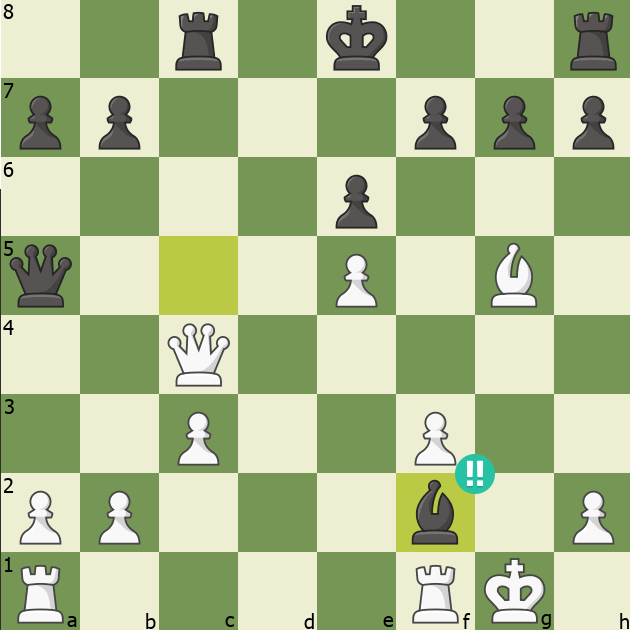
Brilliant Chess Move: Stunning Bishop Sacrifice Led to Checkmate
Most chess players have experienced it at least once. You spot a free pawn, win some material, and feel confident about your position—only to discover that your opponent had seen something much deeper.

Why Your Chess Accuracy Drops After Move 15
If your chess accuracy drops after move 15, the problem is not that you suddenly become a worse player. The problem is that the game has shifted from memory to understanding, and you have not trained that transition enough.
Why You Always Get in Time Trouble (And How Stockfish 18 Fixes It)
Every chess player knows the feeling. You navigate the opening perfectly. You transition into a solid middlegame. You build a completely fine, perhaps even slightly superior, position. And then, you glance at the clock. Your opponent has 15 minutes left. You have 42 seconds. Panic!