Why Do I Keep Losing Equal Positions in Chess?
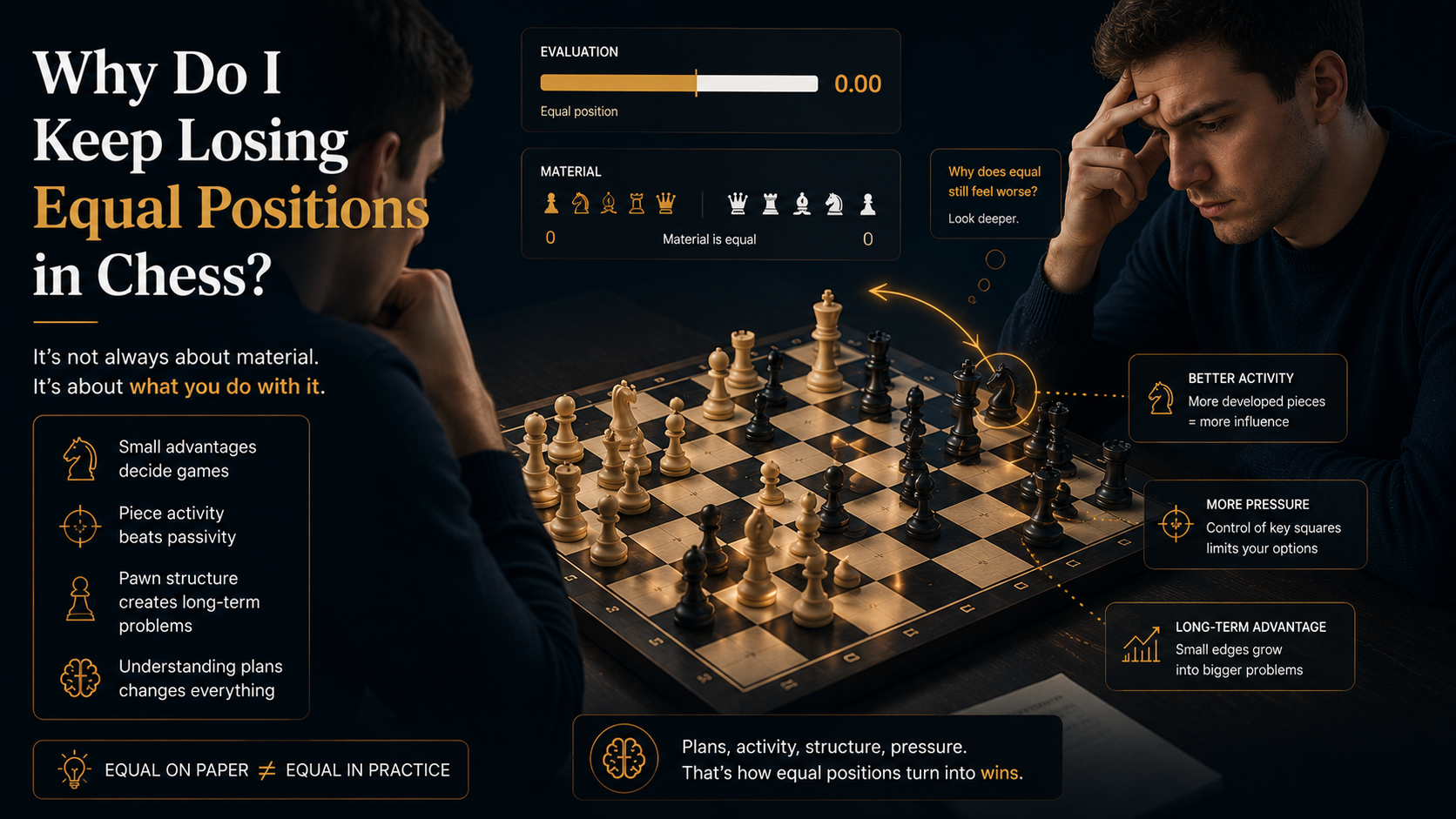
A lot of chess players do not lose because they get crushed out of the opening. They lose because they reach playable, equal positions and then slowly drift into worse ones without noticing exactly when the game changed.
That pattern usually comes from a mix of passivity, unclear plans, weak piece activity, and not recognizing the small imbalances that matter long before material changes.
If you keep losing equal positions in chess, the problem is rarely that equality is “bad luck.” The real issue is that equal positions still demand decisions, and stronger players know how to create problems there while weaker players often wait, simplify blindly, or drift.
Once you understand that, equal positions stop feeling mysterious and start becoming one of the clearest places to improve your practical chess.
Why equal positions are dangerous
Equal positions look harmless, which is exactly why they are so dangerous. When nothing appears to be collapsing, many players stop asking hard questions, and that is when slow mistakes begin to accumulate.
A game can stay level in material while one side quietly gains better squares, more active pieces, easier plans, or safer king play.
This is one reason equal positions feel so frustrating after the game. You review the moves and think, “I was never clearly losing,” but that misses the point. Chess is often lost by small concessions repeated over time, not just by one spectacular blunder.
That same practical reality already shows up across the DeepBlunder blog, especially in How to Stop Hanging Pieces in Chess, Why Do I Miss One-Move Threats in Chess?, and How to Stop Losing Winning Positions in Chess, where the common thread is not “mystery,” but a repeated breakdown in practical decision-making.
What “equal” really means in chess
A lot of club players treat equal as if it means “nothing is happening.” In reality, equal usually means only that neither side has a decisive advantage yet. It does not mean the position is easy, symmetrical, or safe from error.
You can have equal material and still be much worse in activity, king safety, pawn structure, or practical comfort.
That matters because many players evaluate equality too crudely. They look at the pieces, count the pawns, and assume everything is fine. But chess is not scored by arithmetic alone. Active pieces, weak squares, central control, and king exposure can decide the game even when the material count stays level.
So if you keep losing equal positions, one likely cause is that you are reading “equal” too literally and ignoring the dynamic features that actually decide the middlegame.
The most common reason: no real plan
One of the biggest reasons players lose equal positions is simple: they do not know what they are trying to do. Once the opening ends and no tactic is immediately available, they start making moves that are legal and maybe even decent, but not connected to a broader idea.
That creates drift, and drift is deadly in equal positions because the opponent only needs a few more purposeful moves than you to begin taking over.
This is why stronger players often seem to “outplay” others from equal positions without any dramatic tactical shot. They are not always calculating something brilliant. Often they are just solving the position more coherently: improving a worse piece, increasing pressure on a weakness, or steering the game toward a structure they understand better.
If you do not have a plan, your moves become reactive. If your moves become reactive, equality starts slipping before you notice.
Passive chess kills equal positions
Many players reach equality and think their job is to hold it. That sounds reasonable, but in practice it often turns into passive chess: pieces stepping backward, unnecessary defensive moves, automatic exchanges, and a constant fear of creating any imbalance.
The result is that the position stays “equal” just long enough for your opponent to take over the initiative.
This problem is especially common against stronger or more aggressive players. Once a drawish position appears, the weaker player subconsciously starts protecting equality instead of trying to play good moves. Chess.com’s article on equal positions describes this clearly: once a player senses a desirable result is close, it becomes tempting to overestimate the opponent’s ideas and play too safe.
That is a perfect description of how equal positions get lost. You do not need to blunder immediately. You only need to stop asking active questions.
You fail to create imbalances
Strong players rarely wait forever in equal positions. They look for ways to change the nature of the game. According to the Chess.com article, that usually happens in one of three ways: physically, by changing structure or material balance; tactically, by sharpening the position; or positionally, by creating strategic dilemmas.
Those methods matter because competent opponents are hard to beat if you leave the position completely familiar and comfortable.
This is one of the biggest differences between players who merely “hold” equal positions and players who actually win from them. The stronger player is often more willing to introduce tension, accept some risk, and ask the other side practical questions.
If you keep losing equal positions, it may be because your opponent is changing the game and you are only reacting to the new problems after they arrive.
You underestimate small positional problems
Not every losing trend begins with a blunder. Sometimes it begins with one bad recapture, one passive rook, one weak dark square, or one undeveloped piece that stays irrelevant too long.
These details feel small in the moment, which is exactly why they are so dangerous.
The player who loses equal positions often tells the story too late. They say, “I was equal and then suddenly I was worse,” when what really happened was a chain of small concessions that were not respected properly.
That is why equal-position improvement is not only tactical. It is also about sensitivity: noticing that one weak pawn, one inactive bishop, or one exposed king may matter more than the equal material count.
Activity matters more than equality on paper
A simple but powerful truth is that active pieces can outweigh material symmetry. A rook on an open file, a knight on an outpost, or a queen with active targets often gives one side the easier game even if the engine still calls the position equal or near-equal.
That practical edge matters because human players do not convert abstract evaluations; they convert active positions.
This is one reason equal positions are often decided by comfort. The side with easier piece play, safer king placement, and clearer plans tends to make fewer mistakes.
So if your equal positions keep going wrong, ask a better question than “Was it equal?” Ask, “Whose pieces were easier to play?” That is often where the answer begins.
You relax too much because nothing looks tactical
Another major cause is false calm. When the position does not scream for immediate calculation, players assume they can coast. That leads to lazy recaptures, underdeveloped pieces, and a weaker scanning routine than they would use in sharper positions.
But equal positions punish lazy moves just as badly as tactical ones; they just do it more slowly.
This is also why the skills in How to Stop Hanging Pieces in Chess and Why Do I Miss One-Move Threats in Chess? remain relevant here. Even in quiet positions, you still need to ask what your opponent is threatening, what changed after their move, and whether your own move creates a hidden weakness.
Equal positions are not tactical deserts. They are often just tactical positions with a delayed fuse.
Time management gets worse in equal positions
A surprising number of players handle equal positions badly on the clock. Some move too fast because the position “looks normal.” Others burn too much time because nothing seems forcing and they become indecisive.
Both habits are dangerous.
When you move too fast, you miss the small details that define the position. When you move too slowly, you create later panic in the very phase where precision starts to matter more.
This is one reason equal positions often collapse in stages: vague plan, weak clock use, passive move, then one final tactical mistake. The equal position did not betray you; bad pacing did.
You play for “not losing” instead of for good moves
This may be the most common practical mistake of all. Once the position feels equal, many players switch into survival mode. Their hidden goal becomes “do not mess this up,” especially against stronger players or in long games where a draw starts to feel like success.
That mindset leads directly to timid moves and missed chances.
The problem is that chess usually punishes fear-based play. If you only react, your opponent gets to ask the questions. If your opponent keeps asking the questions, you will eventually answer one of them badly.
That is why strong players are dangerous in equal positions. They do not wait for the game to decide itself. They create the kind of imbalance where your uncertainty starts to matter.
You do not know which equal positions fit your style
Not all equal positions are the same. Some are symmetrical and dry. Others are dynamically balanced but sharp. Some are comfortable for players who like maneuvering. Others favor those who enjoy tension and gradual pressure.
If you keep reaching equal positions that you personally hate, you are going to underperform in them even if the engine says the game is fine.
This matters more than people admit. A position can be “equal” and still unpleasant if the plans are easier for your opponent, the structure fits their style, or you do not understand the resulting middlegame well.
That is why opening choice matters too. Openings do not just aim for equality or advantage; they steer you toward types of equal positions you must know how to handle.
Equal positions often expose your middlegame more than your opening
Players often blame openings for games that were really lost later. They say, “I got nothing from the opening,” when the deeper truth is that they reached a playable middlegame and then made worse choices.
This is important because it changes how you improve.
If you keep losing equal positions, more opening memorization may not solve the problem. You may need better middlegame habits: piece improvement, pawn-structure awareness, proactive thinking, and more honest evaluation of king safety and activity.
That is why DeepBlunder’s cluster of practical content works so well together. A player who reads Why Is My Lichess Rating Higher Than Chess.com?, Is 70 Percent Accuracy Good in Chess?, and What Chess Accuracy Is Suspicious? is often wrestling with the same deeper issue: not how to decode numbers, but how to play cleaner chess in positions that still require decisions.
How stronger players win equal positions
Stronger players usually do not “win equality” through magic. They win it by making the position harder for you than it is for them.
According to the Chess.com article, that often means unbalancing the position physically, tactically, or positionally, not to force an immediate blunder but to create unfamiliar or difficult decisions.
That is a useful lesson because it tells you what to watch for. If your opponent changes the pawn structure, introduces a tactical wrinkle, or creates a subtle strategic dilemma, you should not dismiss it because the engine still says 0.0 or near-equal.
Humans lose equal positions when the questions become easier for one side than the other. That is the practical truth behind many “mysterious” losses.
How to stop losing equal positions
1. Stop treating equal as safe
Equal positions are still active positions. Keep scanning threats, piece activity, and structural changes instead of assuming the game will stay balanced on its own.
The equal sign is not a shield. It is just a temporary description.
2. Improve your worst piece
If you do not know what to do, this is often the cleanest rule available. Look at your least active piece and ask how it can become useful.
That simple habit gives you a plan and prevents the drift that kills so many equal positions.
3. Ask who is more comfortable
Material equality matters less than practical comfort. Whose king is safer? Whose rooks are more active? Who has easier pawn breaks?
These questions tell you far more than a lazy “looks equal to me” ever will.
4. Do not fear healthy imbalances
If you never change the position, stronger opponents will often do it first and on their terms. Learn to accept controlled imbalances in structure, activity, or tension when they help you ask the next question.
Equal positions are often won by the player who is willing to create a problem before the opponent does.
5. Review where equality started to slip
After the game, do not just identify the final blunder. Look for the first small concession that made your position harder to play.
That is often where the real lesson lives, because equal positions are usually lost gradually before they are lost visibly.
If your games keep slipping from equal to worse without one obvious disaster, DeepBlunder is built for exactly that kind of review. It helps separate the move where the position was still playable from the move where your plan became passive, your piece became inactive, or your opponent’s idea became easier than yours.
A strong next reading path inside the blog is:
Why this topic matters for improving players
Equal positions are where a lot of real rating progress is hidden. Most players expect to improve by learning openings, spotting tactics, or converting winning positions better, and all of that matters.
But many games are decided before anyone is objectively winning. They are decided when one player handles equality with more purpose than the other.
This makes the topic especially useful for DeepBlunder’s audience. The site already helps readers decode accuracy, blunders, rating confusion, and practical game mistakes.
A guide on equal positions strengthens that cluster by targeting a quieter but very real search intent: “Why do my normal, playable games keep turning against me?”
FAQ
Why do I keep losing equal positions in chess?
You usually keep losing equal positions because equality does not mean the position is easy or harmless. It only means neither side has a decisive advantage yet.
Many players drift in these positions because they have no plan, play too passively, or ignore small changes in activity, structure, or king safety.
A game can remain equal in material while one side’s position becomes much easier to handle.
That practical imbalance is often what decides the result.
So the problem is usually not “bad luck from equal positions.” It is that the equal position still demanded active, accurate decisions.
Can you lose a chess game with equal material?
Yes, absolutely. Equal material does not guarantee an equal position or an equal outcome.
Piece activity, king safety, pawn structure, and control of important squares can make one side much easier to play even when the pieces are numerically balanced.
That is why players often feel shocked after losing a game that looked level on the scoreboard.
The board was equal in count, but not equal in function.
In practical chess, active pieces and safer kings often matter more than material symmetry.
So yes, many games are effectively lost before the material count changes at all.
Why do stronger players beat me from equal positions?
Stronger players usually beat equal positions by asking better questions than you do. They improve their worst piece, create useful imbalances, and steer the game into positions that are easier for them to play.
The Chess.com article explains that strong players often unbalance the game physically, tactically, or positionally in order to create unfamiliar or difficult decisions.
They do not wait for you to blunder immediately. They make the position gradually harder.
If you respond passively, equality starts to drift.
So the real edge is often not one brilliant move. It is better practical management of a playable position.
How do I stop losing equal positions in chess?
Start by treating equal as active rather than safe. Keep checking threats, piece activity, and structure instead of assuming the game will stay balanced on its own.
A very useful practical habit is to improve your worst piece when no tactic is available.
You should also stop making fear-based moves just to “hold” the position.
Equal positions usually reward purposeful play more than passive safety.
After the game, review not only the final blunder but also the first small concession that made your position harder to play.
That is where the pattern becomes trainable.
Why do equal positions feel harder than winning positions?
Equal positions often feel harder because nothing is obvious. In winning positions, the goal is usually clearer: convert the advantage, reduce counterplay, finish the game.
In equal positions, you must create your own direction without overpressing.
That makes decision-making less concrete and easier to mishandle.
Many players either drift or force the issue too early.
The balance between patience and ambition is what makes equal positions so instructive.
That is why they are often a better test of middlegame skill than flashy tactical wins.
Should I simplify equal positions?
Not automatically. Simplifying is only useful if the resulting position is easier for you to understand or handle.
Blind exchanges can help the opponent just as much as they help you.
In some equal positions, reducing tension kills your own winning chances.
In others, it removes the opponent’s best source of activity.
The key question is not “Can I trade?” but “Who benefits from the simplified position?”
That is a much stronger habit than trading because the board looks calm.
Conclusions
If you keep losing equal positions in chess, the answer is usually not that equality is fake or unlucky. The answer is that equal positions still demand plans, activity, and a willingness to solve practical problems before the opponent solves them first.
That is why they are such an important part of improvement. They expose whether you can play chess without the help of a big tactical shot or a clear engine advantage.
The biggest fixes are simple to describe, even if they take work to build: stop treating equal as safe, improve your worst piece, notice small positional problems earlier, and do not confuse material equality with practical comfort.
If you do that consistently, equal positions stop feeling like slow disasters and start becoming playable, winnable middlegames.
From the same category
Keep reading
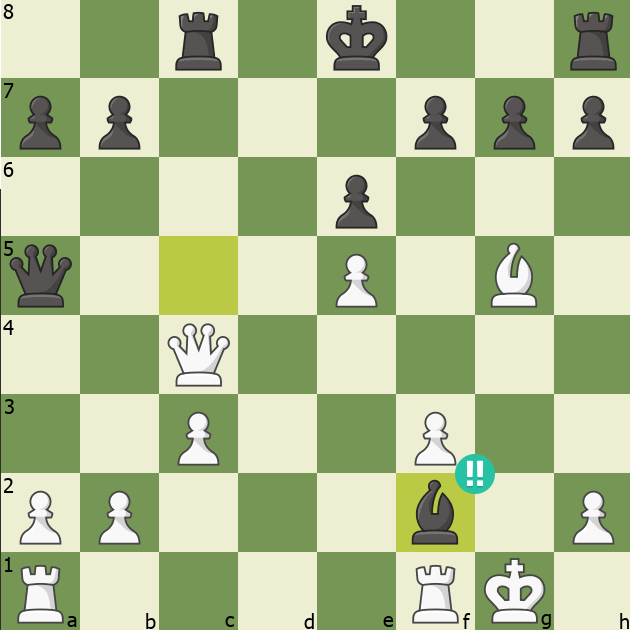
Brilliant Chess Move: Stunning Bishop Sacrifice Led to Checkmate
Most chess players have experienced it at least once. You spot a free pawn, win some material, and feel confident about your position—only to discover that your opponent had seen something much deeper.

Why Your Chess Accuracy Drops After Move 15
If your chess accuracy drops after move 15, the problem is not that you suddenly become a worse player. The problem is that the game has shifted from memory to understanding, and you have not trained that transition enough.
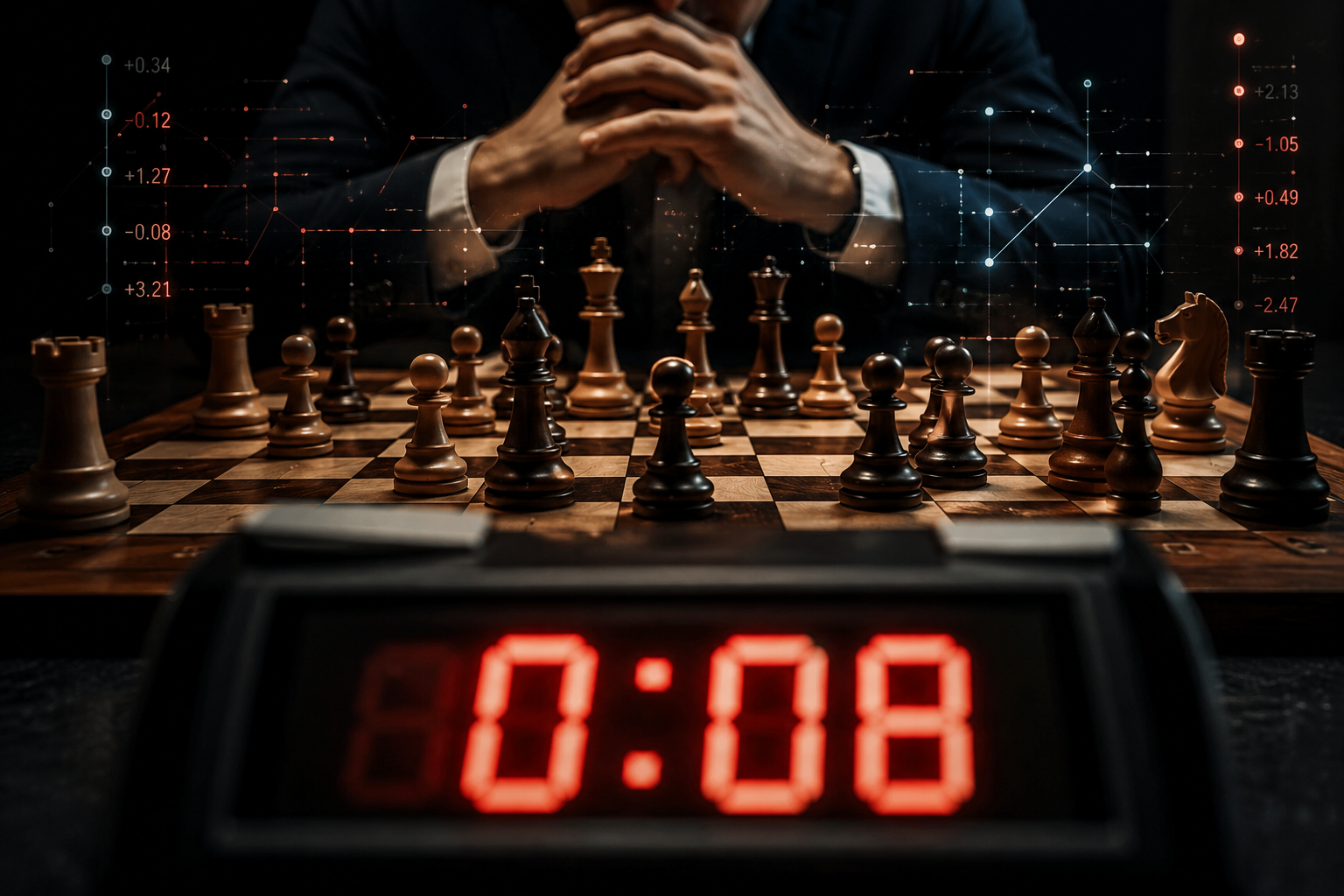
Why You Always Get in Time Trouble (And How Stockfish 18 Fixes It)
Every chess player knows the feeling. You navigate the opening perfectly. You transition into a solid middlegame. You build a completely fine, perhaps even slightly superior, position. And then, you glance at the clock. Your opponent has 15 minutes left. You have 42 seconds. Panic!