Why Do I Play Worse When I’m Winning in Chess?
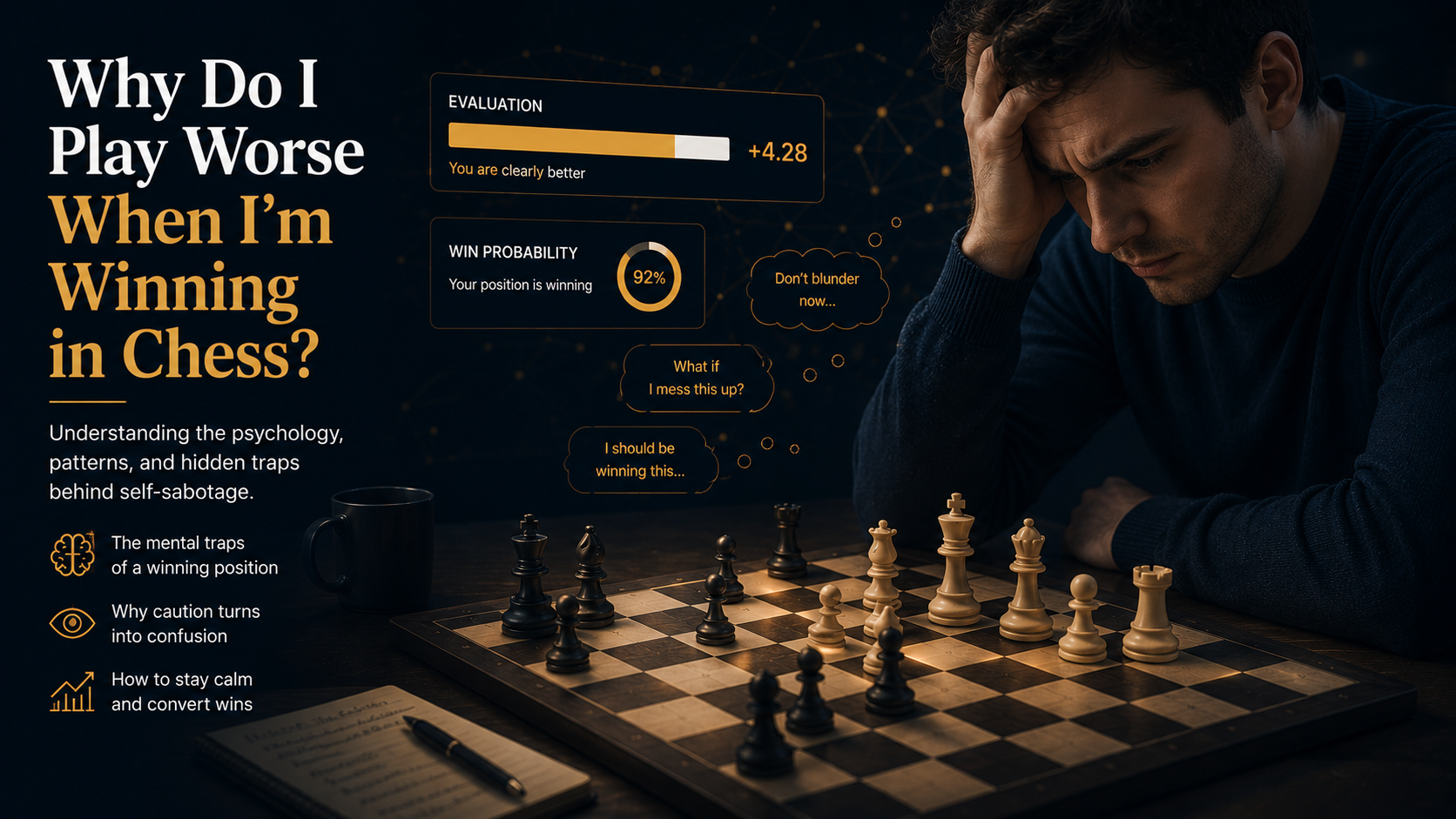
A lot of chess players do not lose because they fail to get winning positions. They lose because they stop playing confidently once they are ahead. Instead of staying active, they become cautious, passive, and emotionally attached to the result.
That shift is more common than most players think. A winning position creates a new kind of pressure: now you are not just trying to outplay your opponent, you are trying not to ruin something you already earned. That fear changes decision-making fast.
If this sounds familiar, the problem is probably not that you “cannot calculate.” The deeper issue is that being ahead changes your mindset, your move selection, and your tolerance for risk. Once you understand that pattern, converting advantages becomes much easier.
Why winning makes some players worse
When the game is equal, most players feel free to think creatively. They look for ideas, try plans, and accept that mistakes are part of the fight. But once the position becomes winning, the emotional goal often changes from “play good moves” to “do not throw this away.”
That sounds harmless, but it changes the whole psychological frame. Instead of playing the position, you start protecting the result in your head. And the moment you do that, your moves often become smaller, slower, and more passive than they should be.
This is one reason many players feel sharp and dangerous in complex middlegames, then suddenly look nervous once the engine would call them clearly better. The advantage itself creates tension.
You stop trusting the process
A lot of players reach a winning position through active chess. They calculate, they attack, they spot tactical chances, and they make decisions with energy. Then they get ahead and abandon the exact process that created the advantage in the first place.
Now they start guessing instead of calculating. They assume trades are always good. They stop checking the opponent’s counterplay carefully. They look for “safe” moves even when those moves slowly give the game away.
This is one of the clearest patterns behind conversion failures. The player who was strong enough to create the advantage suddenly stops behaving like the player who earned it.
You become result-oriented
Winning positions are dangerous because they tempt you to think about the final result too early.
Instead of asking:
What is the best move here?
What is my opponent’s idea?
What changes after the trade?
you start asking:
How do I not mess this up?
How close am I to winning?
What if I blunder now?
That shift is toxic for practical chess. It pulls attention away from the board and into your own anxiety. The position does not care that you are winning. It still demands the same discipline as before.
This is exactly why players who struggle with conversion should also read How to Stop Losing Winning Positions in Chess, because the core problem is usually not only technical. It is psychological and practical at the same time.
What usually goes wrong in winning positions
Passive moves replace active moves
One of the most common mistakes when ahead is replacing strong, active moves with passive “just in case” moves.
You may have a chance to centralize a rook, activate the king, or create a second weakness, but instead you make a slow move that protects something that was not really in danger. That gives the opponent time to reorganize, create counterplay, or escape into a drawing setup.
In chess, safety is not the same as passivity. Many players confuse the two. A safe move can still be active. A passive move often creates new danger by letting the opponent breathe.
You simplify without thinking
Players are often told that when you are better, you should simplify. That advice is sometimes correct, but only when the simplification clearly helps you.
A lot of winning positions are thrown away because the stronger side trades automatically:
queens without checking the resulting endgame
active pieces for passive ones
attacking chances for “safe” equality
a large advantage for a technically unclear ending
Simplification is not a magic rule. It only works when the position after the trade is easier and still better for you.
If you keep missing these transitions, the problem often overlaps with the same board-awareness issues behind Why Do I Miss One-Move Threats in Chess?. You are no longer seeing the position clearly move by move.
You rush because you think the game should already be over
Another classic mistake is impatience. Once players feel they are winning, they want the game to end quickly. That leads to forcing attempts that are not fully calculated, premature sacrifices, or unnecessary pawn grabs.
This often happens because winning creates a false sense of entitlement. You feel like the point already belongs to you, so any move that looks “close enough” gets played too fast. But a winning position is not a reward. It is a responsibility.
This is also one reason How to Stop Hanging Pieces in Chess: A Complete Anti-Blunder Guide fits naturally with this topic. A lot of players do not blunder because they are lost. They blunder because they relax too early when they are better.
You stop looking at the opponent’s resources
The losing side often has one last hope: tricks. Checks, perpetual ideas, stalemate tricks, tactical swindles, desperation sacrifices, and unexpected activity all become more dangerous when the winning side starts assuming the game is basically finished.
That is why strong players keep asking the same questions even in clearly better positions:
What is my opponent threatening?
What forcing moves do they have?
What happens if I get careless for one move?
Many conversion failures are not caused by deep strategic errors. They come from failing to respect the opponent’s final practical chances.
Why your brain changes when you are winning
Fear of loss is stronger than hunger for gain
Human psychology is not neutral. In many situations, people fear losing what they already have more than they value gaining something new. Chess is full of that pattern.
When the game is equal, you are trying to gain an advantage. When you are winning, you are trying not to lose it. Those feel like similar tasks, but emotionally they are completely different.
That is why so many players become timid when they are ahead. They are no longer chasing the best continuation. They are protecting an imagined future result.
The mind starts playing the scoreboard
When you are better, your imagination runs ahead:
“I should win this.”
“If I mess this up, it will be embarrassing.”
“I was +5 and now I am not sure anymore.”
“This was supposed to be easy.”
These thoughts are poison because they make every move heavier than it needs to be. Instead of solving one position at a time, you start carrying the emotional weight of the whole game.
This is also why some players see decent accuracy in equal games, then worse decision-making in winning ones. The quality drop is not always about knowledge. It is often about emotional overload.
That connects well with Is 70 Percent Accuracy Good in Chess? and What Chess Accuracy Is Suspicious?, because numbers in chess often become more emotional than useful when players stop reading them in context.
Winning creates perfectionism
Many players in winning positions stop searching for a good move and start searching for the perfect move. That can be just as destructive as carelessness.
They reject strong practical continuations because they fear they may not be the cleanest. They spend too long comparing several winning moves. Or they panic and choose one quickly because the pressure of choosing feels too high.
But chess rarely demands perfection. It usually demands good enough moves played consistently. In many winning positions, the right goal is not “find the most beautiful line.” It is “do not allow counterplay and keep the edge under control.”
Signs you play worse when you’re winning
You probably have this pattern if the following feels familiar:
You get strong positions but fail to convert them regularly.
You start playing slower and more nervously once you are better.
You trade pieces automatically without checking the resulting ending.
You stop creating threats and start just “holding.”
You blunder after thinking, “I’m basically winning anyway.”
You often say, “I had a winning position and then everything went wrong.”
If that sounds like your games, the issue is not random bad luck. It is a repeated conversion pattern. And repeated patterns are fixable.
How to convert winning positions better
Keep asking the same questions
One of the biggest conversion habits is refusing to change your thinking process just because you are ahead.
Keep asking:
What is my opponent’s best move?
What is their counterplay?
Which of my pieces is worst placed?
Can I improve my king, rook, or queen?
What trade helps me and what trade helps them?
This works because it keeps you in chess mode instead of panic mode. The board still deserves attention, not celebration.
Reduce counterplay before grabbing material
A lot of players lose winning positions because they get greedy. They see a pawn, a loose piece, or a flashy tactic and go for it without checking whether the opponent’s activity matters more.
In many winning positions, the safest path is not “take everything.” It is:
shut down checks
stop passed pawns
neutralize active rooks
simplify only when the result is clearly favorable
Good conversion is often boring. That is not a weakness. That is strength.
Improve the worst piece
This is one of the cleanest practical rules in chess. If you are better and not sure what to do, improve your worst-placed piece.
That simple idea prevents a lot of panic moves. It gives you a structured way to keep building the position without forcing anything. It also keeps you active instead of frozen.
Use mini-goals
Winning positions often become easier when you stop thinking “how do I win the game?” and start thinking:
Can I trade into a better endgame?
Can I create a passed pawn?
Can I fix a weak pawn?
Can I invade on an open file?
Can I eliminate their active piece?
Mini-goals reduce emotional overload. Instead of carrying the full weight of the result, you solve the next useful problem.
Respect simple tactics
Many players lose won positions through one move:
a back-rank trick
a knight fork
a perpetual check idea
a stalemate trick
a skewer after an automatic trade
That is why the tactical scan never stops, even in winning positions. Before every move, check:
checks
captures
threats
This is basic advice, but basic advice wins a lot of real games.
A practical training method for this problem
If you want to improve specifically at converting winning positions, do not review your games randomly. Review them with one question:
What changed after I got the advantage?
Then look for the moment where your thinking shifted.
Was it:
after winning material?
after trading queens?
after entering an endgame?
after seeing the engine bar go up?
after time pressure started?
Then classify the failure:
tactical oversight
passive move
unnecessary simplification
greed
fear of counterplay
time trouble collapse
That turns vague frustration into something trainable.
A very good internal reading path for this is:
Those three topics work together because conversion problems usually contain all three elements: nerves, blunders, and missed resources.
Why this issue matters more than opening theory for many players
A lot of players assume they need better openings. Sometimes they do. But many rating points are not lost in the opening. They are lost after the player has already achieved a better position and then fails to handle it.
That is why practical conversion skill often matters more than memorizing deeper lines. If you keep blowing advantages, more opening prep may just help you reach winning positions you still cannot finish.
This is also why the broader DeepBlunder cluster makes sense together. Articles like Why Is My Lichess Rating Higher Than Chess.com? and What Is the Stupidest Rule in Chess? attract confused, improving players, but conversion content helps them solve one of the most expensive practical leaks in their actual games.
If you often get winning positions and still fail to score the point, stop treating it like bad luck.
Use DeepBlunder to identify the exact move where your winning position started slipping, label whether the problem was fear, passivity, greed, or a missed tactic, and train the pattern before it repeats again.
A strong improvement path is:
follow it with How to Stop Hanging Pieces in Chess
then sharpen your board vision with Why Do I Miss One-Move Threats in Chess?
FAQ
Why do I play worse when I’m winning in chess?
Most players play worse when they are winning because their mindset changes. They stop looking for the best move and start looking for a move that feels “safe.” That often leads to passivity, rushed trades, or fear-based decisions. The position is still asking for accuracy, but the player is now emotionally protecting the result instead of solving the board. That is why many won positions suddenly become messy again. The issue is usually psychological and practical at the same time.
Why do I keep losing winning positions in chess?
You usually keep losing winning positions because you relax too early, rush the conversion, or fail to respect the opponent’s counterplay. Many players think the hard part is over once they are ahead, but that is exactly when technique matters most. A single passive move, greedy pawn grab, or missed tactical idea can undo a whole game’s work. This is why conversion is a separate skill, not just proof that you were better earlier. Strong positions still need strong decisions.
Why do I blunder when I’m ahead?
Blunders when ahead often come from overconfidence or emotional tension. Some players relax because they think the game is already won. Others become too nervous because they know they should win and panic about ruining it. Both mindsets create the same result: lower-quality moves. The board does not care whether you are winning or losing — tactics still exist. That is why the blunder check has to stay active until the game is actually over.
Should I always trade pieces when I’m winning?
No. You should trade pieces only when the resulting position clearly helps you. Many players repeat the rule “trade when ahead” without checking whether the ending remains favorable, whether the opponent’s active piece was actually more dangerous than it looked, or whether the trade removes your winning chances. Good simplification is a tool, not a reflex. The correct question is never “can I trade?” but “does this trade improve my winning chances?”
How can I stop panicking in winning positions?
The best way to stop panicking is to return to process-based thinking. Ask the same questions you asked earlier in the game: what is their threat, what is my best move, what changes after a trade, where is my worst piece? Mini-goals also help a lot. Instead of trying to “win now,” improve one thing at a time: reduce counterplay, improve a piece, create a passed pawn, or enter a favorable ending. Calm structure beats emotional urgency.
What should I focus on when I’m better in chess?
When you are better, focus on three things: reducing counterplay, improving your worst piece, and avoiding unnecessary risk. You do not need the fanciest move. You need a move that keeps the advantage healthy. Winning positions often collapse because players chase beauty instead of control. If you stay active, respect tactics, and avoid drifting into passivity, conversion becomes much easier.
Conclusions
A lot of chess players do not have a “getting better positions” problem. They have a “finishing better positions” problem. That distinction matters, because it changes what you need to train.
If you play worse when you are winning, you are probably not weak at chess in general. You are likely changing your process at the worst possible moment. You stop trusting the habits that got you ahead, and the game punishes the shift immediately.
The fix is practical: stay active, respect counterplay, simplify only with purpose, and keep asking the same disciplined questions until the game is truly over. If you build that habit, your conversion rate improves — and with it, your confidence, your rating, and your entire relationship with winning positions.
From the same category
Keep reading
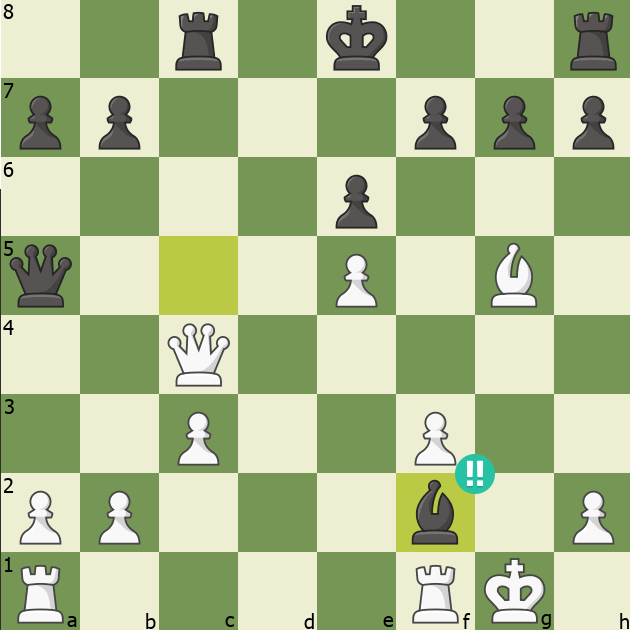
Brilliant Chess Move: Stunning Bishop Sacrifice Led to Checkmate
Most chess players have experienced it at least once. You spot a free pawn, win some material, and feel confident about your position—only to discover that your opponent had seen something much deeper.

Why Your Chess Accuracy Drops After Move 15
If your chess accuracy drops after move 15, the problem is not that you suddenly become a worse player. The problem is that the game has shifted from memory to understanding, and you have not trained that transition enough.
Why You Always Get in Time Trouble (And How Stockfish 18 Fixes It)
Every chess player knows the feeling. You navigate the opening perfectly. You transition into a solid middlegame. You build a completely fine, perhaps even slightly superior, position. And then, you glance at the clock. Your opponent has 15 minutes left. You have 42 seconds. Panic!