Why Is Stalemate Not a Win in Chess?
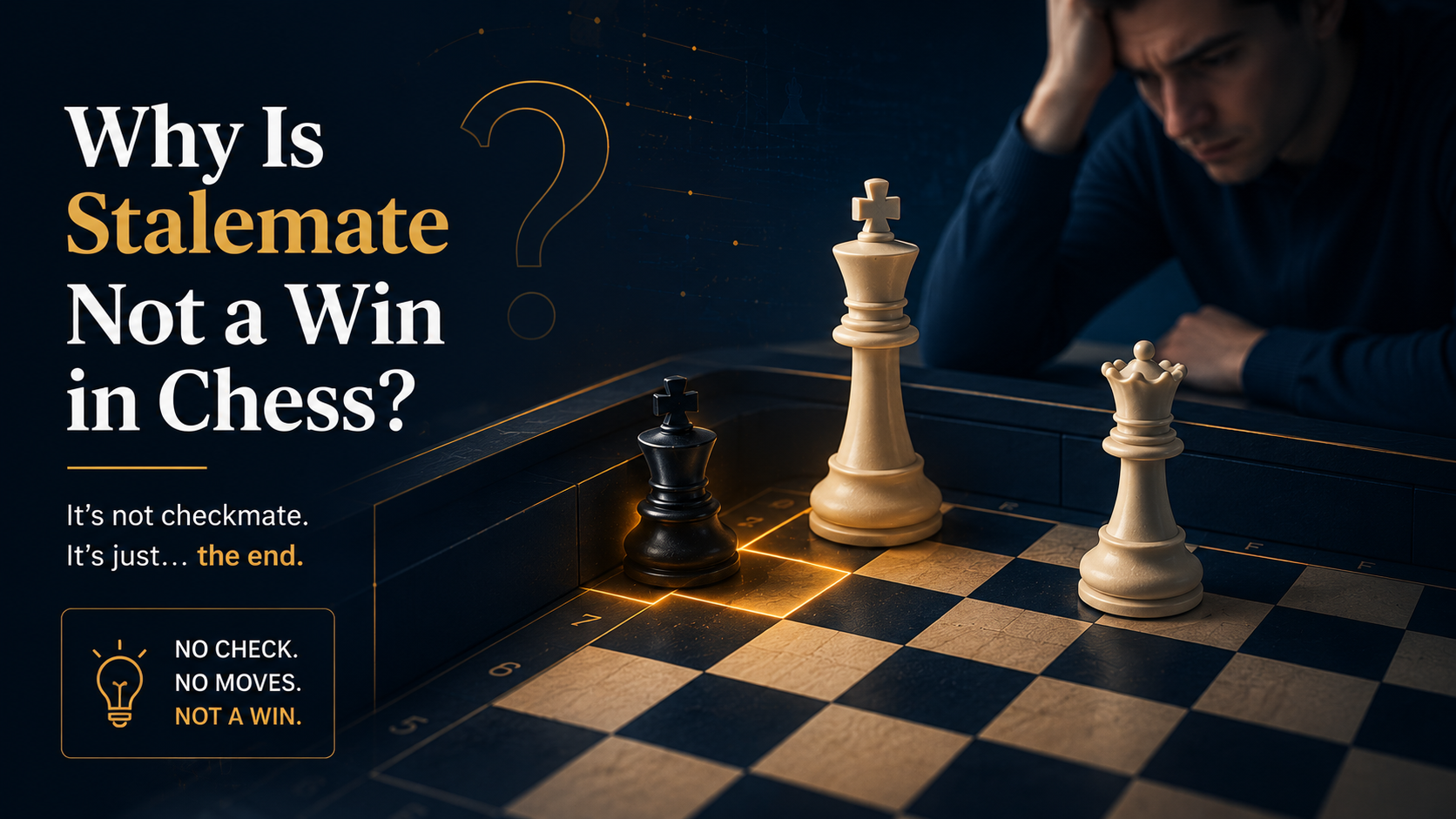
If you are new to chess, stalemate feels wrong the first time you see it. One player is crushing the game, the enemy king is boxed in, escape squares are gone, the board looks over — and yet the result is a draw instead of a win. That moment creates one of the most common beginner reactions in chess: “How is that not checkmate?”
The short answer is simple. Stalemate is not a win because the king is not in check. In chess, you win by checkmating the king, not by trapping it generally, not by having more material, and not by making the position look hopeless. If the side to move has no legal move but the king is not under attack, the game is drawn.
That explanation is technically correct, but on its own it does not satisfy most players. The real question is not only what stalemate is. The real question is why chess treats that position as a draw instead of rewarding the stronger side with a full point. Once you understand that logic, stalemate stops feeling like a bug in the rules and starts looking like one of the defining ideas of the game.
What stalemate means in chess
Stalemate happens when the player whose turn it is has no legal move and is not in check. That is the official definition, and it is the whole reason the result is a draw rather than a win.
The difference between stalemate and checkmate is only one condition, but it is the most important condition in the game. In checkmate, the king is attacked and cannot escape. In stalemate, the king is not attacked, but the side to move still has no legal move.
That distinction can feel tiny when you first hear it, but chess is built on exactness. The game does not award victory for being “basically mated.” It awards victory only when the king is actually in check and there is no legal response.
This is why beginners are often shocked by stalemate even if they already know the rules in theory. The position looks like defeat. The rules see something more precise: no legal move, no check, therefore no checkmate.
Why stalemate is not a win
The simplest answer is that chess defines victory through checkmate, not through domination alone. You do not win because your opponent has less material, fewer squares, or a terrible position. You win because the king is attacked and cannot legally escape.
That means stalemate is not a win for the same reason that “almost checkmate” is not checkmate. The required final condition is missing. If the king is not currently under attack, the rules do not allow the game to be scored as a win.
This may feel harsh to the stronger side, but it is also what makes chess internally consistent. The game does not use a vague standard like “the stronger position deserves the point.” It uses a clear standard: mate or not mate.
That clarity is part of why chess has lasted so well. It asks players not just to dominate but to finish accurately. Stalemate is the rule that reminds you the final move matters just as much as the earlier twenty good ones.
Why beginners think stalemate should be a win
Most beginners come to chess with instincts from other games. In many sports and board games, if one side is completely trapped, helpless, or unable to act, that side simply loses. So when a beginner sees a lone king with nowhere to go, the natural reaction is to assume that the stronger side should get the win.
That instinct is understandable. It is not silly. In fact, it is logical if you are thinking in terms of general domination instead of chess-specific victory conditions. The problem is that chess is not scored by domination. It is scored by legality and precision.
There are also three reasons stalemate feels especially unfair to newer players.
1. The board looks won
A stalemate position often looks visually identical to a checkmating net, especially to untrained eyes. The king is cornered, enemy pieces control the space around it, and the side with more material appears fully in charge.
That visual similarity is one reason the rule feels so irritating. The eye says “mate,” but the law says “draw.” The gap between what the position looks like and what it legally is creates the emotional shock.
2. Beginners value material more than finish
New players often think the game is practically over once they are up a queen, rook, or several pieces. That is why accidental stalemate feels so cruel. They did the hard part, won the material battle, and still failed to score the point.
This is one of the first serious lessons chess teaches: material gives you the tools to win, but it does not give you the result automatically. You still have to finish legally and accurately.
3. Beginners often play for style instead of control
A huge number of accidental stalemates happen because the stronger side starts showing off. Instead of delivering a clean checkmate, they make extra queen moves, take one more pawn, or try to force the king into a picture-perfect corner. That is when the opponent suddenly has no legal move and the game ends in a draw.
This is why stalemate and practical blunders are so closely connected. It is not just a rule problem. It is a decision-making problem. That is also why this topic fits naturally beside How to Stop Losing Winning Positions in Chess and How to Stop Hanging Pieces in Chess: A Complete Anti-Blunder Guide. Both of those articles deal with the same real-world pain: getting most of the game right and still ruining the result with one careless decision.
Why chess keeps stalemate as a draw
The strongest reason is consistency. Chess defines victory precisely, and stalemate does not meet that definition. The king is not attacked, so the game cannot call the position checkmate without changing its own core rule.
That may sound abstract, but it matters a lot. Once the game stops insisting on check as a requirement for victory, the whole logic of king safety changes. Suddenly the objective would not be checkmate anymore. It would be some looser concept like “immobilization” or “dominance,” and that would alter the identity of chess itself.
There is also a second reason: stalemate gives the defending side one last resource. A losing player may have almost nothing left, but if they can force a stalemate, they still save half a point. That keeps the game alive, rewards defensive ingenuity, and forces the stronger side to remain precise all the way to the end.
In that sense, stalemate is not an accident of the rules. It is a feature of the game’s design. It protects the principle that the stronger side must still demonstrate technique, not just superiority.
Why strong players respect stalemate
Beginners hate stalemate. Strong players fear it, use it, and respect it.
That shift is important.
Once you improve, you stop seeing stalemate as an absurd technicality and start seeing it as part of practical endgame chess. You understand that the side with the advantage still has work to do. You also learn that the defending side can use stalemate as a swindle, a resource, and sometimes even an artistic idea in composed studies.
This is why masters and strong club players rarely call stalemate “stupid” in a serious way. They know it punishes carelessness, but they also know it rewards the exact kind of precision that chess is built to value.
The more you improve, the more natural the rule feels. It still hurts when you blunder into it, but it stops feeling arbitrary. It starts feeling deserved.
Why stalemate feels different from other draws
Not all draws feel the same.
A draw by repetition feels understandable because the position keeps looping. A draw in a dead endgame feels understandable because neither side can win. A draw by perpetual check feels understandable because one side cannot escape harassment.
Stalemate feels different because the stronger side often appears completely dominant. The board does not look equal at all. It looks won. That is why the draw feels stolen.
The emotional truth is simple: stalemate is not the most confusing draw because it is the hardest to explain. It is the most confusing draw because it arrives in positions where the stronger side feels entitled to the point.
That entitlement is exactly why the rule creates such strong reactions. It hits at the moment confidence turns into carelessness.
Is stalemate a stupid rule?
This is the emotional version of the same topic, and it is one DeepBlunder has already started covering through What Is the Stupidest Rule in Chess?.
The honest answer is no, stalemate is not a stupid rule. It is frustrating, especially for beginners, but it is deeply consistent with the logic of chess. If the king is not in check, then the game has not reached checkmate, and if the side to move has no legal move, the game cannot continue. A draw is the clean legal result.
The reason the rule gets called stupid so often is not that it lacks logic. It is that its logic clashes with the emotional expectations of players who feel they have clearly outplayed the opponent.
That is why stalemate is such a strong search topic. People are not only searching for a legal explanation. They are searching for an emotional explanation. They want to know why the rule feels so wrong even when it is correct.
Why stalemate improves the game
Stalemate forces the stronger side to stay accurate. Without it, many winning positions would become lazier and less instructive. Players could drift toward victory without worrying about exact king geometry or legal finishing technique.
Instead, stalemate teaches:
Control without suffocation too early.
The difference between attack and mate.
Clean endgame technique.
Respect for the defender’s resources.
The importance of legal move count near the end of the game.
Those are not small lessons. They are part of what separates practical winning from vague “I should be winning” thinking.
This is also why stalemate belongs naturally in a blog focused on improving players. It is a rules topic, but it is also a practical training topic. Understanding stalemate helps players convert better, calculate final positions more honestly, and throw away fewer winning games.
How to avoid stalemate in winning positions
The cleanest rule is simple: before every final-looking move, ask what legal move your opponent will have after you play it.
If the answer is “none,” then ask the second question: is the king actually in check? If not, you may be about to stalemate your opponent.
That one habit saves a shocking number of half-points.
There are also some practical anti-stalemate habits that work immediately:
Do not rush when the opponent has only a king or almost only a king.
Do not make unnecessary queen moves around a trapped king.
Keep at least one escape square available until the mating net is fully ready.
Favor known mating patterns over improvisation.
If you are far ahead, choose the simplest win, not the prettiest one.
This is the same broad philosophy behind How to Stop Losing Winning Positions in Chess. Winning positions are not a reward. They are a technical responsibility.
The most common stalemate blunder
The most common beginner stalemate blunder happens when the stronger side uses a queen to cut off every square around the enemy king without actually giving check. Because the queen controls so much space, it is easy to remove the opponent’s final legal moves by accident.
The sequence usually feels harmless to the winning side. They think they are tightening the net. In reality, they are ending the game immediately — just not in the result they want.
This is one reason basic mating patterns matter so much. If you know how to mate cleanly with king and queen or king and rook, you are far less likely to improvise your way into a draw.
It is also why anti-blunder thinking matters even in winning positions. A player who has learned to scan forcing ideas, loose squares, and legal-move availability will avoid more stalemates than a player who just assumes the game is over. That connects directly with Why Do I Miss One-Move Threats in Chess?, because the same problem often hides underneath both errors: incomplete board awareness.
Why stalemate matters even if it feels rare
Some players treat stalemate like a beginner-only issue. That is a mistake.
Yes, accidental stalemate happens far more often at lower levels. But the concept matters at every level because it teaches a central principle of chess: the game is defined by legal precision, not by general superiority.
Even strong players use stalemate ideas in defense, especially in endgames and studies. That means understanding stalemate is not just about avoiding embarrassment. It is also about respecting a real defensive resource built into the game.
And because stalemate is emotionally unforgettable, it often becomes one of the strongest teaching moments in a player’s development. Many players improve their conversion technique permanently after throwing away one especially painful won game.
Why this topic connects so well with the rest of the blog
This topic sits right in the middle of the DeepBlunder content cluster.
It connects to:
What Is the Stupidest Rule in Chess?, because stalemate is the rule most often called stupid.
What Is the Rarest Chess Rule?, because both articles explain strange or misunderstood legal moments in chess.
How to Stop Losing Winning Positions in Chess, because stalemate is one of the cleanest examples of throwing away a won game.
How to Stop Hanging Pieces in Chess: A Complete Anti-Blunder Guide, because both topics live inside the same world of avoidable practical errors.
Why Do I Miss One-Move Threats in Chess?, because board awareness and disciplined checking routines prevent both tactical blunders and stalemate oversights.
That internal logic matters because readers who care about stalemate are usually not only asking about rules. They are also dealing with improvement pain: ruined wins, strange endings, and the feeling that one move erased a whole game.
If you keep turning won positions into draws, the issue is usually not bad luck. It is missing one final layer of precision.
Use DeepBlunder to review the exact move where your win slipped, identify whether the problem was stalemate, a missed threat, or careless move order, and then train the pattern until it stops happening.
A strong path from here is How to Stop Losing Winning Positions in Chess, then How to Stop Hanging Pieces in Chess, then Why Do I Miss One-Move Threats in Chess?.
Could chess change the rule?
Every so often, someone suggests a simpler rule: if the opponent has no legal move, the stronger side should win, whether the king is in check or not. That sounds beginner-friendly, but it would change more than people realize.
If stalemate were a win, chess would lose a large part of its defensive richness. Many endgame ideas, swindles, studies, and technical conversion standards would disappear or become weaker. The difference between “controlling the king” and “mating the king” would collapse.
The game would become simpler, yes. But it would also become flatter. One of the hardest and most beautiful parts of chess is that being better is not enough. You still have to finish legally.
That is why stalemate survives every wave of beginner frustration. It may feel rude, but it protects something central to the structure of chess.
How to explain stalemate in one sentence
If you want a featured-snippet answer, this is the cleanest version:
Stalemate is not a win in chess because the king is not in check, and chess only awards victory for checkmate, not for simply leaving the opponent with no legal moves.
That sentence works because it captures both the legal rule and the deeper reason behind it.
FAQ
Why is stalemate not a win in chess?
Stalemate is not a win because the king is not in check. In chess, the win condition is checkmate, which means the king is under attack and cannot escape.
If the side to move has no legal moves but the king is not attacked, the game cannot continue, but it also cannot be scored as checkmate.
That is why the result is a draw.
This can feel unfair to the stronger side, especially when the board looks completely won.
But the rule is consistent with how chess defines victory.
The game rewards exact mate, not general domination.
Why does stalemate count as a draw instead of a win?
Stalemate counts as a draw because chess distinguishes between immobilizing the king and checking the king. If the king is not in check, then mate has not happened, even if the player to move has no legal moves left.
That makes the draw the only legal result once the game cannot continue.
The rule may feel strange to beginners because the position often looks completely lost.
But chess has always been built around the exact condition of checkmate, not around material advantage or visual dominance alone.
This is one of the reasons strong players respect stalemate even when casual players hate it.
It protects the difference between “winning” and “finished.”
Is stalemate the stupidest rule in chess?
Many players say yes, especially when they first blunder into it, which is exactly why What Is the Stupidest Rule in Chess? connects so strongly with readers.
But the more honest answer is no. Stalemate is frustrating, but it is not stupid.
It is one of the clearest rules in chess once you accept that mate requires check.
The rule feels unfair because the stronger side often looks completely dominant.
Still, it rewards technique and gives the defender one final resource.
That is not bad design. It is demanding design.
How do you avoid stalemate in chess?
The best practical habit is to ask, before every final-looking move, what legal move your opponent will have afterward. If the answer is “none,” then check whether the king is actually in check.
If the king is not in check, you may be about to stalemate instead of mate.
It also helps to learn clean mating patterns with king and queen or king and rook, because improvising around a trapped king is where many accidental stalemates happen.
Do not rush won positions, and do not show off with extra queen moves.
The simplest win is often the safest win.
That is why stalemate prevention is really part of good conversion technique.
Why do beginners hate stalemate so much?
Beginners hate stalemate because the board usually looks won, and in most other games that kind of helpless position would count as a loss.
They also tend to value material more than finishing technique, so a draw after winning the queen battle feels like the rules are punishing the wrong player.
Another reason is that accidental stalemate often appears right at the end, when the stronger side already feels emotionally sure of the point.
That timing makes the draw feel like theft.
With experience, players start seeing stalemate less as nonsense and more as a technical boundary built into chess.
But the first few experiences are painful for almost everyone.
Can stalemate ever be a good thing?
Yes, absolutely — if you are the defender. Stronger players use stalemate ideas as practical resources in lost endings and as artistic tools in composed studies.
A side that looks completely busted can sometimes still save half a point by forcing a position with no legal moves.
That defensive possibility is one reason the rule stays in the game.
It gives the weaker side a final chance and forces the stronger side to stay precise.
So while accidental stalemate feels horrible for the attacker, intentional stalemate can be a brilliant save for the defender.
That duality is part of what makes the rule so memorable.
Conclusions
Stalemate is not a win in chess because the king is not in check. The game only awards victory for checkmate, and checkmate requires both attack and no legal escape. If the attack is missing, the result is a draw, no matter how dominant the position looks.
That is why stalemate feels so harsh to beginners. It does not just punish bad positions. It punishes inaccurate finishing. But that is also why the rule belongs in chess. It preserves the exact meaning of mate, gives the defender one last resource, and forces the stronger side to prove the win cleanly.
If you want the practical lesson, it is this: chess does not reward “almost.” It rewards accuracy all the way to the end. And if that is the part of the game that still hurts, the strongest internal next reads on DeepBlunder are What Is the Stupidest Rule in Chess?, How to Stop Losing Winning Positions in Chess, How to Stop Hanging Pieces in Chess, Why Do I Miss One-Move Threats in Chess?, and the wider DeepBlunder Blog
From the same category
Keep reading
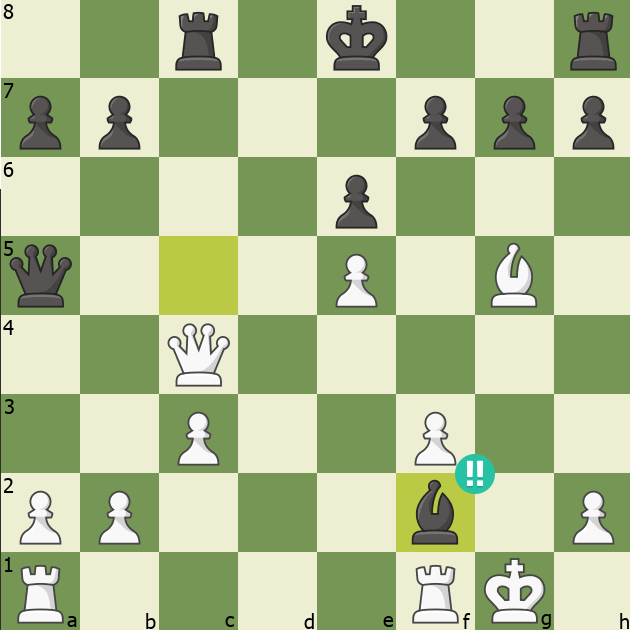
Brilliant Chess Move: Stunning Bishop Sacrifice Led to Checkmate
Most chess players have experienced it at least once. You spot a free pawn, win some material, and feel confident about your position—only to discover that your opponent had seen something much deeper.
Why Your Chess Accuracy Drops After Move 15
If your chess accuracy drops after move 15, the problem is not that you suddenly become a worse player. The problem is that the game has shifted from memory to understanding, and you have not trained that transition enough.
Why You Always Get in Time Trouble (And How Stockfish 18 Fixes It)
Every chess player knows the feeling. You navigate the opening perfectly. You transition into a solid middlegame. You build a completely fine, perhaps even slightly superior, position. And then, you glance at the clock. Your opponent has 15 minutes left. You have 42 seconds. Panic!