Why You Keep Losing Rook Endgames: What Stockfish Sees That You Don’t
Rook endgames are where chess players discover whether they really understand the board or whether they were simply surviving until the pieces came off. They look simple because there are fewer units left, but in practice they are full of invisible tactical details, tempo races, side checks, king activity, and one-move inaccuracies that completely change the result.
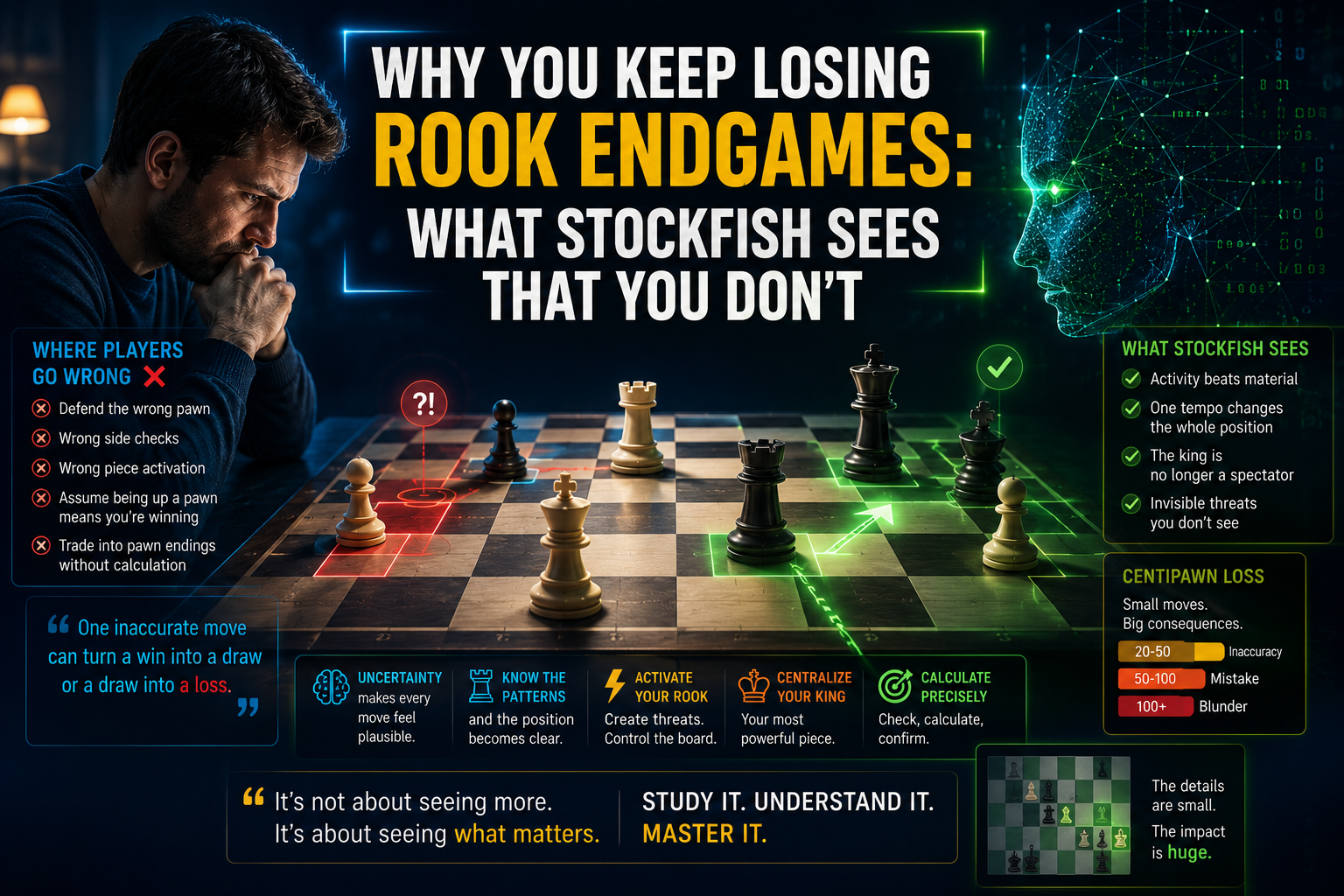
Most club players do not lose rook endgames because they are bad at calculation in general. They lose them because they mis-evaluate priorities. They defend the wrong pawn. They check from the wrong side. They activate the wrong piece. They assume being up a pawn means they are winning. They trade into pawn endings they never properly calculated. Then, after the game, they blame time trouble.
The hard truth is that time trouble is often just a symptom. The real problem is uncertainty. When you do not know the key patterns, every rook move feels plausible. When you do know the patterns, the position becomes much clearer. You stop choosing from ten candidate moves and start choosing from two.
This is where DeepBlunder has a clear content edge. Generic chess blogs often tell readers to “activate your rook” or “centralize your king.” That advice is not wrong, but it is too vague to change behavior. DeepBlunder content should always go one level deeper: show the blunder, show the engine idea, show the centipawn swing, and explain why the human move feels natural even when it is objectively wrong.
Why rook endgames still break club players in 2026
The reason rook endgames remain so painful is simple: they punish shallow thinking. In many middlegames, a decent plan can compensate for imperfect accuracy. In rook endgames, one inaccurate move can turn a win into a draw or a draw into a loss in just a few seconds.
This is especially frustrating because the positions often look calm. There are no queens on the board. There is no immediate mating attack. No piece is obviously hanging. And yet the evaluation changes dramatically after one rook move because rook endgames are built on geometry. A rook on the wrong rank is not just “a little passive.” It may no longer cut off the king, no longer defend from the side, no longer check from behind, and no longer support a passed pawn at the right moment.
That is why so many players experience the same emotional pattern:
They come out of the opening fine.
They survive the middlegame.
They simplify while slightly better.
They reach a rook endgame and feel optimistic.
Five moves later, the engine says the position is equal.
Ten moves later, the engine says they are lost.
This emotional collapse is not random. It comes from several recurring mistakes that appear in thousands of online and over-the-board games every day.
What Stockfish sees before you do
A strong engine does not “panic” about the kinds of details that confuse humans. It evaluates structure, activity, king paths, checking distance, and tactical resources all at once. Humans often see one idea at a time.
Activity beats material
One of the biggest differences between engine logic and human logic is how much value the engine gives to activity. Club players cling to pawns. Engines cling to mobility.
If you are up a pawn but your rook is stuck defending it from behind while the enemy rook is active, your extra pawn may not matter. In fact, your extra pawn may be the reason you lose, because it ties your rook down to passive defense. Stockfish often prefers a line where a player temporarily gives back material if it frees the rook, activates the king, or creates a checking net from the side.
Humans resist this because material is visible and activity is abstract. You can count a pawn. You cannot count “practical energy” as easily. Yet in rook endgames, the active rook is often the true extra piece.
One tempo is often the whole position
In rook endings, players talk about “only one move” as if it were a cliché. It is not a cliché. It is the format. If your king reaches one square first, the rook gains checking distance. If your rook reaches the fourth rank first, you build the bridge. If your passed pawn advances one move too early, it becomes a target.
This is why engines punish “natural” moves so brutally. A move can look sensible and still be positionally fatal. The move did not hang a rook or blunder mate. It just lost a tempo. In a rook ending, losing a tempo can mean losing the structure of the whole position.
The king is no longer a spectator
Many club players carry middlegame instincts into the endgame. They still treat the king as something to shelter rather than mobilize. That habit is disastrous.
Once major attacking pieces are gone, the king must become an active unit. A king one square closer to the center can be the difference between defending a pawn and losing it, between supporting a passer and failing to queen it, between holding a draw and getting cut off forever. Players who “wait” with king activation are usually not being careful. They are simply late.
What is centipawn loss, and why should you care?
If you want to write classic DeepBlunder content, you need to translate engine judgment into human language. One of the easiest bridges is centipawn loss. The term refers to how much value a move gives away compared to the engine’s best move, measured in hundredths of a pawn.
That sounds technical, but the idea is practical. If the best move keeps your advantage at +1.80 and your move drops it to +0.60, you did not just play “slightly worse.” You handed away a huge chunk of your edge. In rook endgames, these swings happen all the time because the position is so sensitive to precise rook placement and king routes.
Average centipawn loss matters because it tells a truth the final result can hide. You can win a game and still play the endgame badly. You can draw a game and still miss a winning technique. You can lose a game and blame flagging when the engine shows that the decisive mistake happened six moves earlier.
For coaching-style content, centipawn loss works especially well because it gives readers a number attached to a feeling they already know. They know the sensation of “I think I messed this up.” The engine lets you name exactly how much.
A better way to explain centipawn loss to readers
Instead of defining it in cold technical terms, frame it like this inside your content:
A 10 to 20 centipawn loss move is usually a small inaccuracy.
A 30 to 80 centipawn loss move often means you drifted from the best plan.
A 100 plus centipawn loss move is usually a serious mistake.
A 300 plus centipawn loss move in an endgame often means you just transformed the result.
That framing is simple, sticky, and perfect for SEO because it matches how users search. They are not typing “engine evaluation calibration in late-stage rook endings.” They are typing “what is centipawn loss in chess” and “how bad is 100 centipawn loss.”
The 7 rook endgame mistakes club players keep repeating
1. Passive rook, active opponent
The most common rook ending mistake is placing your rook where it merely guards weaknesses instead of creating threats. Passive defense feels responsible. In reality, it often makes your position collapse slowly.
A passive rook typically leads to three problems:
Your king gets overloaded with defensive tasks.
Your rook loses checking distance.
Your opponent improves for free.
A good rule of thumb is this: if your rook can only move along two or three squares without losing something, it is probably too passive. In many positions, the practical solution is not “defend better.” It is “counterattack faster.”
2. Checking from the wrong side
Rooks love distance. Side checks work best when the rook has enough files to harass the king repeatedly. If you check from the short side, you may run out of room after one or two checks and the enemy king can hide.
This is why the short side and long side concept matters so much. The defending king usually belongs on the short side of the pawn. The rook usually wants the long side to maximize checking space. Players who do the reverse often feel as though the position “suddenly” became losing. It did not suddenly become losing. The defensive setup was wrong from the start.
3. Pushing the passed pawn too early
A passed pawn creates urgency, so weaker players often push it immediately. That instinct is understandable but dangerous.
Before you advance a passed pawn in a rook endgame, ask:
Does the push improve my king’s access?
Does the push give my rook a better square?
Does the push limit the enemy king?
Or does it simply turn the pawn into a fixed target?
Many winning rook endings are won not by racing the pawn first, but by improving king position, cutting off the enemy king, and only then pushing the pawn when the tactical details are ready.
4. Forgetting to cut off the king
The enemy king is often the real defender. If you do not cut it off, it will walk toward your pawn and neutralize your advantage.
This is one of the easiest things for engines to notice and one of the easiest things for humans to miss because the threat is slow rather than dramatic. The king is not attacking anything immediately. It is just approaching. But in rook endgames, “just approaching” is a major event.
When reviewing your games, a strong DeepBlunder-style question is:
At what moment could I have cut off the king, and what happened because I failed to do it?
That question teaches pattern recognition much faster than generic post-game commentary.
5. Trading rooks without calculating the pawn ending
Players often think, “Rook trade equals simplification, simplification equals safer.” That is one of the most expensive shortcuts in chess.
Many rook endings are drawable with active rook play but losing as pawn endings. Others are hard to convert with rooks on the board but trivially winning once the rooks come off. If you trade without calculating the resulting king-and-pawn race, you are not simplifying. You are gambling.
A practical review habit is to freeze the position right before the rook trade and ask:
If rooks disappear immediately, whose king arrives first?
Which side creates a passed pawn first?
Is opposition relevant?
Is one pawn structure fatally weak?
6. Playing the move that “looks active” instead of the move that solves the position
Club players often know that activity matters, so they swing too far the other way. They stop playing passive moves, which is good, but then start making flashy rook moves that create motion without solving the actual problem.
In rook endings, activity is not random movement. It is purposeful coordination. A rook move is active only if it improves checking distance, supports promotion, cuts off the king, attacks weak pawns, or forces concessions. If the rook just looks busy, the move may still be empty.
7. Hoping instead of calculating in time trouble
Time trouble does not invent weaknesses. It exposes them. If you reach move 45 and still do not know whether you should check from behind, trade rooks, or bring the king, you will spend time because the position is structurally unclear to you.
That is why the best solution to rook endgame panic is not simply “play faster.” It is learn more patterns before the game. The more theoretical positions and practical setups you recognize, the fewer branches you need to calculate over the board.
The DeepBlunder framework: how to review a rook endgame like an engine-assisted coach
DeepBlunder content becomes memorable when it does more than explain the answer. It explains why the wrong move feels so tempting. That emotional and cognitive layer is the real product fit.
Use this five-step framework whenever you review a rook ending:
1. Freeze the first critical moment
Do not start with the final blunder. Start with the first move where the evaluation clearly shifts. That is usually where the misunderstanding begins.
2. Compare your move with the engine move
Do not just note that the engine disliked your move. Ask what changed concretely:
King activity
Rook activity
Pawn structure
Checking distance
Promotion race
Ability to cut off the king
3. Name the human illusion
Every blunder has a story you told yourself. Maybe it was:
“I should keep the extra pawn.”
“Checks are always safe.”
“Trading simplifies.”
“My king should stay protected.”
“I’ll push the passer and ask questions later.”
If you name the illusion, you are far less likely to repeat it.
4. Translate the engine line into one principle
Do not memorize fifteen-move engine lines unless the position is theoretical. Instead, extract one practical lesson:
Activate before defending.
Improve the king before pushing.
Check from the long side.
Cut off first, advance second.
Calculate the pawn ending before trading.
5. Save one pattern, not the whole game
People forget full games. They remember patterns. Turn each review into one reusable pattern card. That is the content loop DeepBlunder should own.
Find the blunder: a model example
Imagine this practical scenario. White is up one pawn in a rook ending. White’s rook is active, but Black’s king is not fully cut off. White sees a passed pawn chance and pushes immediately. The move looks energetic. It also feels forcing, which makes it psychologically attractive.
Then the evaluation drops.
Why? Because the pawn push allowed Black’s rook to attack from the side while Black’s king used the newly fixed pawn as a target. White turned a flexible advantage into a static weakness. The human move said, “I am making progress.” The engine move said, “You are choosing the wrong kind of progress.”
This is the exact kind of moment that makes for strong article hooks, social clips, and interactive “Find the Blunder” formats:
Position on screen.
Prompt: “White to move. Do you push the pawn?”
Reveal: “Stockfish says no.”
Explanation: “Because your king is not active enough and the rook loses checking control.”
You don’t need another vague “study endgames” reminder. You need to see the exact move where your position stopped being good and the exact reason the engine hated it.
Analyze 1 game for free with DeepBlunder and find the moment your rook endgame went from winning to drawable, or from drawable to lost. Instead of memorizing random theory, you will see what Stockfish saw, why your move felt natural, and which practical pattern you should actually train next.
The 4 rook endgame patterns every improving player must know
Lucena: the bridge-building win
The Lucena position is one of the most famous rook endgames because it teaches a core truth: winning is often about creating shelter from checks, not just promoting a pawn.
The key idea is simple. Your king has reached the promotion square in front of the pawn, but the enemy rook is checking from the side. If you panic and move the king aimlessly, you may drift into perpetual checks or even throw away the win. The proper method is to build a bridge with your rook, usually by bringing it to the fourth rank, so the king can step out and the rook can interpose.
What players get wrong:
They move the king too early.
They allow repeated side checks.
They do not understand why the rook belongs on the fourth rank.
They know the name “Lucena” but not the geometry.
How to make Lucena useful in practical play:
Learn the visual pattern, not just the label.
Practice it from both colors.
Set it up against an engine until you can win it quickly.
Notice how the winning technique depends on coordination, not speed.
Philidor: the defensive wall
The Philidor position is the defensive twin of Lucena. If you are down a pawn but your king is well placed and your rook controls the right rank, the position can often be held.
What makes Philidor so practical is that it teaches disciplined defense. The defender keeps the rook on the third rank to stop the enemy king from advancing. Once the pawn reaches the sixth rank, the defender switches to checking from behind.
What players get wrong:
They start checking too early.
They abandon the rank barrier.
They let the enemy king step forward.
They confuse “activity” with “random checks.”
The lesson is powerful beyond the exact theoretical setup. Good rook defense often means knowing when not to check yet.
Short side defense: checking space matters
Short side defense is one of those ideas that sounds abstract until it wins or saves a game. Once you understand it, you start seeing why certain defensive setups feel cramped and others feel effortless.
The principle is:
Put the defending king on the short side of the pawn.
Put the rook on the long side so it has room to check.
Why it matters:
The rook needs horizontal space.
The attacking king needs shelter.
Every extra file changes whether checks are sustainable.
A lot of “mysterious” engine evaluations in rook endgames become much less mysterious once you understand this single spatial rule.
Vancura-type defense: saving bad-looking positions
The Vancura setup is more advanced, but it is a fantastic teaching weapon because it shows how active rook placement can rescue apparently hopeless positions against rook pawns or edge pawns.
Even if your readers do not memorize every detail, exposing them to the idea is useful. It trains the deeper lesson that defense is not always about sitting and waiting. Sometimes the saving resource is active harassment from the side combined with precise king placement.
That idea fits DeepBlunder perfectly:
The human eye sees “lost.”
The engine sees “holdable.”
The content explains the hidden mechanism.
How to train rook endgames without hating the process
A lot of players avoid endgame work because they think it means long manuals, sterile diagrams, and slow progress. That is the wrong model. The best endgame training for most improvers is short, repetitive, and tightly connected to their own mistakes.
A practical 15-minute rook endgame routine
Here is a compact routine that actually sticks:
5 minutes: one theoretical position
Pick one setup:
Lucena
Philidor
Short side defense
Rook behind passed pawn
King cut-off technique
Replay it until the geometry feels familiar.
5 minutes: one personal blunder
Take a real game you played. Find the first major evaluation shift. Ask:
What changed?
What should I have prioritized?
Which pattern does this resemble?
5 minutes: one engine-tested correction
Play the corrected setup against an engine or board editor from both sides. Do not just read the answer. Execute it.
This routine works because it turns abstract knowledge into muscle memory. The goal is not to become an endgame encyclopedia. The goal is to stop making the same expensive mistakes.
What to measure when you review
Instead of asking “Did I win?” ask:
Did I activate my rook early enough?
Did I centralize my king fast enough?
Did I cut off the enemy king?
Did I calculate the rook trade?
Did I push the passed pawn at the right time?
Did I allow side checks from the long side?
Did I understand the critical pattern?
These questions are much more actionable than the game result.
FAQ
Why do I keep losing rook endgames?
Because rook endgames are less about general chess “feeling” and more about exact priorities. Most players lose them by misjudging rook activity, king activity, checking distance, pawn timing, and rook trades. If you consistently feel better out of the middlegame but worse after simplification, rook endings are probably a real rating leak rather than random bad luck.
What is the biggest rook endgame mistake for club players?
The biggest mistake is passive rook placement. Club players often defend weaknesses with the rook instead of using the rook actively to check, cut off the king, or attack weaknesses. Once the rook becomes passive, the rest of the position often gets tied down.
Is being up one pawn enough to win a rook endgame?
Not always. An extra pawn means very little if your rook is passive, your king is far away, or the defending side has active checking resources. Many one-pawn rook endings are drawn with correct technique.
Should I always keep my rook behind the passed pawn?
As a practical default, yes, this is often a very strong rule. A rook behind a passed pawn supports promotion if it is your pawn and attacks it efficiently if it is the opponent’s pawn. But like all rules, it depends on the exact king positions and checking resources.
What is centipawn loss in chess?
Centipawn loss measures how much value your move gave away compared with the engine’s best move, measured in hundredths of a pawn. In practical terms, it helps you identify whether your move was a tiny inaccuracy, a serious mistake, or the move that changed the result of the endgame.
Which rook endgames should beginners learn first?
Start with:
Lucena position
Philidor position
Short side defense
Rook behind passed pawn
Basic king cut-off patterns
These positions give you a very high practical return because they appear in many related structures, not just in textbook diagrams.
How can I improve rook endgames fast?
Use a focused loop:
Learn one key pattern.
Review one personal blunder.
Replay the corrected setup.
Test it against an engine.
Repeat.
This approach is faster than reading dozens of pages without applying them to your own games.
How do I analyze rook endgames with Stockfish without getting lost?
Do not start by reading the full engine line. Start by identifying the first move where the evaluation changes significantly. Then ask what changed: rook activity, king access, checking distance, pawn timing, or trade consequences. Once you know the reason, the engine line becomes much easier to understand.
Why do rook endgames feel harder than middlegames?
Because they remove the noise. In the middlegame, you can survive with broad principles and practical complications. In the endgame, every square matters more. You have fewer pieces, but each move carries more strategic and tactical weight.
Are rook endgames really worth studying for club players?
Yes, because they occur often in practical play and they convert small advantages or save difficult defenses. Even modest improvement in rook endgames can produce immediate rating gains because so many players mishandle them.
From the same category
Keep reading
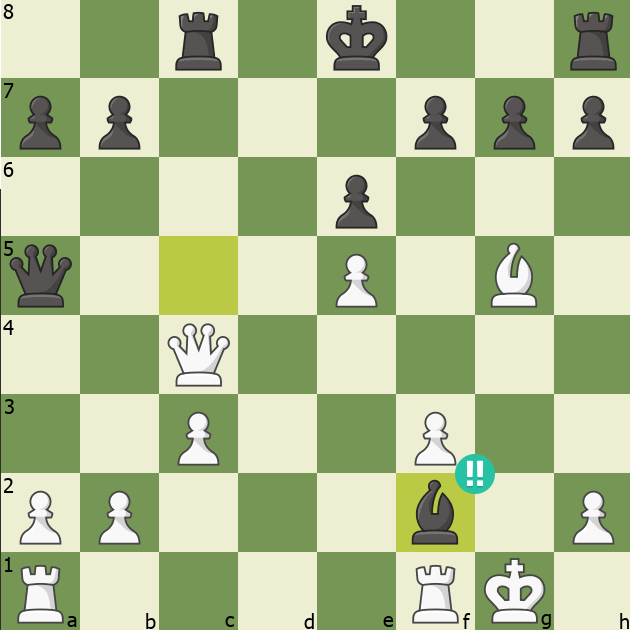
Brilliant Chess Move: Stunning Bishop Sacrifice Led to Checkmate
Most chess players have experienced it at least once. You spot a free pawn, win some material, and feel confident about your position—only to discover that your opponent had seen something much deeper.

Why Your Chess Accuracy Drops After Move 15
If your chess accuracy drops after move 15, the problem is not that you suddenly become a worse player. The problem is that the game has shifted from memory to understanding, and you have not trained that transition enough.
Why You Always Get in Time Trouble (And How Stockfish 18 Fixes It)
Every chess player knows the feeling. You navigate the opening perfectly. You transition into a solid middlegame. You build a completely fine, perhaps even slightly superior, position. And then, you glance at the clock. Your opponent has 15 minutes left. You have 42 seconds. Panic!