Prophylaxis in Chess: How to Think One Move Ahead of Your Opponent
Prophylaxis is one of the most misunderstood concepts in club chess. Most players spend their think-time calculating what they want to do. Strong players spend equal time asking: what does my opponent want to do -- and how do I stop it before it happens?
That difference in thinking habits separates players who plateau at 1400 from those who push through 1800 and beyond.
This article breaks down prophylaxis in concrete, learnable terms. You will see how the concept works in real positions, not just as a vague principle, but as a specific question you can ask on every move.
What Is Prophylaxis in Chess?
Prophylaxis (from the Greek prophylaktikos, "guarding in advance") is the habit of making a move that prevents your opponent's best plan, without compromising your own position.
Nimzowitsch coined the term in My System (1925) and it remains one of the most durable ideas in positional chess. The core question is simple:
"What would my opponent play if it were their move right now?"
You ask that question. You evaluate whether their plan is dangerous. If it is, you make a move that either prevents it outright or makes it significantly less effective. If their plan is not dangerous, you proceed with your own idea.
Prophylaxis is not passive chess. It does not mean playing defensively or without ambition. It means being one step ahead -- playing confidently because you have already defused the bomb.
Why Club Players Miss It
At the 1200-1600 level, chess thinking is almost entirely offensive. Players look at the board through their own eyes: what can I take? What can I attack? What tactic is there for me?
The opponent's ideas are treated as reactions to your play, not as independent threats you need to anticipate. This creates a pattern the DeepBlunder engine catches constantly: a player executes a four-move plan perfectly, then on move five -- when there are no immediate tactics -- plays a routine developing move and gets hit by the counterattack they never considered.
The DeepBlunder AI analysis of thousands of club games shows that most blunders in the 1400-1700 range are not calculation errors. They are attention failures -- the player simply never asked "what does my opponent want?"
Prophylaxis is the cure for that category of mistake.
The Prophylactic Question in Practice
Let's look at a concrete example from the Italian Game -- one of the most theoretically rich middlegames at the club level.
Position 1: A Standard Italian Middlegame
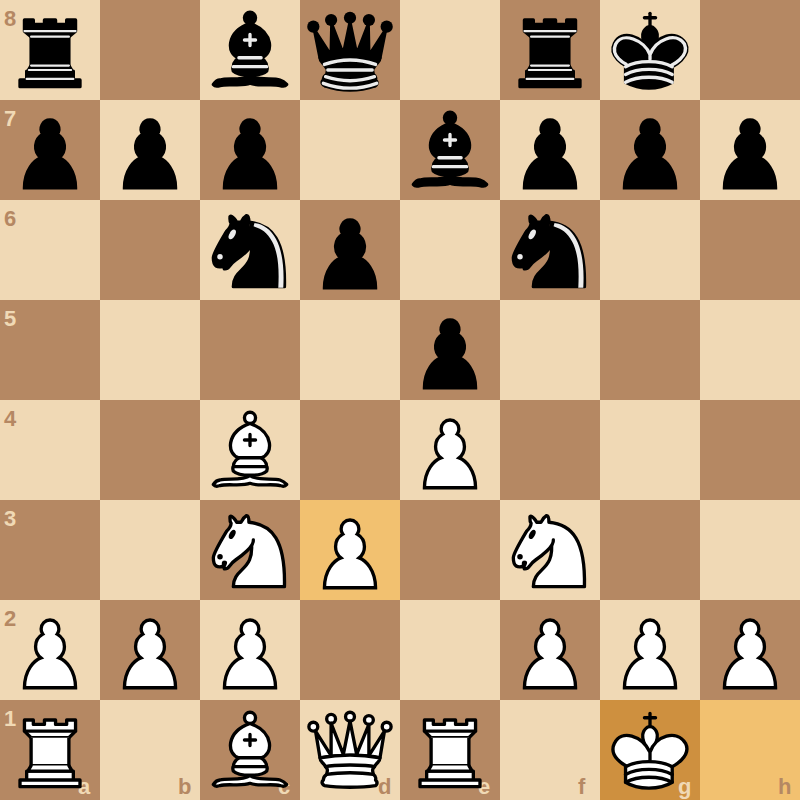
This is a typical position after 1.e4 e5 2.Nf3 Nc6 3.Bc4 Bc5 4.0-0 Nf6 5.d3 0-0 6.Nc3 Be7 7.Re1 d6 8.Bb3 (the classic Giuoco Piano setup). White has castled, has a solid pawn center, and the bishop on b3 is well-placed.
But stop. Ask the prophylactic question: what does Black want to do?
Black's most natural plan involves ...Nd7 followed by ...Nf8-g6, contesting the kingside. Critically, Black also has the resource ...Na5, hitting the b3 bishop and creating queenside pressure. If White simply plays Nd2 without thinking, Black plays ...Na5 and White's bishop must move again. After Bb2 ...Nc4, the knight lands on c4 with tempo and Black has equalized.
The prophylactic move is h3 -- preventing ...Ng4 ideas and slightly restricting Black's piece activity, while being a completely neutral pawn move that costs nothing. This is prophylaxis at its most practical: a one-tempo investment that removes an opponent option entirely, played before the threat has materialized.
Position 2: The Bishop Retreat That Prevents Everything
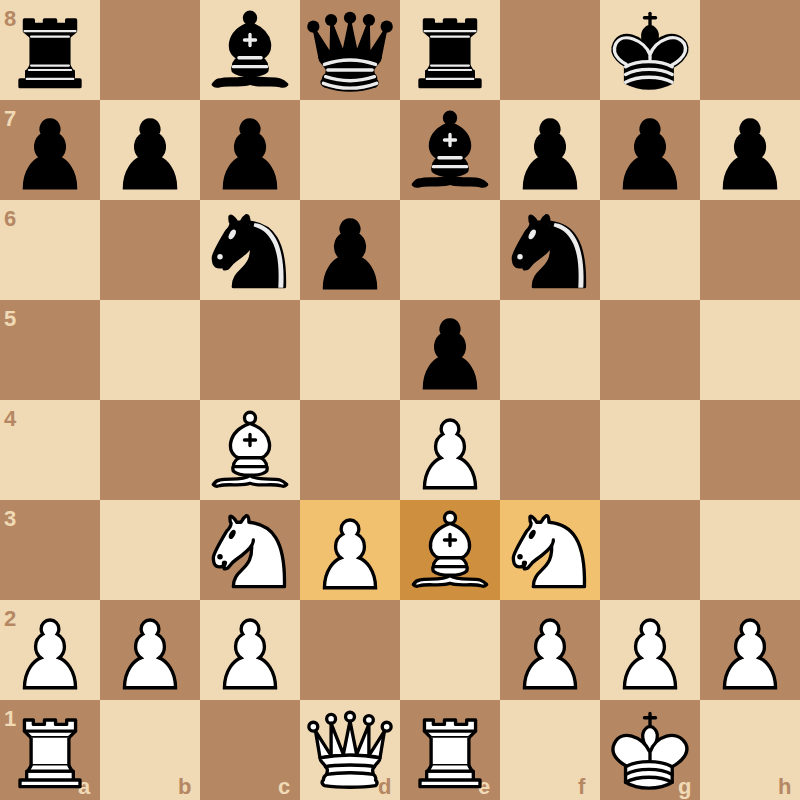
Here White has just played Be3. Black's main counterplay involves putting pressure on the e4 pawn via ...Nd4 or using the d4 square for a knight after trading the c3 knight. The bishop on e3 directly monitors d4, making ...Nd4 considerably less effective. This is restriction prophylaxis -- you are not preventing a specific tactic but reducing the scope of your opponent's pieces before they reach their ideal squares.
Three Patterns to Learn
Prophylaxis is not one idea -- it is a family of related thinking habits. Here are the three most important patterns you need to recognize.
Pattern 1: Square Seizure Before Occupation
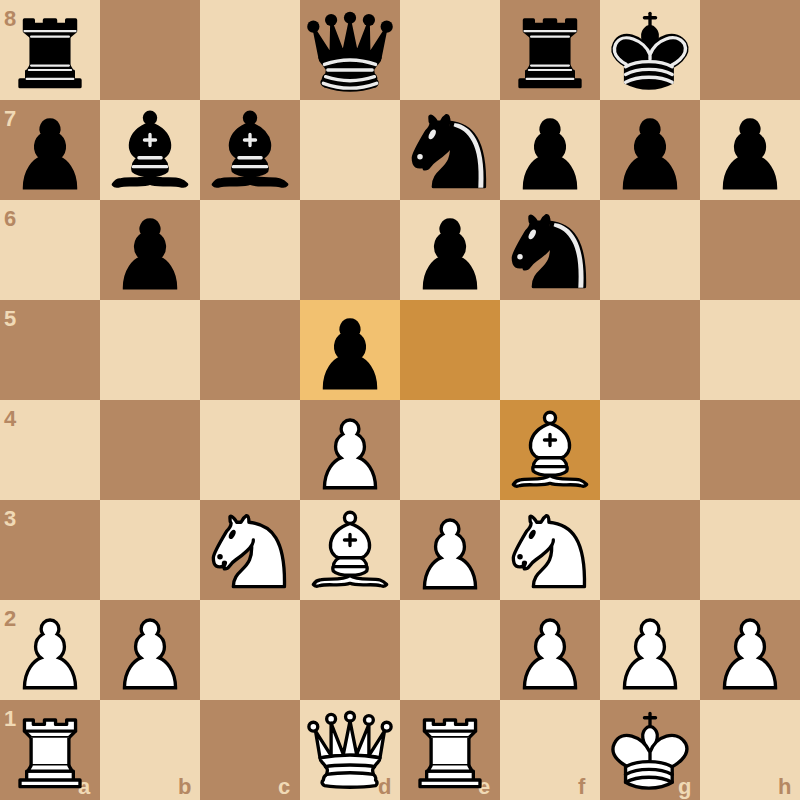
In this Queen's Gambit declined-type structure, White's bishop sits on f4. Black's knight on f6 is eyeing g4 -- if it reaches g4, it attacks the bishop and generates activity. More problematically, with ...Ne4 ideas also on the horizon, Black's minor pieces are about to become very active. The prophylactic response is the move pair h3 followed by g3, preventing ...Ng4 permanently and stabilizing the bishop's position.
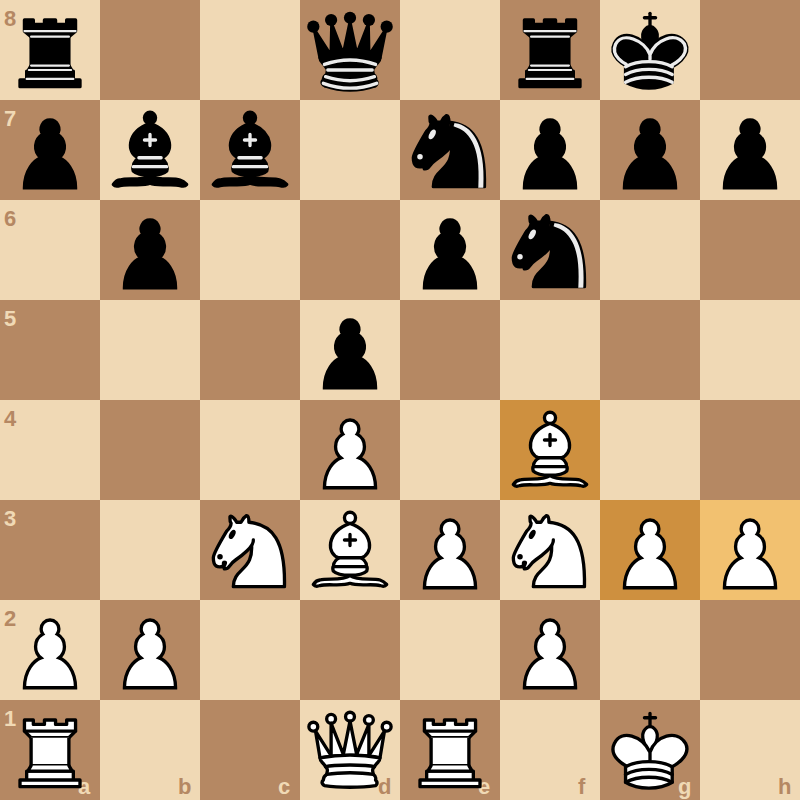
After h3-g3, Black's knight has no access to g4 and White's f4 bishop is secure. White spent two moves on prophylaxis. In exchange, White gets a position where Black has to find an entirely new plan. That is a good trade.
Pattern 2: Rook Endgame Prevention
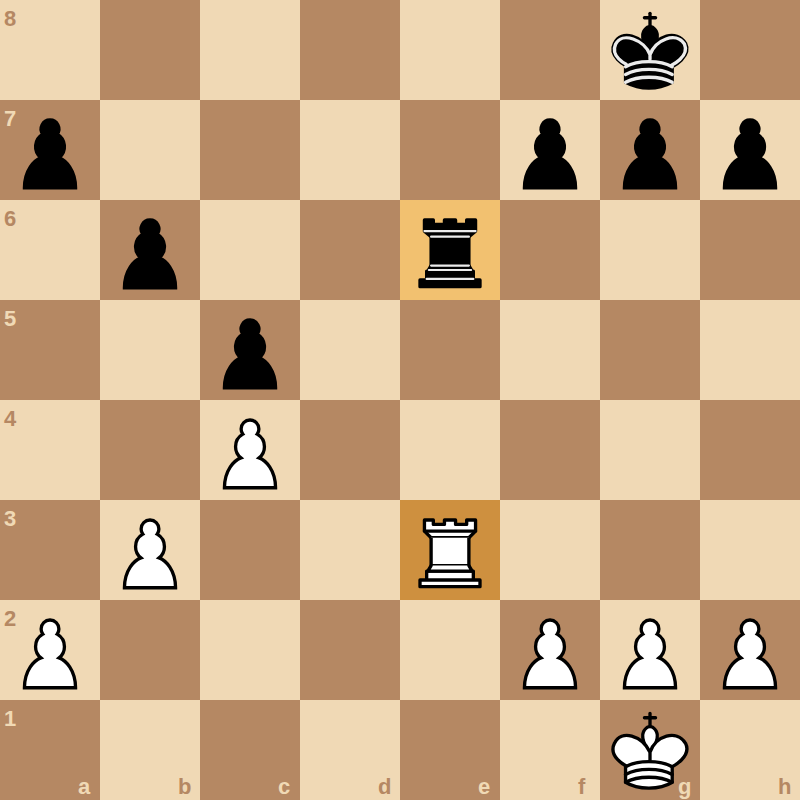
Prophylaxis becomes even more critical in endgames, where every tempo matters. The natural-looking move is to advance a queenside pawn -- but stop and ask: what does Black want? Black wants to activate the rook along the sixth rank, potentially swing it to the kingside via f6 or g6, and create a passed pawn on the queenside.
The prophylactic approach is to first position the king -- Kf2-e3-d3 -- cutting off Black's rook from queenside files and centralizing for the pawn endgame. Without this foresight, White reacts to Black's rook activity instead of preventing it. Prophylaxis in endgames is often about king placement: the player who centralizes first forces the opponent to react.
Pattern 3: Preventing the Open File Invasion
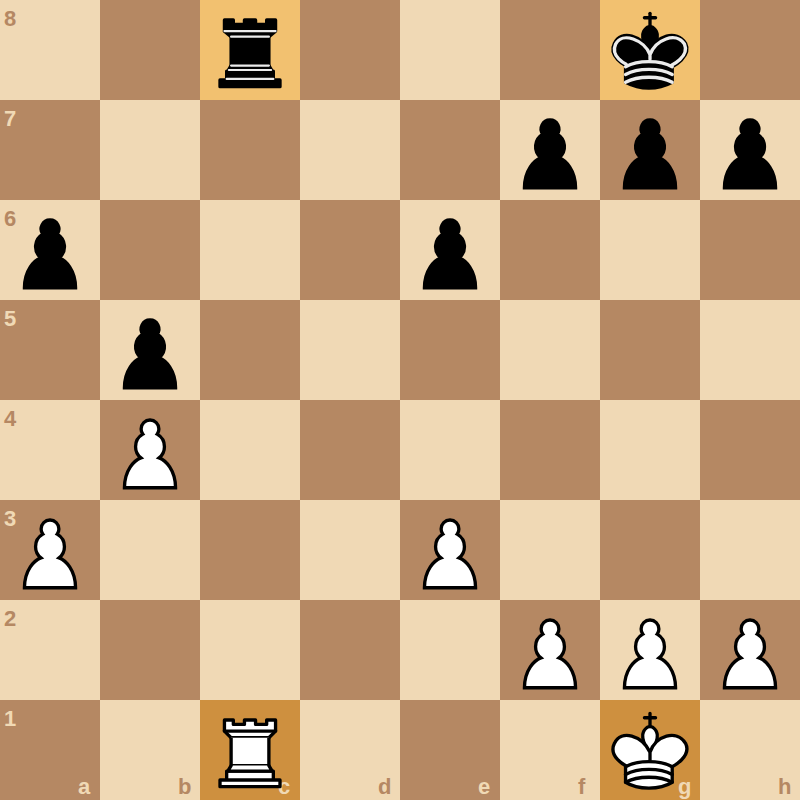
In symmetrical rook endgames, the c-file is the central battleground. Both sides want rook control. The prophylactic question: if it is Black's move, they will swing to the seventh rank. White's answer is to contest the c-file immediately and target Black's second rank before Black targets White's. Whoever reaches the seventh rank first gains a decisive positional advantage. Most club players see this as an attacking idea rather than a prophylactic one. The thinking is identical: you are asking what your opponent wants and getting there first.
Prophylaxis vs. Passivity: Where Players Go Wrong
The most common misapplication of prophylaxis is confusing it with passivity.
Passivity is making a neutral or retreating move because you do not know what else to do.
Prophylaxis is making a specific move because you have identified your opponent's threat, assessed it as dangerous, and neutralized it -- while retaining the initiative or your own plans.
The test: after your prophylactic move, do you still have a plan? If yes -- you have played prophylaxis. If you made the move and now feel stuck, with no idea what comes next -- that was passivity dressed up in theory.
When you prevent one of your opponent's plans with h3, you must immediately pivot back to your own agenda: perhaps a queenside majority push, a knight rerouting, or a pawn break. Prophylaxis buys you time; it does not win games on its own.
How to Train Prophylactic Thinking
The best training method is opponent-move prediction -- before every move you make, force yourself to state what your opponent's best response would be. This breaks the habit of one-directional thinking.
Before you move, ask: "If it were my opponent's move right now, what is their single best move?"
Evaluate whether that move is dangerous. If yes, ask: "Can I prevent it without losing tempo?"
If you can prevent it cheaply, do so. Then re-evaluate your plan.
This sounds mechanical, and initially it is. With practice, the question becomes automatic -- part of the rhythm of your calculation rather than a separate step. The DeepBlunder app makes this training explicit: when the engine flags a blunder, the analysis often shows that the missed move was a prophylactic one. Training your eye to recognize these positions is how you convert engine recommendations into actual game improvement.
The Grandmaster's Lens
Karpov is the canonical example of prophylactic chess. His games from the 1970s and 1980s are masterclasses in preventing opponent counterplay -- he would routinely make quiet moves that on closer inspection were precisely timed to deprive Black of every active plan.
Study any Karpov game from his 1978 or 1981 world championship matches against Korchnoi. Look for moves that seem to accomplish nothing -- no piece is developed, no pawn advances. Ask yourself: what was Karpov preventing? The answer is usually a significant piece rerouting or a pawn break that would have given Korchnoi exactly the counterplay he needed.
Petrosian is another essential study. His use of prophylaxis was so extreme that critics called his style prophylactic to a fault -- but he became World Champion with it. You do not need to play like Karpov. But adopting even 200f his habit -- pausing to ask "what does my opponent want?" -- will eliminate a significant percentage of your worst blunders.
Frequently Asked Questions
Is prophylaxis the same as playing defensively?
No. Prophylaxis is a specific thinking technique -- asking what your opponent wants and pre-empting it -- not a style of play. Aggressive, attacking players use prophylaxis constantly. Magnus Carlsen plays prophylactically even in sharp tactical positions: he avoids lines where his opponent gets dangerous compensation not by retreating, but by choosing lines that deny the opponent's best counterplay from the outset.
How do I know when to prioritize prophylaxis over my own attack?
Use a rough decision rule: if your opponent's plan would generate decisive threats within two to four moves, stop it first. If their plan is slow and you can create threats faster, proceed with your own agenda. The key is accurately assessing the tempo -- how quickly does their plan become dangerous?
What is the difference between prophylaxis and a waiting move?
A waiting move has no specific goal -- you play it because you are unsure what to do and hope your opponent makes an error. Prophylaxis has a precise target: you have identified your opponent's threat and you are removing it. The visual result may look similar (a quiet move), but the thinking is entirely different.
Can prophylaxis be learned, or is it an intuitive skill?
It can absolutely be learned, and the learning mechanism is repetition of the habit: asking the prophylactic question on every single move, even when you are attacking. After a few hundred games of consciously asking "what does my opponent want?", the question becomes automatic. Use DeepBlunder's game analysis to audit your games specifically for missed prophylactic moments -- positions where a quiet, inexpensive move would have stopped your opponent's winning idea entirely.
Are there common pawn structures where prophylaxis is especially important?
Yes. The IQP (isolated queen's pawn) structure demands prophylaxis from both sides: the side with the IQP must prevent blockading moves (typically ...Ne4 or ...Nd5 for Black); the side blockading must prevent the IQP side from launching kingside attacks with e5. The King's Indian Defence and the Grunfeld also feature systematic prophylaxis -- White must constantly neutralize Black's ...e5 or ...d5 breaks, while Black prevents White's queenside pawn advances.
Start Seeing the Board Differently
Prophylaxis is ultimately a habit of empathy -- imagining yourself on the other side of the board, seeing the position through your opponent's eyes, and removing their best option before they play it.
The strongest practical skill you can develop at the club level is not a new opening or a sharper tactical eye. It is the habit of pausing before every move to ask one question: what does my opponent want?
That question, asked consistently, will eliminate the category of blunders that comes not from miscalculation but from simply not noticing what the other player was trying to do.
Use DeepBlunder to review your recent games. Sort your blunders by type -- and look specifically for moves where the engine recommends a quiet, non-developing move that seems to do nothing. Those are the prophylactic moves you missed. Understanding why the engine values them so highly is the fastest way to internalize this skill and start applying it at the board.
Related reading: How to stop hanging pieces in chess | Why you blunder right after finding a good move | Why you keep missing zwischenzugs
From the same category
Keep reading
Chess Accuracy Explained: What Your Score Really Means at Every Rating Level
Learn what your chess accuracy score actually measures, what 80%, 95%, 97% and 99% mean at every rating level, and when high scores look suspicious.
The Discovered Attack: How to Unleash Hidden Tactics in Chess
Learn how to spot and execute the discovered attack, one of the most explosive and game-winning tactical motifs in chess. Includes step-by-step master examples, diagrams, and a 3-point checklist.
The Greek Gift Sacrifice: How to Spot and Execute the Classic Bishop Sac
Learn how to spot, calculate, and execute the Greek Gift Sacrifice (Bxh7+). Master the 4-point checklist and defeat every king retreat with this classic chess tactic.