Why do you keep missing zwischenzugs in chess?
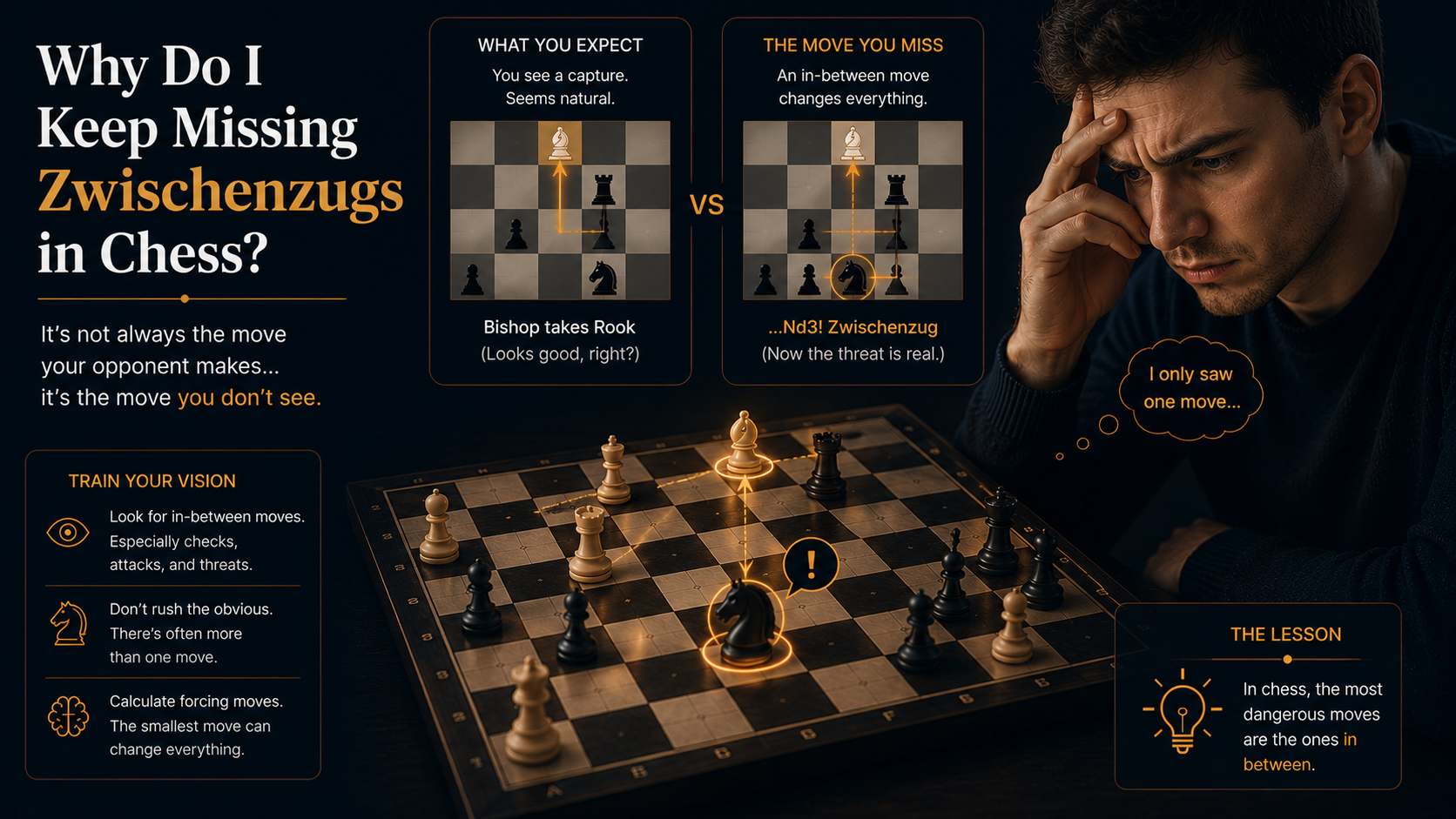
A lot of chess players do not lose tactics because they cannot calculate at all. They lose them because they calculate the expected line, assume the expected recapture, and completely miss the one move in the middle that changes everything.
That move is often a zwischenzug, also called an in-between move. It appears when one player interrupts the “obvious” sequence with a stronger move first, usually a check, threat, attack, or tactical resource that changes the order of events. Miss it once, and a good position can collapse fast.
If this keeps happening to you, the problem is usually not that zwischenzugs are too advanced. The real issue is that your brain loves automatic stories. You expect the normal sequence, trust the most natural recapture, and stop looking for the move that breaks the script.
That is why zwischenzugs hurt so much. They do not just punish bad calculation. They punish assumptions.
What a zwischenzug actually is
A zwischenzug is an in-between move played before the expected move in a tactical sequence.
The simplest version looks like this: one player takes a piece, and the other side seems forced to recapture. But instead of recapturing immediately, they insert a stronger move first. Maybe it is a check. Maybe it attacks the queen. Maybe it wins a rook with tempo. Maybe it changes the whole evaluation of the position before the “obvious” recapture even happens.
That is what makes the tactic so painful. The moves are often not hard to understand once you see them. The hard part is noticing that the sequence was never as automatic as it felt.
And that is why so many players miss them. They are not really failing to calculate a long line. They are failing to question the first assumption inside the line.
Why zwischenzugs are so easy to miss
You assume the recapture is forced
This is the most common reason.
A large number of tactical mistakes begin with a sentence in your head like:
“Of course they take back.”
“That is the only move.”
“Then I recapture and I’m fine.”
“The trade is automatic.”
The moment you tell yourself that, your calculation becomes narrower than the position deserves.
A zwischenzug punishes exactly that kind of thinking. It appears in the gap between what you thought had to happen and what the board actually allows. That is why the tactic often feels humiliating after the game. You were not outcalculated by ten moves. You were outcalculated by one move you never even considered.
This overlaps closely with the pattern DeepBlunder already covers in Why Do I Miss One-Move Threats in Chess?, where the core problem is often not a lack of tactical knowledge but a failure to check what the opponent can do before returning to your own idea.
A zwischenzug is often exactly that kind of missed threat, just hidden inside a sequence that looked forced.
You calculate the line you want to be true
Many players do not calculate neutrally. They calculate hopefully.
They see a tactical idea they like, a capture that wins material, or an exchange that seems to simplify the position. Then they start building a story that confirms the move:
I take.
They take back.
I take again.
I’m better.
That is not really analysis. It is a wish dressed as a variation.
A zwischenzug ruins that kind of calculation because it demands one extra question: what if the sequence does not continue the way I expect? If you never ask that question, you are not calculating the position. You are rehearsing the version of the position that makes you comfortable.
This is also why some players blunder right after finding a good move. DeepBlunder’s article on that exact pattern explains how a player often relaxes too early after spotting something strong and fails to reset their calculation for the new position.
A missed zwischenzug is often born in that same moment of premature satisfaction.
You stop after the first forcing idea
Most players are good at spotting the first forcing move in a line. They see the capture, the check, the exchange, or the tactical shot.
What they often miss is that the opponent also has a forcing move in return.
That is what makes zwischenzugs so dangerous. They often come from the side that appears to be “reacting,” but the reaction is not passive. It is active, precise, and timed perfectly. You expect a recapture. They give a check. You expect a simplification. They attack your queen. You expect a clean trade. They insert a move that forces your king into a worse square first.
A lot of amateur calculation stops one move too early. It handles the first punch and forgets the counterpunch.
Why zwischenzugs show up so often in real games
Between-moves are not rare puzzle tricks. They appear constantly in practical chess because so many positions contain the ingredients that make them possible:
loose pieces
exposed kings
overloaded defenders
active queens and rooks
forcing checks
natural but automatic recaptures
That is why they matter so much for improving players. If you miss one or two zwischenzugs per month, that is not just bad luck. It is a meaningful leak in your calculation process.
They also show up in exactly the kinds of positions players mishandle most often:
equal positions that feel safe
winning positions that feel under control
tactical sequences where one move seems obvious
quiet positions where the board looks too normal to be dangerous
DeepBlunder already has articles on several of those pain points, including Why Do I Keep Losing Equal Positions in Chess? and Why Do I Play Worse When I’m Winning in Chess?, both of which show how players often get punished not by deep mystery but by a drop in practical honesty at the wrong moment.
A missed zwischenzug is one of the cleanest examples of that.
The real enemy: automatic moves
The deepest lesson here is not about one tactic. It is about automatic thinking.
A lot of chess mistakes happen because players see a move that feels standard and stop testing it. In recapture sequences, this is especially dangerous. The brain loves closure. Once it sees a trade starting, it wants the trade to finish in the most normal possible way.
That is why between-moves are such a good training topic. They expose whether you are really looking at the board or just following a familiar script.
If you keep missing zwischenzugs, your problem may not be “I need harder tactics.” It may be this:
I trust automatic moves too much.
That is a much more useful diagnosis, because it gives you something concrete to work on.
The positions where players miss zwischenzugs most often
1. Recapture positions
This is the classic case.
One piece gets taken. The other side appears to recapture. The whole board starts to feel mechanical.
Then a check appears first.
Or a queen gets attacked.
Or a rook hangs with tempo.
Or the king is pulled into a vulnerable square before the recapture happens.
Recapture positions are dangerous because they make the human mind feel efficient. You think, “I already know what is next.” That is exactly the moment where you should become suspicious.
A useful practical rule is simple:
Whenever a recapture feels automatic, ask what happens if it isn’t.
That single question catches a surprising number of tactical problems.
2. Queen trades and major-piece exchanges
Many players relax around queen trades because they assume simplification lowers tactical risk.
Sometimes it does. But sometimes the queen trade is only “available” after one side inserts a tactical detail first. A check, attack on the rook, discovered threat, or intermediate capture can completely change whether the trade is favorable.
This is one reason players often feel cheated by the engine afterward. They thought they were simplifying. The engine shows they were stepping into a tactical sequence with a better move in the middle.
The problem was not simplification. The problem was assuming simplification happens cleanly by default.
3. Tactical wins that are not quite clean
You spot a tactic. You win material. You feel good.
Then the opponent has one active move first.
This is the exact kind of pattern DeepBlunder highlights in Why Do I Blunder Right After Finding a Good Move in Chess?. The move you found may be strong, but the new position still demands respect.
A zwischenzug often appears right there, in the gap between “I found the tactic” and “the tactic actually works the way I think.”
That is why these mistakes feel unfair. You did find something real. You were just not honest enough about the reply.
4. Winning positions
Winning positions are full of hidden between-moves, because the stronger side often becomes result-oriented. Instead of asking what the opponent can still force, they assume the position will convert itself.
DeepBlunder’s article on playing worse when winning makes this point very well: once players feel ahead, they often become passive, overconfident, or too focused on not ruining the result.
That is fertile ground for a zwischenzug, because the opponent’s last tactical resources stop getting the respect they deserve.
Outside discussion of conversion mistakes points the same way. Players regularly throw better positions by relaxing too early, rushing to simplify, or missing one final tactical resource from the defending side.
An in-between move is often exactly that resource.
5. Equal positions that feel dry
Equal positions are another perfect environment for missed between-moves.
Why? Because nothing appears dramatic. The position feels technical, normal, maybe even a little boring. Then a trade begins, one move seems routine, and suddenly a check or attack changes everything.
That connects directly to the logic in Why Do I Keep Losing Equal Positions in Chess?, where the danger lies in treating playable positions as if they will stay harmless on their own.
A zwischenzug in an equal position is rarely random. It is usually the punishment for one player drifting into autopilot.
Why the move feels obvious after the game
This is one of the most frustrating parts.
After the game, the zwischenzug often looks easy. You see the check. You see the attack. You see that the recapture was never forced.
That does not mean you are stupid for missing it.
It means the move belonged to a category the human brain regularly underchecks:
in-between replies
forcing moves inside “forced” lines
non-automatic recaptures
tactical interruptions inside clean-looking exchanges
This matters because it changes how you train. If you tell yourself, “I just need to calculate deeper,” you may miss the real issue. Often the issue is not depth. It is branching. You are not asking enough candidate questions inside the sequence.
A stronger way to frame it is:
I did not miss a long line. I missed one alternative move in a line I thought was automatic.
That is a very trainable problem.
What better players do differently
Stronger players are not immune to zwischenzugs, but they usually protect themselves in two important ways.
First, they distrust forced-looking sequences more.
Second, they scan for forcing replies before assuming the line is clean.
That means they ask things like:
Do they have a check first?
Can they hit my queen before recapturing?
Is one of my pieces overloaded after this trade?
What happens if they do not take back immediately?
What move would annoy me most here?
That last question is underrated. A lot of between-moves are not hard to spot once you stop looking for the most “correct” reply and start looking for the most annoying one.
Good practical players are often better at that than players who only calculate linear sequences. They think less like a machine and more like a dangerous opponent.
How to stop missing zwischenzugs in chess
1. Stop assuming recaptures are automatic
This is the foundation.
Every time a line includes an expected recapture, force yourself to ask:
What if they don’t take back yet?
What forcing move comes first?
What changed after my move?
What is hanging now?
You do not need to ask this forever on every move. But if missed zwischenzugs are a recurring issue, you do need to ask it often enough to change your habits.
2. Scan checks before recaptures
Checks are the most common kind of zwischenzug because they force the issue and often change the order of the whole position.
A very practical rule is:
Before assuming any trade finishes normally, check whether one side has an in-between check.
This is especially important when queens, rooks, or exposed kings are involved.
A lot of tactics that look deep are really just “the check in the middle.” If you miss that, the whole line becomes fantasy.
3. Treat “obvious” moves as suspicious
The more obvious a move feels, the more valuable it is to test it.
That sounds backward, but it is true. Most players inspect strange moves. They do not inspect natural ones. Between-moves thrive exactly there.
So if a line feels too clean, ask why. If the recapture feels too automatic, ask what could interrupt it. If the position looks like it is simplifying itself, ask whether the simplification is actually favorable without one final tactical detail in the middle.
4. Recalculate after every forcing move
A sequence is not one block. It is a chain of changing positions.
That is why the anti-zwischenzug habit is not “calculate farther.” It is “recalculate honestly after each forcing move.”
Ask after every important move:
Which lines opened?
Which pieces became loose?
Whose king is less safe now?
Which forcing moves appeared that did not exist one move ago?
This overlaps strongly with the logic behind How to Stop Hanging Pieces in Chess and Why Do I Miss One-Move Threats in Chess?. In both cases, the mistake often comes from failing to update the board honestly after a change in the position.
5. Learn to ask the annoying question
Here is one of the best practical questions in chess:
What is the most annoying move my opponent could play before doing the obvious thing?
That question is almost built for zwischenzugs.
It helps because it changes your mindset from “what is the correct line?” to “how can this line be disrupted?” In practical chess, that second question is often the more useful one.
6. Review every missed zwischenzug as a pattern
Do not just review the move. Review the type.
Write down:
Was it a check in the middle?
Was it an attack on a queen or rook?
Was it a move that won tempo before the recapture?
Was it in a winning, equal, or tactical position?
Did I assume the sequence was forced too early?
If you do that consistently, missed zwischenzugs stop being random pain and become a recognizable family of mistakes.
If this kind of mistake keeps appearing in your games, DeepBlunder is built for exactly that kind of post-game review.
DeepBlunder’s homepage presents it as AI chess analysis and coaching with Stockfish 18, including move-by-move explanations, blunder detection, and personalized improvement tips.
That is especially useful for missed zwischenzugs because the real lesson is often not “you missed move 27.” The real lesson is:
you assumed the recapture was forced
you stopped looking for checks
you calculated the line you wanted to be true
you failed to reset after the position changed
A strong internal reading path from here is:
A practical anti-zwischenzug routine
If you want something you can use immediately, use this every time a line seems to simplify by force.
The in-between move check
Before you trust any tactical sequence, ask:
Do they have a check first?
Do they have an attack on my queen first?
Is one of my pieces loose after my move?
Am I assuming a recapture that is not actually mandatory?
What move would be most annoying for me here?
This takes only a few seconds. But it breaks the biggest habit that causes these mistakes: narrative calculation.
The “not yet” rule
Here is another useful one:
When your brain says, “Then they just take back,” reply with: “Not yet.”
That tiny phrase forces you to delay the assumption. It reminds you that the recapture may happen later, but not before one more move changes the position.
The tempo awareness check
A lot of zwischenzugs work because they come with tempo. That means the move is not just good — it forces you to respond.
So ask:
Which side has the move with tempo here?
If I make this trade, who gets to ask the next question?
Am I the one forcing, or am I about to get forced?
That awareness is often enough to catch the tactical interruption before it happens.
Why this topic matters so much for improvement
A missed zwischenzug is not just one missed tactic. It reveals a bigger weakness in how a player thinks about sequences.
That is why this is such a strong training topic. It teaches:
how to distrust automatic moves
how to calculate branches instead of stories
how to scan for forcing replies
how to keep honesty inside tactical lines
how to stop assuming that natural equals forced
And because these mistakes often happen in normal games rather than puzzle-like positions, fixing them gives immediate practical value.
This is exactly the kind of improvement area DeepBlunder already focuses on publicly. The site’s strongest blog content is not generic theory; it is practical content about the exact moments where players stop seeing the board clearly enough.
Missing zwischenzugs belongs in that family because it is one of the clearest examples of “I thought I understood the position, but I was trusting the wrong thing.”
FAQ
Why do I keep missing zwischenzugs in chess?
You usually keep missing zwischenzugs because you assume the most natural move in a sequence is also the forced one. That often happens in recaptures, trades, and tactical lines where the brain wants the position to continue in a clean, familiar order.
A zwischenzug punishes that assumption by inserting a stronger move first.
The real problem is often not depth of calculation.
It is trusting the script too early.
Once you start asking what can happen before the expected move, these tactics become much easier to spot.
What is a zwischenzug in chess?
A zwischenzug is an in-between move played before the move everyone expects next, usually before a recapture or simplification.
Instead of following the obvious sequence, one player inserts a stronger move first, such as a check, attack, or tactical threat.
That changes the order of events and often changes the evaluation of the whole position.
What makes zwischenzugs so powerful is that they exploit automatic thinking.
They appear exactly where the other player has stopped questioning the sequence.
That is why they are so common in practical games.
Why do I assume automatic recaptures in chess?
Because automatic recaptures feel efficient and normal. The human brain likes closure, especially in trading sequences where one move seems to “obviously” demand the next move.
The problem is that chess does not reward what feels automatic.
It rewards what is actually strongest in the position.
If you never stop to ask whether a better move exists before the recapture, you will miss a lot of tactical resources.
That is why between-moves hurt so much.
They punish the gap between what feels natural and what is truly best.
How do I spot zwischenzugs faster?
The fastest way is to scan forcing moves before trusting the expected line.
Ask whether one side has a check, queen attack, rook attack, or tempo move before the recapture.
It also helps to distrust any line that looks too clean.
If the sequence feels automatic, that is usually the moment to test it hardest.
A useful practical habit is to ask, “What is the most annoying move my opponent could play first?”
That question catches many zwischenzugs quickly.
Do zwischenzugs matter in equal and winning positions too?
Yes, very much. DeepBlunder’s articles on equal positions and winning positions both show how players often get punished when they relax too early or assume the position will behave normally.
A zwischenzug in an equal position often punishes autopilot.
A zwischenzug in a winning position often punishes overconfidence.
In both cases, the move works because one player stopped respecting the opponent’s active possibilities.
That is why between-moves are not just tactical tricks.
They are practical reality.
Can missing zwischenzugs hurt my accuracy?
Yes. One missed in-between move can turn a good tactical idea into a bad result very quickly, especially if it loses major material or changes the evaluation sharply.
That is one reason post-game review can feel harsher than the experience of the game itself.
You remember the move you found.
The engine remembers the stronger reply you ignored.
DeepBlunder’s accuracy-related content already shows how one major swing can shape the quality of an entire game.
A missed zwischenzug is often exactly that kind of swing.
Conclusions
If you keep missing zwischenzugs in chess, the real issue is usually not that the tactic is too sophisticated. The issue is that you are trusting automatic moves too early.
That is good news, because it gives you a very clear improvement path.
Slow down whenever a line looks forced. Check for in-between checks, attacks, and tempo moves. Distrust the clean recapture just a little more. And when your mind says, “Then they obviously take back,” train yourself to answer, “Maybe — but not yet.”
That small habit can save an amazing number of games.
From the same category
Keep reading
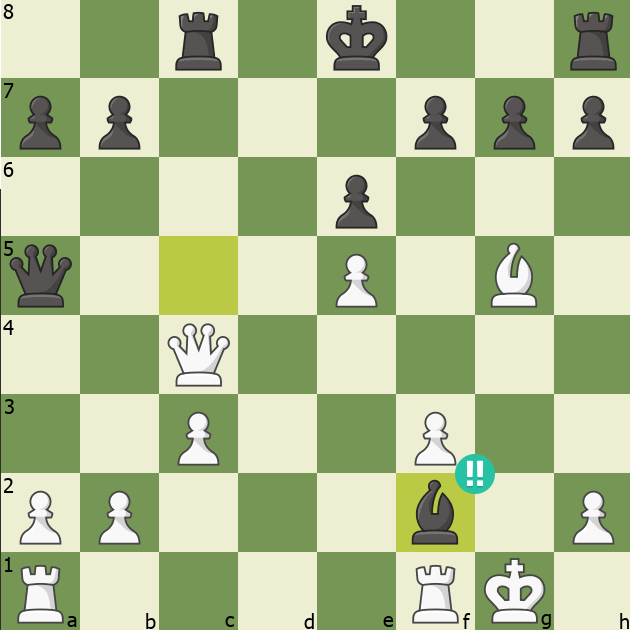
Brilliant Chess Move: Stunning Bishop Sacrifice Led to Checkmate
Most chess players have experienced it at least once. You spot a free pawn, win some material, and feel confident about your position—only to discover that your opponent had seen something much deeper.
Why Your Chess Accuracy Drops After Move 15
If your chess accuracy drops after move 15, the problem is not that you suddenly become a worse player. The problem is that the game has shifted from memory to understanding, and you have not trained that transition enough.
Why You Always Get in Time Trouble (And How Stockfish 18 Fixes It)
Every chess player knows the feeling. You navigate the opening perfectly. You transition into a solid middlegame. You build a completely fine, perhaps even slightly superior, position. And then, you glance at the clock. Your opponent has 15 minutes left. You have 42 seconds. Panic!