Why Do I Keep Getting Forked in Chess?
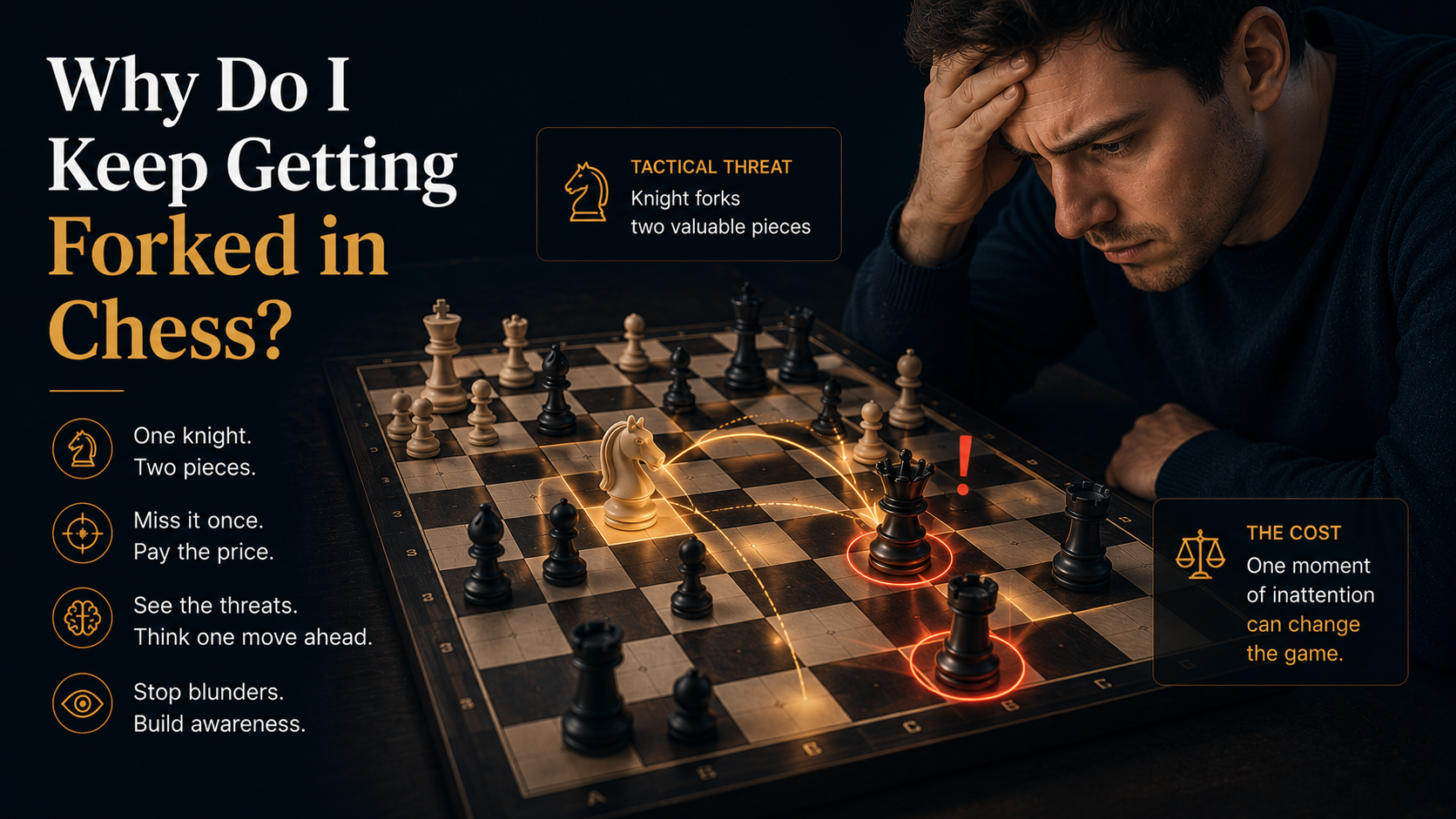
Few chess mistakes feel as annoying as getting forked.
You make a normal-looking move, your opponent jumps in with a knight, and suddenly two of your pieces are under attack at once. Sometimes it is your king and queen. Sometimes it is your rook and bishop. Sometimes it is a fork you know in theory, but somehow still did not see when it mattered.
That is what makes forks so frustrating. They are rarely mysterious after the game. Once the tactic happens, it feels obvious. The real pain is that it did not feel obvious one move earlier.
If this keeps happening to you, the good news is that the problem is usually very fixable. Most players do not get forked because they are bad at chess in general. They get forked because they repeat a few very specific habits: they stop scanning knight jumps, they place valuable pieces too close to each other, they focus too much on their own idea, or they relax after one good move.
A fork in chess is a tactic where one piece attacks multiple enemy pieces at the same time, and knights are especially dangerous forkers because their movement makes the attack hard to meet cleanly.
That means this is not just a “tactics” problem. It is also a board-awareness problem.
What a fork really punishes
A fork is not only a tactic. It is a punishment for poor coordination.
That is why players who keep getting forked often misdiagnose the issue. They say, “I need more tactics,” when the deeper problem is often one move earlier. The real question is usually not “Why didn’t I see the fork once it happened?” but “Why did I leave my pieces arranged so the fork was possible at all?”
This matters because many forks are preventable before calculation gets difficult. If your king and queen are drifting into the same fork pattern, or your rooks and minor pieces are sitting on vulnerable squares, the tactic is often already in the air.
So the best anti-fork improvement does not begin with memorizing fancy motifs. It begins with learning how to spot danger before the knight lands.
Why knight forks feel so unfair
Knights are the piece most players complain about when forks happen, and that makes sense.
A bishop, rook, or queen attacks along visible lines. A knight does not. It jumps. It attacks squares that are not connected visually in the same way, which makes it much easier for the human eye to miss the danger until it is too late.
That is why knight forks often feel cheap, even when they are fully deserved. The pattern is harder to “see” intuitively because the attack does not travel through open lines. It appears suddenly.
This is also why improving players often say things like:
“I never saw the knight move.”
“I knew the tactic, but not in that position.”
“I was focused on my attack.”
“I thought the knight had no dangerous square.”
Those are not random excuses. They point to the real issue: the player was not updating the knight’s jump map after every move.
Why you keep getting forked in chess
1. You start with your own plan instead of your opponent’s threat
This is the biggest reason by far.
A lot of players begin each turn by asking, “What do I want to do here?” That feels natural, but it is often the wrong starting point. If you do that before checking what your opponent is threatening, you will miss tactical ideas that are already available to them.
This is exactly why the DeepBlunder article Why Do I Miss One-Move Threats in Chess? is such a natural companion to this topic. It explains the same underlying habit: players often miss threats not because they lack intelligence, but because they begin with their own idea before checking the opponent’s forcing ideas.
Forks thrive on that mistake. You are busy improving your position. Your opponent is busy attacking two pieces at once.
2. Your valuable pieces are too close together
Forks are much easier when your pieces cooperate badly.
If your king and queen, or queen and rook, or rook and bishop are sitting on squares a knight can hit together, you are creating the conditions for a tactic before your opponent even has to calculate deeply. This is one reason forks feel repetitive: the same poor piece spacing keeps generating the same tactical punishment.
A lot of club players think forks are purely about vision. They are not. They are also about geometry. If your important pieces are arranged carelessly, the tactic becomes easier to find and harder to avoid.
3. You stop scanning knight jump squares
Many players know the phrase “checks, captures, threats,” but they do not apply it specifically enough against knights.
When a knight is near your position, one of the most useful practical habits is to ask:
Which jump squares does it have next?
Which of those jumps would attack two things?
Which of my pieces become vulnerable if the knight moves with tempo?
If you are not asking those questions, you are playing against the knight as if it were a bishop or rook. That is why the tactic feels invisible. You are using the wrong visual model.
4. You relax after a good move
This pattern appears constantly in amateur games.
You make a move you like. Maybe you won a pawn, improved your position, or found a nice tactical idea. Then you relax. You assume the position is under control. That is often exactly when the fork appears.
This is why Why Do I Blunder Right After Finding a Good Move in Chess? fits so well here. Many blunders happen because a player experiences a burst of relief after a strong move and stops treating the new position like fresh work.
A fork is one of the most common punishments for that mental drop.
5. You are playing too fast in “normal” positions
Forks do not only appear in crazy tactical battles. They often appear in positions that look routine.
That is why speed is so dangerous. In quiet middlegames, players move faster because nothing looks urgent. But nothing looking urgent is often the exact condition that allows a simple knight tactic to slip through.
This overlaps strongly with DeepBlunder’s anti-blunder content. How to Stop Hanging Pieces in Chess: A Complete Anti-Blunder Guide and Why Do I Miss One-Move Threats in Chess? both point back to the same practical truth: most painful mistakes are not always deep; they are often fast.
The fork usually starts one move earlier
This is the most important idea in the whole article.
Most players think the blunder is the move where the fork lands. Often it is not. Often the real mistake happened one move before, when you allowed the knight access, weakened a key square, or arranged your pieces so the tactic became possible.
That is why post-game review matters so much. If you only look at the move where the knight jumped in, you may miss the deeper pattern. The better question is:
What did I allow before the fork became possible?
That question changes everything. It turns a tactical accident into a structural lesson.
Maybe you:
moved a pawn that weakened a critical square
placed your queen on a square that lined up with your king
traded the one defender that controlled the jump square
got greedy and grabbed material
stopped watching the knight because it looked passive
Those are not five different problems. They are one problem wearing different clothes: you stopped respecting the setup phase of the tactic.
Why beginners get forked so often
Beginners are especially vulnerable to forks for three reasons.
First, they value immediate ideas more than hidden threats. They see their own move clearly, but they do not yet have the habit of asking what the opponent can do next.
Second, they often place pieces on active-looking squares without checking how those squares relate to each other. A queen centralized too early or a king left in the middle often becomes fork material.
Third, they tend to evaluate safety too emotionally. If the position feels okay, they assume it is okay. But knight tactics punish “feels okay” chess very quickly.
This is one reason your accuracy can look worse than the game felt. A single fork can create a large drop in the quality of the whole game, especially if it loses major material. DeepBlunder’s accuracy articles already show how one serious swing can shape the final impression of a game.
What Stockfish sees before you do
This is where the DeepBlunder angle becomes useful.
DeepBlunder’s homepage describes the product as AI chess analysis and coaching with Stockfish 18, including move-by-move explanations, blunder detection, and personalized improvement tips.
That matters for fork mistakes because a fork is often not just “a tactic you missed.” It is the result of a sequence of small decisions that the engine sees as dangerous before the human player feels the danger.
What Stockfish often sees before you do is:
the vulnerable square your opponent’s knight is heading for
the overloaded piece that cannot defend everything
the spacing problem between your major pieces
the tactical cost of one “normal” developing move
That is why anti-fork training works best when it is explained, not only scored. The point is not just to say “fork here.” The point is to understand why the fork became possible.
How to stop getting forked in chess
Scan knight moves before your own move
This is the single best habit to build.
Before you play your move, glance at the opponent’s knight and ask:
Where can it jump next?
Which jumps come with check?
Which jumps attack my queen, rook, or king?
Does one jump hit two valuable things?
This does not take long once it becomes habit. But it prevents an enormous number of avoidable tactics.
Separate your valuable pieces
If your king and queen are easy to hit together, fix that before the tactic appears. If your rook and bishop are living on easy fork squares, improve the coordination.
This is simple advice, but simple advice saves real games. A lot of players spend too much time looking for brilliant moves and too little time improving the shape of their position.
Respect “quiet” knight moves
Many forks are enabled by a quiet move one turn earlier.
The knight is repositioned. A central square is vacated. A supporting pawn move happens. Nothing explodes immediately, so the danger gets ignored. Then the jump arrives.
That is why the right question is not only “Can I be forked now?” It is also “Is my opponent preparing a fork square?”
Do not grab material blindly
A lot of fork tactics happen because one side gets greedy.
You win a pawn, pick up a loose piece, or chase an attack without noticing that your king and queen are drifting into a tactical pattern. Greed narrows attention. Narrow attention is perfect territory for forks.
When in doubt, ask whether the extra material is changing your coordination for the worse. Sometimes the pawn is free. Sometimes the pawn is bait.
Review every forked game the same way
If this is a recurring pattern, your review process should be specific.
After every game where you got forked, write down:
Which piece delivered the fork?
What two targets were hit?
What move allowed the setup?
What warning sign did you ignore?
Was the mistake speed, greed, tunnel vision, or bad piece spacing?
Do that often enough, and you stop seeing forks as random humiliation. You start seeing them as one recurring family of mistakes.
Mid-article CTA
If knight forks keep showing up in your games, use DeepBlunder to review the exact moment the tactic became possible.
Because the real lesson is usually not only “you missed the fork.” It is:
the move that weakened the key square
the piece placement that made two targets vulnerable
the moment your attention shifted away from the opponent’s threat
With DeepBlunder’s Stockfish 18 analysis, move-by-move explanations, blunder detection, and personalized coaching-style feedback, you can turn a fork from a painful surprise into a repeatable training pattern.
A strong internal reading path from here is:
A practical anti-fork routine
If you want something simple and usable, try this before every move:
The anti-fork check
Look at every enemy knight.
Mark its possible jump squares.
Ask whether any jump comes with check.
Ask whether any jump attacks two valuable pieces.
Only then decide on your move.
This routine sounds basic, but that is exactly why it works. Forks punish players who skip basics, not players who lack magic.
A second good habit is this one:
The loose-piece check
Which of my pieces is undefended?
Which of my valuable pieces are sitting too close together?
If the knight jumped with tempo, what would be hit?
That routine is not glamorous, but it saves rating points.
FAQ
Why do I keep getting forked in chess?
You usually keep getting forked because you are missing the setup, not only the final tactic. Most forks become possible one move earlier, when a square is weakened, a defender is removed, or two valuable pieces end up close enough to be hit together.
A lot of players focus on their own idea first and only notice the fork when it lands.
That is why the problem is often awareness and piece coordination more than raw tactical knowledge.
If you start scanning knight jumps and checking your piece spacing before every move, the pattern usually becomes much easier to control.
How do I stop knight forks in chess?
The best way to stop knight forks is to build a repeatable scan. Before moving, check every enemy knight and ask which jump squares attack two targets or come with check.
You should also keep your king, queen, and rooks from drifting into easy fork patterns.
A second big improvement is slowing down in normal-looking positions, because forks often happen when nothing seems urgent.
If you review each forked game by identifying the setup move, the improvement becomes much faster.
Why are knight forks so hard to see?
Knight forks are hard to see because knights do not attack along straight visible lines. They jump, which makes their threats feel less natural to the eye than rook, bishop, or queen threats.
That is why many players know fork patterns in theory but still miss them over the board.
The solution is not just “calculate more.”
It is to specifically map knight jumps as part of your move routine.
Are forks only a beginner problem?
No. Beginners suffer from them more often, but forks punish any player who relaxes, gets greedy, or stops scanning forcing ideas.
The difference is that stronger players usually recognize the setup sooner and coordinate their pieces better.
So while the tactic is common at lower levels, the underlying lesson is universal.
Every player benefits from respecting jump squares, loose pieces, and hidden tactical geometry.
Can getting forked ruin my accuracy?
Yes, very easily. Losing major material to a fork often creates a large evaluation swing, and one large swing can damage the quality of the whole game.
That is why a game that felt mostly fine can suddenly receive a disappointing post-game score.
The fork may have happened in one move, but it often changed everything.
Preventing one or two major tactical shots is sometimes enough to improve both results and accuracy noticeably.
What should I review after I get forked?
Review the position one move before the fork became possible.
That is usually where the useful lesson is hiding.
Ask what square became weak, which piece became loose, and whether your targets were arranged carelessly.
Then ask whether the mistake came from speed, greed, or tunnel vision.
If you do that consistently, forks stop feeling random and start becoming a recognizable pattern you can train against.
Conclusions
If you keep getting forked in chess, the real problem is usually not that forks are too advanced. It is that the warning signs are being missed one move too early.
That is good news, because warning signs can be trained.
Once you start scanning knight jumps, spacing your valuable pieces better, and treating every quiet position with a little more respect, forks become far less mysterious. They stop feeling like cheap surprises and start looking like what they usually are: tactical punishments for small positional carelessness.
And once you can see the setup before the jump, you are already playing a different kind of chess.
From the same category
Keep reading
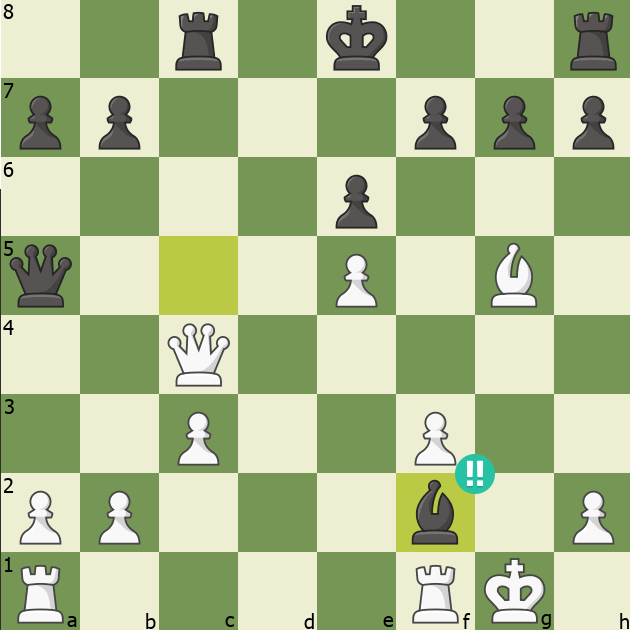
Brilliant Chess Move: Stunning Bishop Sacrifice Led to Checkmate
Most chess players have experienced it at least once. You spot a free pawn, win some material, and feel confident about your position—only to discover that your opponent had seen something much deeper.

Why Your Chess Accuracy Drops After Move 15
If your chess accuracy drops after move 15, the problem is not that you suddenly become a worse player. The problem is that the game has shifted from memory to understanding, and you have not trained that transition enough.
Why You Always Get in Time Trouble (And How Stockfish 18 Fixes It)
Every chess player knows the feeling. You navigate the opening perfectly. You transition into a solid middlegame. You build a completely fine, perhaps even slightly superior, position. And then, you glance at the clock. Your opponent has 15 minutes left. You have 42 seconds. Panic!