Why Do I Play Too Fast in Quiet Chess Positions?
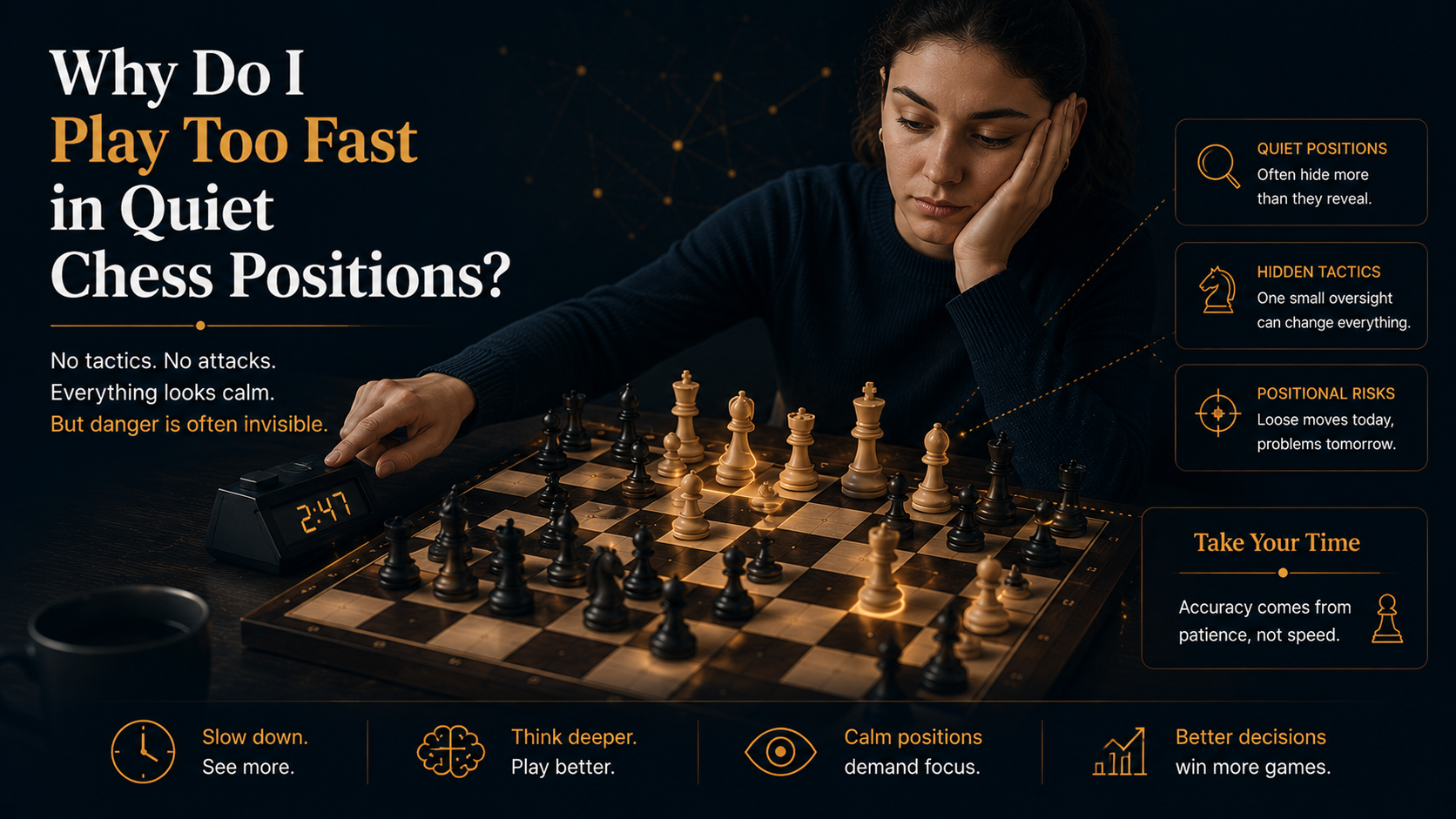
A lot of chess players do not blunder in chaotic positions because chaos forces them to pay attention. They blunder in quiet positions because calm positions feel safe, and “feels safe” is one of the most dangerous thoughts you can have over the board.
If you play too fast in quiet chess positions, the problem is usually not laziness or lack of talent. It is that your brain is using the wrong danger signal. When nothing looks urgent, you stop scanning deeply, stop checking the opponent’s ideas properly, and start playing on autopilot. That is when a normal-looking move turns into a missed tactic, a drifting equal position, or a winning game that slips away.
This pattern matters because it is expensive. Quiet positions are where a lot of club games are actually decided. Not with one flashy sacrifice, but with one soft move, one missed knight jump, one weak square, one passive trade, or one moment where a player moves too quickly because the board looked calm.
Why quiet positions are so deceptive
Quiet positions create a false sense of safety.
When there is no obvious attack, no forcing line, and no tactical explosion on the board, many players assume the position can be handled with less effort. That is a natural human reaction, but in chess it is often a bad one. Calm positions do not remove danger. They hide it.
That is why quiet positions produce such painful mistakes. After the game, the blunder often looks simple. You left a piece loose. You missed a one-move threat. You allowed a fork setup. You let your opponent improve every piece while you made one harmless move too many. The mistake feels embarrassing because the position did not look difficult enough to justify it.
But that is exactly the trap. Quiet positions do not shout. They whisper. And players who only slow down when the board starts screaming usually lose a lot of games that were completely playable.
This fits a pattern already visible across the DeepBlunder blog. The site’s practical articles focus repeatedly on the gap between what players think they are missing and what they are actually missing: not genius-level calculation, but better awareness of one-move threats, blunder patterns, and decision quality from move to move.
Why players move too fast in quiet chess positions
You think “nothing is happening”
This is the most common cause.
The board looks stable. Material is level. No king is in immediate danger. No one is hanging a queen in one move. So you tell yourself the position is normal, and because it feels normal, you move like the position does not deserve much energy.
That single assumption causes a surprising number of losses.
A quiet position still asks important questions:
Which piece is worst placed?
Which pawn break matters?
What square is becoming weak?
What does the opponent want next?
Which trade helps one side more than the other?
If you do not ask those questions, the position starts drifting. And one of the hardest truths in chess is that drift often feels harmless until it is already expensive.
The article Why Do I Keep Losing Equal Positions in Chess? makes this point clearly: equal positions often get mishandled because players treat equality as safety instead of seeing it as a position that still demands active decisions.
Quiet positions create the same illusion. They look stable, so players stop treating them as work.
You only slow down for visible tactics
A lot of improving players have a strong but narrow warning system. They know when to focus if there is a check, a sacrifice, or a sharp attacking line. They recognize danger once it becomes visual.
The problem is that many blunders happen before the danger becomes visual.
A knight reroutes. A file opens slowly. A pawn push creates a weak square. A defender moves. A queen and king drift into the same tactical pattern. Nothing looks urgent on the surface, so the player keeps moving quickly. Then one move later the tactic is obvious — and already too late.
This is one reason DeepBlunder’s anti-blunder articles work well together. How to Stop Hanging Pieces in Chess, Why Do I Miss One-Move Threats in Chess?, and Why Do I Blunder Right After Finding a Good Move in Chess? all point at the same practical reality: players usually do not collapse because they know nothing. They collapse because attention drops at the wrong moment.
Quiet positions are where that drop happens most easily.
You confuse calm with simple
Calm and simple are not the same thing.
A position can be strategically calm and still be difficult. It can contain:
subtle piece-improvement problems
invisible tactical motifs
long-term king-safety issues
move-order traps
pawn-structure choices that change the whole middlegame
But because the position is not forcing, players often assume it is easy. That is one of the worst trade deals in club chess: the board gives you a position that requires judgment, and you pay for it with speed.
The stronger player in a quiet position is often not the one calculating the deepest line. It is the one noticing more: the bad bishop, the weak square, the loose rook, the useful exchange, the safe waiting move, the one active plan worth pursuing.
If you move too fast in these positions, you are not necessarily making huge tactical mistakes right away. Often you are missing the small details that make the next tactical mistake possible.
Why quiet positions produce so many one-move blunders
One-move blunders are often treated as beginner mistakes, but many of them are actually quiet-position mistakes.
That sounds strange at first, because people imagine blunders happening in wild attacking games. In reality, quiet positions create the perfect conditions for simple tactical oversights:
your scan becomes lazy
your move feels routine
the opponent’s idea seems too simple to matter
you stop checking the most forcing reply
The DeepBlunder article on one-move threats says most players miss them not because they are untalented, but because they start with their own idea before properly checking the opponent’s forcing ideas.
That habit becomes even more dangerous in calm positions, because the player often feels justified in moving quickly.
This is why quiet positions are so unforgiving. They punish boredom. They punish autopilot. They punish the belief that basic things are too basic to require respect.
A knight fork that appears “out of nowhere” often did not come out of nowhere at all. It came from one fast move in a position you assumed did not deserve caution.
Quiet positions are where equal games get lost
Many players imagine losing equal positions as some mysterious skill gap. In reality, equal positions are often lost through quiet impatience.
You have a playable game. Nothing is clearly wrong. But instead of improving your worst piece, asking what your opponent wants, or making a useful waiting move, you play something automatic. Then something small changes:
a file opens
a square weakens
your rook becomes passive
the opponent’s knight gets an outpost
your king loses one layer of safety
One move later the position still looks “about equal.” Three moves later it is harder to play. Six moves later you are worse. Then you look back and say the game slipped for no reason.
It did not slip for no reason. It slipped because a quiet position invited a fast move and a fast move invited a careless concession.
That is exactly why the article Why Do I Keep Losing Equal Positions in Chess? matters here. It points out that equal positions remain dangerous because they still demand plans, activity, and attention to small imbalances rather than passive hope.
Quiet positions are often equal positions with softer edges. The same discipline problem shows up in both.
Quiet positions also ruin winning positions
There is another version of this pattern that hurts even more: moving too fast once the position has become better for you.
Many players do not slow down when winning. They either rush to finish or relax because they think the hard part is over. That creates a different kind of quiet-position blunder. The board is calmer than before, so the player starts moving by feeling:
“This should be winning.”
“I’ll just trade.”
“I don’t need to calculate every little thing now.”
“Any reasonable move should do.”
That mindset is deadly.
DeepBlunder already has a strong article on this exact shift in decision-making: Why Do I Play Worse When I’m Winning in Chess?. It explains that once players get an advantage, they often become passive, overly result-oriented, or less respectful of counterplay.
Quiet winning positions are often where the most painful throws happen, because the player mistakes reduced tension for reduced responsibility.
The same lesson appears in outside discussion of winning-position mistakes too: players often relax too early, forget the clock, get greedy, or stop playing actively once they are ahead.
A quiet winning position is not permission to coast. It is a test of whether you can stay disciplined when the board stops yelling at you.
The hidden psychology of playing too fast
Your brain uses visible tension as a focus trigger
Many players do not have one stable level of concentration. They have two modes.
Mode one is the alert mode: tactical, sharp, forcing, scary, obviously dangerous. In that mode, they calculate more carefully.
Mode two is the relaxed mode: no immediate check, no sacrifice, no chaos, no obvious tension. In that mode, they start trusting instinct too much.
That split is normal, but it becomes expensive if the calm mode is too calm.
The board does not always tell you when it deserves full attention. Stronger players build a thinking process that works even when the position looks boring. Weaker players outsource that decision to the appearance of danger.
That is why quiet positions often expose your real discipline level better than sharp ones do.
Fast moves feel efficient
There is also a subtle emotional reward in playing fast. It makes you feel smooth, confident, and in control.
In quiet positions, that feeling can become addictive. You make a move that “looks fine,” save time, stay in rhythm, and feel like the game is flowing. The problem is that rhythm is not the same as accuracy.
Some players lose games because they cannot think fast enough. Others lose because they think fast when they should not.
Quiet positions often create the second problem. The moves are easy to make, but not always easy to justify.
You are afraid of overthinking
A lot of players know they sometimes think too much in sharp positions, so they overcorrect in quiet ones. They tell themselves:
“Don’t overcomplicate it.”
“Just make a normal move.”
“I’m wasting time.”
“Not every move needs deep calculation.”
That advice is partly true. Not every move needs deep calculation. But every move does need a minimum level of honesty.
The answer is not to calculate twenty moves in a quiet rook ending or a balanced middlegame. The answer is to use a stable process:
check the opponent’s threats
identify your worst piece
notice tactical details
choose a move with a reason
That is not overthinking. That is thinking enough.
The most common blunders in calm positions
The “routine move” blunder
You make a move you have seen a hundred times:
a natural recapture
a developing move
a queen retreat
a rook centralization
a pawn push that looks healthy
The move is not crazy. It is not flashy. That is exactly why it is dangerous. Because it feels ordinary, you do not inspect it properly.
Then you discover it allowed a tactic, weakened a square, or stepped into a move-order problem. This kind of blunder hurts because it feels beneath you. But that is the point: quiet positions often punish ordinary-looking mistakes more than bizarre ones.
The passive “just in case” move
Calm positions tempt players to make soft defensive moves that are not actually necessary:
an extra king move
an unnecessary pawn cover
a rook move that protects something not under threat
a queen shuffle that gives up activity
These moves often come from a vague desire to stay safe. But passive safety is not real safety if it gives the opponent easier play.
This is also why equal positions and winning positions often go wrong in the same way. The player stops asking, “What improves my position?” and starts asking, “What move feels safe enough not to lose?” That shift is often where the trouble begins.
The missed quiet threat
Your opponent does not attack immediately. They improve a piece. They reroute a knight. They place a rook on a file. They fix one weakness.
Nothing explodes, so you move quickly too. Then a move later the threat is real and your options are worse than before.
Quiet positions reward players who understand that preparation is action. A move does not need to win material immediately to be dangerous. Sometimes the most serious threat is simply that the opponent’s next move will be easier than yours.
The endgame drift
Quiet positions become especially dangerous in endgames, because endgames often look simple before they are simple.
A king move, a pawn push, a rook activation, a trade decision — these can decide the game even when no tactic appears instantly. Players move too fast because the board has fewer pieces and the position “looks technical,” but technical positions often punish inaccuracy very hard.
This is another reason quick moves are so deceptive. Less material can mean more clarity, but it can also mean every small concession matters more.
What better players do differently in quiet positions
They do not necessarily calculate much deeper. Often they just refuse to turn off the process.
In a calm position, stronger players usually keep doing a few basic things:
they ask what the opponent wants
they improve the worst piece
they avoid unnecessary weakening moves
they notice when a “normal” move creates tactical problems
they use the calm to organize the position, not to coast
That is why stronger players often appear patient in quiet positions rather than passive. They are still playing actively, but their activity may look small:
better square
better file
better king
better trade
better structure
These small improvements matter because quiet positions amplify small edges. If you move too fast, you often donate exactly those edges.
How to stop playing too fast in quiet positions
1. Treat quiet as suspicious
This is the most useful mindset change.
The calmer the position looks, the more you should remind yourself that hidden blunders are possible. Not because every quiet move is a trap, but because quiet positions are where your discipline tends to drop.
A simple mental rule helps:
If the position looks easy, double-check why it looks easy.
That question interrupts autopilot.
2. Use a smaller scan, not no scan
You do not need full tournament-level calculation on every quiet move. But you do need a minimum routine.
Try this:
What is my opponent threatening?
Which of my pieces is worst placed?
Are there checks, captures, or direct tactics I am ignoring?
Does my move weaken something important?
What simple move would improve my position?
This takes far less time than a deep tactical search, but it is enough to prevent a lot of “how did I miss that?” moments.
3. Slow down at transitions
Not all quiet moments are equally dangerous. The most dangerous ones are transitions:
from opening to middlegame
from middlegame to endgame
after a trade
after a pawn break
after winning or losing a pawn
after the opponent improves a piece quietly
These are the moments when the position can still look calm while its logic changes underneath you.
If you only slow down in visibly sharp positions, you will miss many of the transitions that actually decide your games.
4. Learn to value useful waiting moves
Quiet positions are often won by players who can make a good improving move without forcing anything.
That skill matters because it removes panic. If you do not know how to improve a position calmly, you are more likely to move fast just to “do something.” But if you can ask, “What is my worst piece?” and answer honestly, you suddenly have a plan that does not depend on drama.
This overlaps with the same practical improvement philosophy running through DeepBlunder’s existing content: many recurring mistakes are solved not by becoming more brilliant, but by becoming more stable.
5. Review quiet mistakes differently
Do not only review blunders by looking at the engine swing. In quiet positions, the first mistake is often small.
Ask:
What move did I play too quickly?
What assumption made me move quickly?
What small weakness did I ignore?
What did the opponent improve while I was on autopilot?
Was the blunder tactical, or did the tactic only appear because I stopped respecting the position?
That review process helps you train the pattern, not just the final move.
If your games often go wrong in positions that looked “fine,” DeepBlunder is exactly the kind of tool that can help.
DeepBlunder’s homepage presents it as AI chess analysis and coaching with Stockfish 18, including move-by-move explanations, blunder detection, and personalized improvement tips.
That matters in quiet positions because the problem is often not just one bad move. It is the hidden idea behind the bad move:
the threat you ignored
the square you weakened
the passive move that let the game drift
the calm moment where your attention switched off
A strong internal reading path from here is:
A practical anti-autopilot routine
If you want something simple you can actually use, try this whenever the board looks quiet.
The calm-position check
Before every “normal-looking” move, ask:
What would my opponent do if I passed?
Which piece of mine is least useful?
Does my move weaken a square, file, or diagonal?
Am I playing this because it is good, or because it is easy?
If I played this instantly in a blitz game, would I still trust it?
That last question is surprisingly useful. Many quiet-position mistakes feel like blitz moves played in a slower game.
The one-breath rule
Here is an even simpler version:
When a position looks calm, take one full breath before moving.
That is it.
The point is not meditation. The point is interruption. Fast mistakes in quiet positions often come from uninterrupted flow. One breath breaks the spell. It creates enough distance to ask whether the move is actually justified.
Why this topic matters for real improvement
A lot of players think improvement comes mostly from solving tactical puzzles, memorizing openings, or analyzing spectacular losses. Those things matter, but a huge number of rating points are lost somewhere much quieter.
They are lost in positions that did not look urgent enough to deserve respect.
That is why this topic is so valuable. It sits underneath many other chess frustrations:
hanging pieces
missed one-move threats
losing equal positions
throwing winning positions
disappointing accuracy after a game that felt okay
DeepBlunder’s current blog already reflects that pattern. Its strongest practical articles are not generic “be better at chess” content. They are pain-point pieces about the exact moments where players stop seeing the board clearly.
Quiet positions belong in that cluster because they are one of the biggest places where attention quietly dies.
FAQ
Why do I play too fast in quiet chess positions?
You usually play too fast in quiet chess positions because your brain treats visible tension as the main danger signal. When the board looks calm, you assume less calculation is needed, so your attention drops too early.
That makes routine-looking moves feel safer than they really are.
In practice, quiet positions often hide one-move threats, strategic concessions, and piece-improvement battles that still deserve respect.
The problem is not always speed itself.
It is trusting the feeling of safety too much.
That is why quiet positions often produce very avoidable mistakes.
Why do I blunder in calm positions in chess?
Because calm positions create autopilot. You stop scanning as carefully, focus more on your own plan, and assume the opponent has nothing immediate.
That is exactly the setup in which simple tactical ideas get missed.
DeepBlunder’s article on one-move threats makes this pattern very clear: many players miss threats because they start with their own idea before checking the opponent’s forcing ideas.
In calm positions, that habit gets even worse because the board does not feel dangerous.
So the blunder often happens not because the tactic was deep, but because your process got lazy.
That is a very fixable kind of mistake.
Why do I lose equal positions when nothing seems wrong?
Because equal does not mean easy or safe. DeepBlunder’s equal-positions article explains that many “normal” games get lost because players drift, play passively, or fail to create a plan while the opponent keeps improving.
The board can stay level in material while one side quietly gets better squares, better activity, or an easier game.
If you move too fast in those positions, you often miss the small concession that starts the slide.
That is why equal positions feel mysterious after the game.
They were not decided by one dramatic blow, but by several small choices made too casually.
Quiet positions magnify that problem.
How do I slow down in chess without overthinking?
The answer is not to calculate everything deeply. The answer is to use a short, stable routine.
Before moving, check the opponent’s idea, look for simple tactics, identify your worst piece, and ask whether your move weakens something.
That is enough to stop many quiet-position blunders without turning every move into a ten-minute think.
A small scan is better than no scan.
The goal is not to become slow.
The goal is to become deliberate.
Why do I miss tactics in quiet positions?
Because you are usually not looking for them with the same seriousness you would use in a sharp position.
Quiet positions trick you into thinking only strategic moves matter, but tactical details never fully disappear.
A loose piece, weak square, fork setup, or tactical reply may already be there even if the board looks calm.
That is why so many tactics in quiet positions feel obvious afterward.
They were simple enough to see, but only if the player had stayed alert.
The issue is often not tactical talent, but tactical honesty.
Can quiet positions ruin my accuracy?
Yes. A game can feel smooth for a long time and still lose quality quickly after one careless move in a calm position.
DeepBlunder’s accuracy-related content shows how one significant error can shape how the whole game is evaluated afterward.
That is why players are often surprised by a disappointing post-game review after a game that felt “mostly fine.”
The engine remembers the swing, even if the human mostly remembers the calm.
Preventing one or two quiet-position blunders can improve both results and overall game quality fast.
A lot of accuracy pain is really attention pain.
Conclusions
If you play too fast in quiet chess positions, the issue is usually not that calm positions are boring. The issue is that calm positions are misleading.
They make players feel safe before the board has actually become safe.
That is why the fix is not dramatic. It is disciplined. Respect quiet positions a little more, use a small scan before “normal” moves, slow down at transitions, and stop treating calm as permission to switch off.
Many games are not lost in the wild part. They are lost in the quiet part, where one player stays honest a little longer than the other.
From the same category
Keep reading
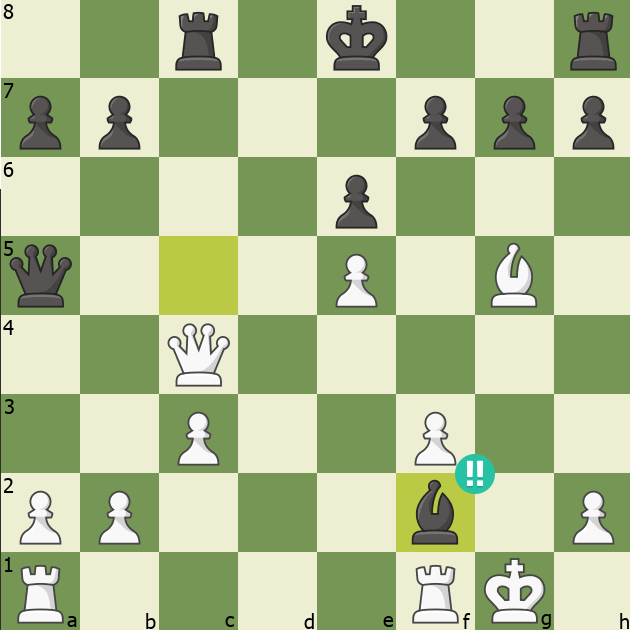
Brilliant Chess Move: Stunning Bishop Sacrifice Led to Checkmate
Most chess players have experienced it at least once. You spot a free pawn, win some material, and feel confident about your position—only to discover that your opponent had seen something much deeper.

Why Your Chess Accuracy Drops After Move 15
If your chess accuracy drops after move 15, the problem is not that you suddenly become a worse player. The problem is that the game has shifted from memory to understanding, and you have not trained that transition enough.
Why You Always Get in Time Trouble (And How Stockfish 18 Fixes It)
Every chess player knows the feeling. You navigate the opening perfectly. You transition into a solid middlegame. You build a completely fine, perhaps even slightly superior, position. And then, you glance at the clock. Your opponent has 15 minutes left. You have 42 seconds. Panic!