Why Do I Always Get in Time Trouble in Chess?
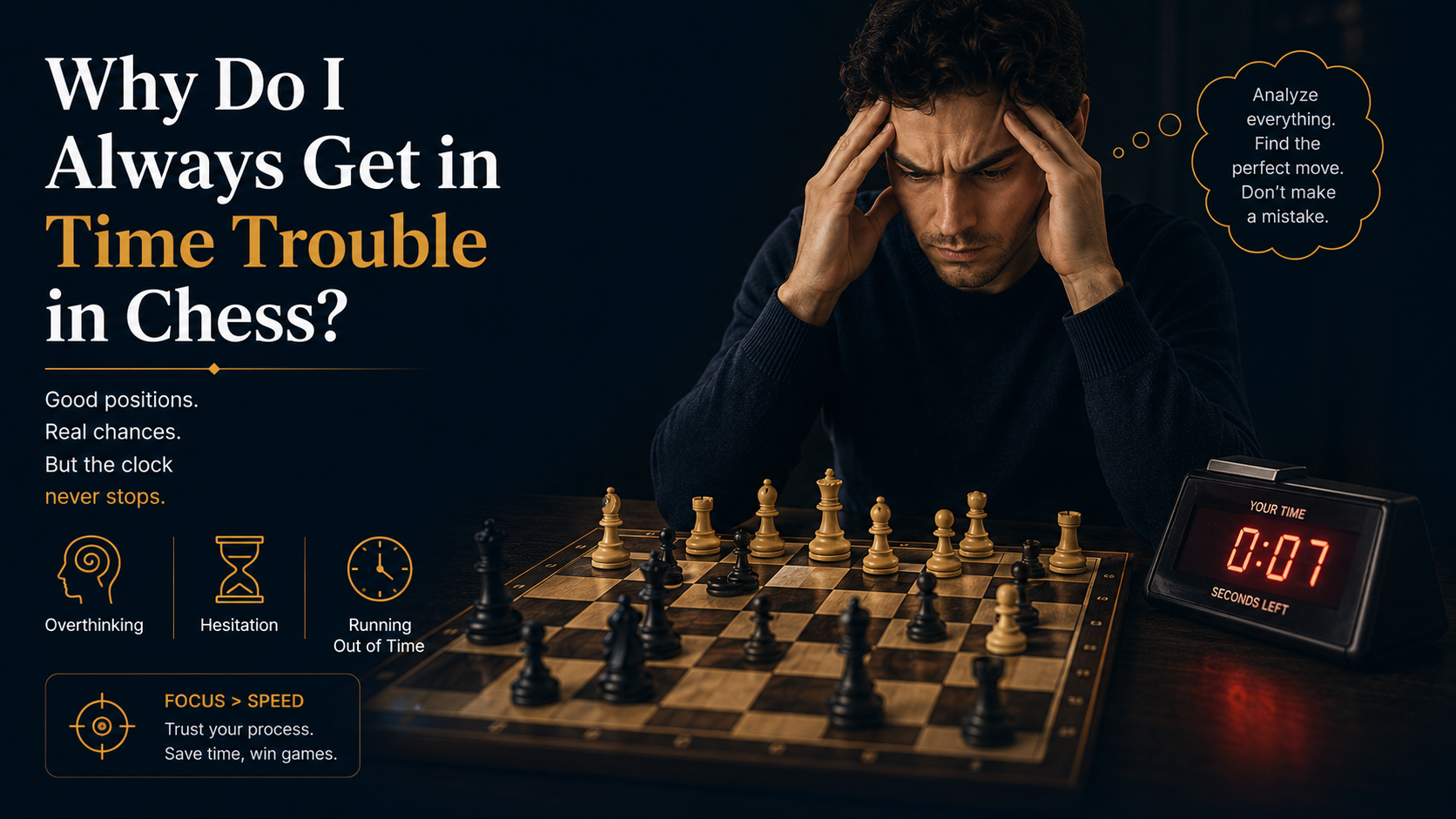
If you constantly get into time trouble in chess, the problem is rarely that you “think too slowly.” The problem is usually psychological: you are burning your clock on the wrong things.
Many players lose on time because they are perfectionists trying to find the ultimate engine move, or because they freeze when choosing between two equally good options. Others spend massive amounts of time in quiet, normal positions just because they are afraid of making a mistake. In all these cases, time trouble is not a calculation issue. It is a decision-making issue.
The hardest truth about chess time management is this: the clock is a piece on the board. A brilliant move that leaves you with 10 seconds for the rest of the game is often a bad practical decision. If you keep losing won games on time or blundering because you only have seconds left, you do not need to become a faster calculator. You need to become a more practical decision-maker.
Why time trouble is rarely about "slow calculation"
When players lose on time, they often complain that their calculation speed is too slow. But calculation speed is almost never the root cause of chronic time trouble.
Most players who burn their clock are not calculating deep lines at all. They are calculating the same short line three or four times because they do not trust their own conclusion. Or they are staring at an equal position without a plan, waiting for an idea to magically appear. Or they are calculating variations that are highly unlikely to happen on the board.
In other words, they are not out of time because chess is hard. They are out of time because their thinking process is inefficient.
This is a recurring theme across DeepBlunder’s improvement guides. Whether the topic is missing one-move threats or blundering in quiet positions, the root of the problem is often how you organize your attention, not how smart you are. Time trouble works exactly the same way.
The 5 psychological reasons you get into time trouble
Chess players get into time trouble for very specific, predictable reasons. If you can identify which of these matches your personality, the fix becomes much easier.
1. Perfectionism
Perfectionists are terrified of making an inaccuracy. They find a perfectly good, solid move, but instead of playing it, they spend five minutes searching for an even better one.
The problem with perfectionism in a timed game is that it ignores practical reality. If you find a move that improves your position, stops counterplay, and poses a threat, spending half your remaining clock to verify if another move is +1.2 instead of +0.9 is self-sabotage.
In classical and rapid chess, you only have the luxury of striving for “perfect” moves once or twice a game in critical moments. For the rest of the game, “good enough” is exactly what you should aim for.
2. Indecisiveness between equal options
This is one of the biggest clock-killers in club chess. You have two decent options. Maybe it is a choice between retreating a bishop to e7 or d6. Both are fine. Both keep the position equal. But because the decision feels unclear, you freeze.
You calculate one line. Then the other. Then back to the first. You cannot decide which is objectively superior.
The secret stronger players know is this: if you cannot tell the difference between two normal moves after a minute of thinking, it probably does not matter. Just pick the one that feels best and hit the clock. Wasting 10 minutes to choose between two equal squares is a much bigger mistake than picking the slightly less accurate square quickly.
3. Tactical fear
Some players have been traumatized by past blunders. They remember that one time they missed a knight fork or hung a queen, so now they check every single position as if there is a hidden trap.
This overlaps directly with the problem discussed in Why Do I Keep Getting Forked in Chess? and How to Stop Hanging Pieces. If your tactical vision is built on paranoia instead of a structured scan, you will burn time looking for ghosts.
You do need to check for checks, captures, and threats. But you do not need to check them five times per move just to feel “safe.”
4. Overcalculating simple positions
This happens frequently when players try to calculate forcing lines in positions that are actually quiet and maneuvering.
You do not need to calculate five moves deep in a closed, blocked position where nothing is under attack. In those positions, you should be making decisions based on positional principles: improving your worst piece, controlling an open file, or fixing a pawn weakness.
If you try to brute-force calculate quiet positions, you will exhaust your brain and your clock simultaneously. That is why Why Do I Play Too Fast in Quiet Chess Positions? is an important read—managing pacing means knowing when to move fast, but also knowing when deep calculation is actually required.
5. Procrastination on forced moves
This is perhaps the most illogical habit in chess. Your opponent plays a move that attacks your queen. You only have one legal square to move the queen to. Yet, you sit there for three minutes thinking about the move.
Why? Because you are trying to calculate what happens after the forced move.
That is a massive waste of time. If a move is forced, play it immediately. You can do all your follow-up calculation while the opponent’s clock is ticking. Burning your own time on a move you have to play anyway is a pure mechanical error.
Why winning positions cause the worst time trouble
One of the most frustrating things in chess is getting a completely winning position and then flagging (losing on time) or blundering because you only have seconds left.
Why does time trouble suddenly appear when you are winning?
Because of fear. When the game is equal, you play freely. When you are winning, the pressure changes. You realize you have something to lose. You become terrified of throwing the game away, so you start triple-checking every move to ensure it is 100% safe.
This is the exact psychological trap DeepBlunder explains in Why Do I Play Worse When I’m Winning in Chess?. The emotional shift makes you passive, and passivity makes you slow. Instead of playing the board, you play the scoreboard, and the clock punishes you for it.
Losing on time with an extra queen is mathematically the same as getting checkmated in the opening. The result is zero. The clock demands just as much respect as the material balance.
The problem with "playing the board, not the clock"
Many coaches tell beginners to “play the board, not the clock.” That is good advice when you are first learning how the pieces move. But once you start playing timed games competitively, that advice becomes dangerous.
The clock is part of the board.
If you find a brilliant 5-move tactical sequence but it leaves you with 15 seconds to play the remaining 30 moves of the endgame, you have not played a good game of chess. You have played a good puzzle, and you are going to lose the game.
You have to factor the remaining time into your evaluation of the position. A simpler, slightly less accurate plan that can be executed quickly is objectively better than a complex, highly accurate plan that requires time you do not have.
How to stop getting into time trouble
If you are tired of watching your flag fall in good positions, you have to change your habits. Here are the practical rules that fix time management.
1. Use the 10% rule
A very effective practical guideline for rapid and classical games is the 10% rule. As a general habit, you should almost never spend more than 10% of your total starting time on a single move.
If you are playing a 30-minute game, your maximum think for any move should be about 3 minutes. If you are playing a 10-minute game, you should rarely spend more than 1 minute on a single decision.
You are allowed to break this rule once or twice a game for a critical, game-deciding tactical moment. But if you are breaking it on move 8 of a standard opening, you are failing at time management.
2. If you don't know what to do, improve your worst piece
This is the ultimate cure for indecisiveness. When you are staring at an equal, quiet position and you cannot find a grand plan, do not sit there for five minutes hoping for inspiration.
Find your least active piece and move it to a better square.
That is it. It is a productive, safe, and efficient way to make a decision and hit the clock. It keeps the game moving and shifts the pressure back to your opponent.
3. Play forced moves instantly
If you only have one legal move, or if every other move immediately loses a piece, play the forced move right away. Do your deep thinking on your opponent's time. Every second you spend looking at a move you are forced to play is a second you are stealing from your future self.
4. Trust your first instinct in equal choices
If you are choosing between two very similar developmental moves or two safe retreating squares, give yourself 30 seconds to find a concrete tactical difference. If you cannot find one, pick the move you liked first.
The tiny difference in objective engine evaluation between the two squares is not worth the massive practical cost of burning your clock.
5. Do not calculate when you are lost
If you are in a completely dead, lost position, do not burn your remaining 10 minutes trying to find a magical save. If the position is truly lost, play quickly and create practical problems. If you play fast, your opponent might blunder. If you burn all your time, you will just lose slowly.
If time trouble is ruining your games, the best way to fix it is to understand exactly where you are burning your clock.
With DeepBlunder, you can review your games and use Stockfish 18 to identify the moments where you spent 3 minutes on a move that only required 10 seconds. Was it because you overcomplicated an equal position? Did you miss a simple forcing reply? Did you freeze when you were winning?
DeepBlunder doesn’t just show you the engine evaluation; its AI coaching gives you personalized feedback on your decision-making process. Stop guessing why you flag, and start fixing the habit.
A strong internal reading path from here is:
The danger of playing only one time control
Sometimes time trouble happens because you have conditioned your brain to the wrong pace.
If you play 3-minute blitz every day for a year, and then suddenly play a 30-minute rapid game, you will likely play far too fast and blunder. Conversely, if you only play daily correspondence chess, and then switch to 10-minute games, you will almost certainly lose on time because your brain is used to having infinite hours to verify every decision.
If you consistently struggle with the clock, the easiest fix might simply be changing the time control you play. If you constantly flag in 10-minute games, switch to 15+10 (15 minutes with a 10-second increment per move). The increment guarantees that as long as you can make a move every 10 seconds, you will never lose on time in an easily won endgame.
Why analyzing time trouble matters
Most players review their games by looking only at the blunders and inaccuracies. They ignore the clock times.
But if you look at a game and see that you played a brilliant novelty on move 12, but it took you 14 minutes in a 15-minute game, that move was actually a massive mistake. You bought a slight advantage at a price you could not afford.
Start reviewing your games with the clock in mind. Identify the exact move where your time management broke down. Was it perfectionism? Fear? Indecision? Once you name the psychological trigger, you can stop it from happening in the next game.
FAQ
Why do I keep getting into time trouble in chess?
You usually get into time trouble because of psychological habits, not slow calculation. Most players burn time because they are perfectionists trying to find the absolute best move, because they freeze when choosing between two equal options, or because they are afraid of blundering. Time trouble is rarely about the position being too complex; it is about your decision-making process being inefficient.
Why do I flag in winning positions?
Players often flag (lose on time) in winning positions because the emotional pressure changes. When the game is equal, you play naturally. When you get a winning position, you become afraid of throwing the game away. This fear makes you passive, and you start double-checking every single move to ensure it is completely safe. That perfectionism burns your clock and ironically causes you to lose the game you were trying so hard to protect.
How do I stop losing on time in chess?
To stop losing on time, you have to become a more practical player. Use the 10% rule: never spend more than 10% of your total game time on a single move, unless it is a highly critical tactical moment. Play forced moves instantly. If you are choosing between two equally good moves, pick one quickly and trust your instinct. And if you consistently flag, switch to a time control with an increment (like 15+10) so you always have a few seconds to make a move.
Is it better to make a bad move fast or lose on time?
It is almost always better to make a practical move quickly than to lose on time. If you lose on time, your score is 0. If you make a slightly inaccurate move fast, your opponent still has to prove they can exploit it, and they might blunder under pressure. The clock is a piece on the board; respecting your time limit is just as important as respecting your opponent's threats.
Why do I think too long on one move in chess?
Thinking too long on one move usually happens when you are trying to calculate deep variations in a position that doesn't require it. If the position is closed, quiet, or maneuvering, you should rely on positional principles (like improving your worst piece) rather than brute-force calculation. Thinking too long can also be a sign of indecision when you are presented with multiple good candidate moves.
Does overthinking in chess cause blunders?
Yes, overthinking often leads to time-trouble blunders later in the game. If you spend 10 minutes ensuring your 15th move is perfect, you will be forced to play your next 20 moves with only seconds on the clock. The resulting panic almost guarantees that you will make a severe tactical oversight. Buying a small advantage early at the cost of your clock is a bad practical trade.
Conclusions
Time trouble is not a curse, and it is not a sign that you are a slow thinker. It is simply a symptom of bad practical habits.
Whether you are paralyzed by perfectionism, terrified of hidden tactics, or burning minutes on forced moves, the solution is the same: you have to stop treating every move like a life-or-death puzzle. Learn to accept "good enough" moves in normal positions, improve your worst piece when you are stuck, and remember that an imperfect plan played quickly is better than a perfect plan that loses on time.
The clock is part of the game. Once you start respecting it as much as your king, your results will instantly improve.
From the same category
Keep reading
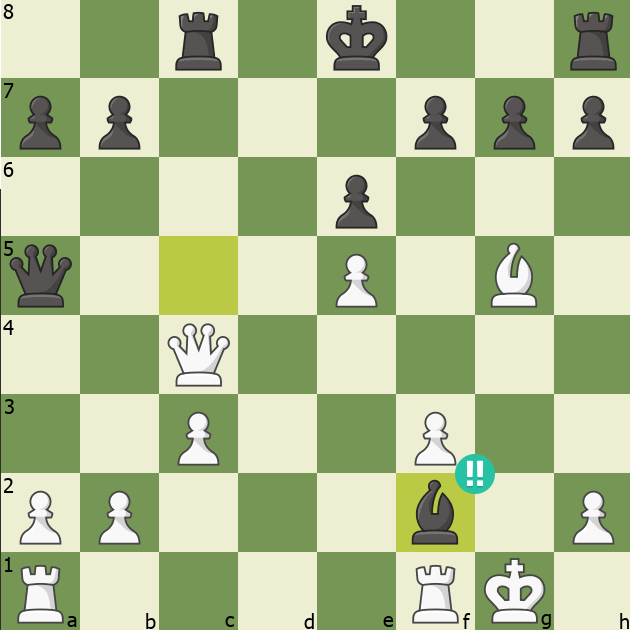
Brilliant Chess Move: Stunning Bishop Sacrifice Led to Checkmate
Most chess players have experienced it at least once. You spot a free pawn, win some material, and feel confident about your position—only to discover that your opponent had seen something much deeper.

Why Your Chess Accuracy Drops After Move 15
If your chess accuracy drops after move 15, the problem is not that you suddenly become a worse player. The problem is that the game has shifted from memory to understanding, and you have not trained that transition enough.
Why You Always Get in Time Trouble (And How Stockfish 18 Fixes It)
Every chess player knows the feeling. You navigate the opening perfectly. You transition into a solid middlegame. You build a completely fine, perhaps even slightly superior, position. And then, you glance at the clock. Your opponent has 15 minutes left. You have 42 seconds. Panic!